1.
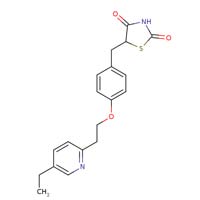
glucose, decreases withdrawal of glucose from the liver, and reduces quantity of glucose. [2] .HCl According to literature review, a HPLC method for the estimation of Pioglitazone hydrochloride is available. [3] The method is relatively complex and expensive. The UV method for estimation of Pioglitazone hydrochloride in methanol: water: hydrochloric acid (250:250:1) system [4] and in 0.2 M sulphuric acid [5] have been reported. However, quantitative estimation of PH in other media has not been reported. This is essential in drug release study. The objective of the study was to develop a simple, accurate, precise, cost effective and reproducible UV method for estimation of PH in 0.1N hydrochloric acid as per ICH guidelines. [6] Shimadzu UV/Visible double beam spectrophotometer and a Jasco V-630 instrument with 1 cm matched quartz cells were used for the spectral measurement. Shimadzu AX200 analytical balance was used for the weighing purpose. The reference standard of PH was obtained as a gift sample from Aarti Drugs, Thane (India) with 99.8% assay value. PH tablets (Piomed, 15 mg) were obtained from the market and utilized for the study. All other chemicals were of analytical grade.
2. a) Selection of The Media
The criterion for selection of the medium was the solubility and the stability, i.e. PH should be soluble Standard solution of PH was prepared by dissolving 100 mg of drug in 100 ml of 0.1N hydrochloric acid (Solution A, 1000 µg/ml). Further 10 ml of the solution A was diluted to 100 ml with 0.1N hydrochloric acid (Solution B, 100 µg/ml). Solution B was used as the standard stock solution.
3. c) Preparation of Calibration Curve
Aliquots of 1 ml to 7 ml of the standard solution B were transferred into a series of calibrated 10 ml standard volumetric flasks and the final volume was made up using 0.1N hydrochloric acid. The solutions were scanned in the range of 200-400 nm against blank (0.1N hydrochloric acid). The absorption maximum was found to be at 269 nm. (Figure 2)The absorbance of the solutions were measured at 269 nm against the blank (Table 1) and the calibration curve was constructed. (Figure 3) The proposed method was applied to marketed PH tablets (Piomed, 15 mg). Twenty tablets of PH were weighed and powdered in a glass mortar. Powder equivalent to 100 mg of the drug was weighed accurately and transferred to a 100 ml standard volumetric flask. It was dissolved in about 50 ml of 0.1N hydrochloric acid and the volume was made up with 0.1N hydrochloric acid so that the concentration was 1000 µg/ml (Solution P). Ten ml of the solution P was transferred to a 100 ml standard volumetric flask and the volume was adjusted with 0.1N hydrochloric acid (Solution Q). The solution was filtered through Whatmann filter paper no. 41. The filtrate was diluted suitably with 0.1N hydrochloric acid to obtain a sample solution (20µg/ml). The absorbance of the sample solution was measured at 269 nm and the amount of PH was determined from the calibration curve. The method was studied for accuracy and precision. a) Linearity Pioglitazone hydrochloride exhibited maximum absorption at 269 nm and obeyed Beer's Law in the range of 10-70 µg/ml. [8,10] Linear regression of absorbance Vs concentration yielded equation y= 0.022x + 0.017 with a correlation coefficient of 0.999.
4. b) Accuracy
To determine the suitability and reproducibility of the proposed method, recovery studies were carried precision, the % drug content and the relative standard deviation (RSD) values 99.59722 ± 0.4722, 100.7488 ± 0.4522, 100.4226 ± 0.5617 and 0.4940 respectively. When the analyst was changed the RSD values were 0.48225 and 0.4662. According to ICH guidelines, an acceptance criterion for the precision is RSD ? 2%.
out by adding known amount of standard PH (80%, 100%, and 120%) to the tablet solution P and analyzing the mixtures by the proposed method. Three samples were prepared for each recovery level. The percentage recovery of PH was found to be 99.3233 ± 0.7026 (Table 3) indicating that there is no interference by the excipients in the method. According to ICH guidelines, an acceptance criterion for the % recovery is 98-102%.
5. c) Precision
Precision of the method was demonstrated by intra-day and inter-day variation studies. For intra-day precision, six sample solutions of Pioglitazone hydrochloride of same concentration (20µg/ml) were analyzed three times in a day. The result is indicated by % RSD in Table 4.
During the intermediate precision (inter-day precision), six sample solutions of the same concentration (20µg/ml) were analyzed on three consecutive days and by two different analysts in same laboratory. The results are indicated by % RSD in Table 5 and 6.
For intra-day precision, the % drug content and the relative standard deviation (RSD) were found to be 99.958 ± 0.7874, 99.928 ± 1.104, 99.297 ± 1.114 and 1.0087 respectively; whereas for inter-day When the analysis was carried on two different instruments, the RSD values were 0.5297 and 0.5213. The LOD and LOQ of PH were determined by using standard deviation of the response and the slope approach as defined in the ICH Guidelines [6]. The LOD and LOQ were found to be 0.03µg/ml and 0.1µg/ml respectively. The proposed method showed molar absorptivity of 9.6013 × 10⁴ l/mol.cm. (Table 2)
6. March


| Sr. | Concentration | Absorbance | Standard |
| no | (µg/ml) | deviation | |
| 1 | 0 | 0 | 0 |
| 2 | 10 | 0.2380 | ± 0.003551 |
| 3 | 20 | 0.4620 | ± 0.003404 |
| 4 | 30 | 0.7385 | ± 0.003593 |
| 5 | 40 | 0.9034 | ± 0.002524 |
| 6 | 50 | 1.1134 | ± 0.000917 |
| 7 | 60 | 1.3600 | ± 0.001000 |
| 8 | 70 | 1.5359 | ± 0.002571 |
| Sr | Parameter | Result |
| no | ||
| 1. | Absorption maxima | 269 nm |
| 2. | Linearity range | 10-70 µg/ml |
| 3. | Standard Regression | y = 0.022x + 0.017 |
| Equation | ||
| 4. | Correlation | 0.999 |
| coefficient (r 2 ) | ||
| 5. | Molar Absorptivity | 9.6013 × 10 4 l/mol.cm |
| 6. | A (1%, 1 cm) | 244.328 dl/gm/cm |
| 7. | Accuracy (% | 99.3233 ± 0.7026 |
| recovery ± S.D) | ||
| 8. | Specificity | A 20 µg/ml of drug in |
| 0.1 N HCl at UV | ||
| detection wavelength | ||
| of 269 nm shows an | ||
| absorbance value of | ||
| 0.4620 ± 0.003404 | ||
| 9. | LOD (µg/ml)) | 0.03 |
| 10. | LOQ (µg/ml) | 0.10 |
| d) Preparation of Sample Solution | ||
| Ingredient | Pioglitazone hydrochloride | ||
| Tablet amount | 20 | 20 | 20 |
| (µg/ml) | |||
| Level of | 80 | 100 | 120 |
| addition (%) | |||
| Amount added | 16 | 20 | 24 |
| (µg/ml) | |||
| Amount | 35.748 | 39.574 | 44.1288 |
| recovered | |||
| (µg/ml) | |||
| % Recovery | 99.3000 | 98.9350 | 100.2927 |
| Average % | 99.3233 ± 0.7026 | ||
| recovery | |||
| hydrochloride | |||
| Sample | Analysis of Pioglitazone | ||
| Number | hydrochloride as percent of drug | ||
| content | |||
| 10:00 am | 2:00 pm | 6:00 pm | |
| 1 | 101.214 | 98.979 | 98.569 |
| 2 | 99.458 | 99.568 | 100.598 |
| 3 | 99.587 | 99.259 | 99.454 |
| 4 | 100.254 | 101.871 | 100.598 |
| 5 | 98.979 | 99.298 | 97.995 |
| 6 | 100.256 | 100.598 | 98.568 |
| Mean ± | 99.958 ± | 99.928 ± | 99.297 |
| SD | 0.7874 | 1.104 | ± 1.114 |
| Average | 99.7276 ± 1.00875 | ||
| ± RSD | 1.0087 | ||
| hydrochloride | |||
| Sample | Analysis of Pioglitazone hydrochloride | ||
| number | as percent of labeled content | ||
| DAY-1 | DAY-2 | DAY-3 | |
| 1 | 99.8467 | 100.725 | 100.053 |
| 2 | 100.0230 | 101.146 | 99.8792 |
| 3 | 99.4538 | 99.9875 | 99.9103 |
| 4 | 98.9985 | 100.5473 | 101.163 |
| 5 | 99.1356 | 100.856 | 100.5409 |
| 6 | 100.1257 | 101.231 | 100.9892 |
| Mean ± | 99.59722 ± | 100.7488 ± | 100.4226 ± |
| SD | 0.4722 | 0.4522 | 0.5617 |
| Average | 100.2562 ± 0.4940 | ||
| ± RSD | 0.4940 | ||
| (Intra-day precision) | ||
| Sample | Analysis of Pioglitazone | |
| number | hydrochloride as percent of | |
| labeled amount | ||
| Analyst-I | Analyst-II | |
| 1 | 100.2346 | 99.1035 |
| 2 | 100.9812 | 99.1418 |
| 3 | 99.8754 | 98.7460 |
| 4 | 100.0213 | 99.2435 |
| 5 | 99.5381 | 97.9924 |
| 6 | 100.1509 | 98.6356 |
| Mean | 100.1335 | 98.8149 |
| Std. | 0.48225 | 0.4662 |
| Deviation | ||
| d) Robustness | ||
| Instruments) | ||
| Sample | Analysis of Pioglitazone | |
| number | hydrochloride as percent of | |
| labeled content | ||
| Shimadzu | Jasco | |
| 1 | 99.184 | 100.231 |
| 2 | 98.793 | 101.104 |
| 3 | 99.862 | 100.863 |
| 4 | 100.021 | 99.982 |
| 5 | 98.795 | 101.016 |
| 6 | 99.568 | 99.989 |
| Mean | 99.3705 | 100.5308 |
| Std | 0.5297 | 0.5213 |
| Deviation | ||
| e) Limit Of Detection (LOD) And Limit of Quantitation | ||
| (LOQ) | ||