1.
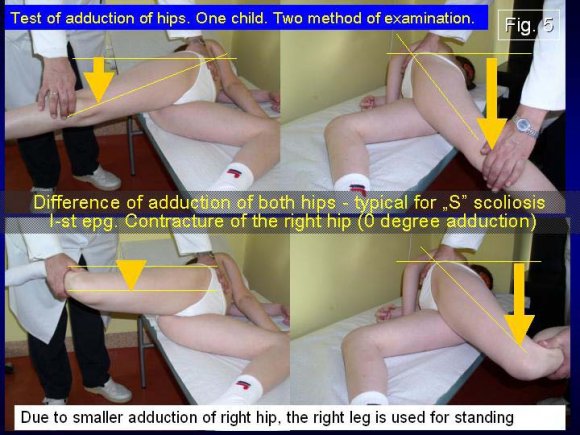
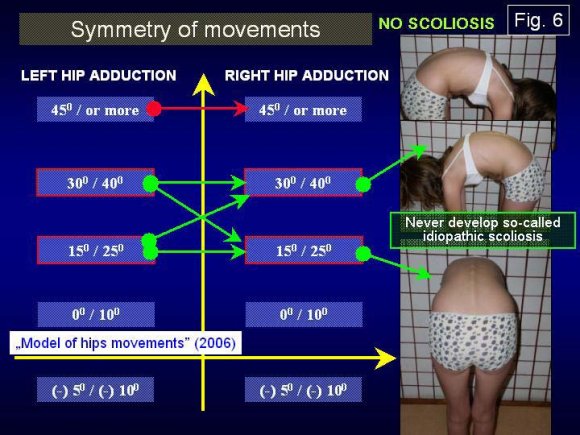
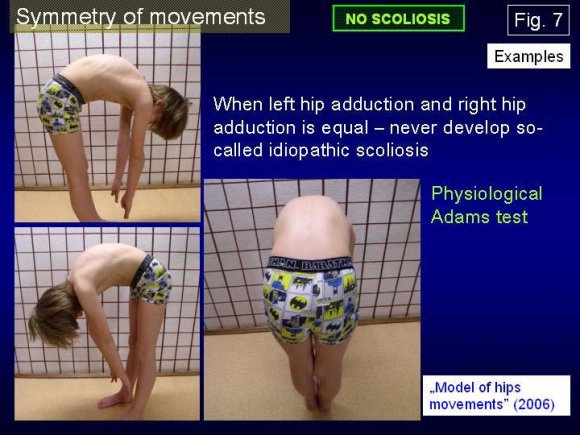
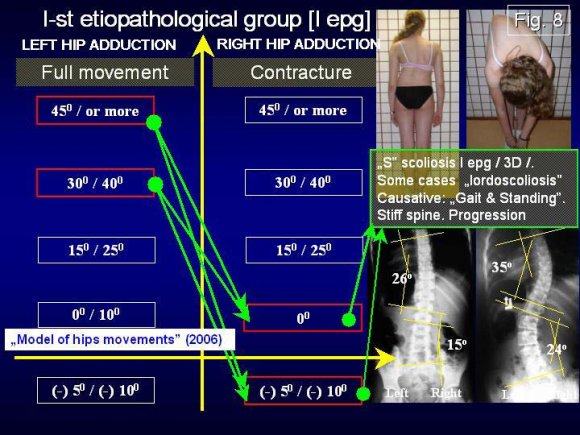
I. Introduction a) New tests for scoliosis n the diagnosis of so-called idiopathic scoliosis we should use widely known old tests such as Adams & Meyer test, symmetry or asymmetry of waist test, but also new tests like -the side bending test for scoliosis (Lublin test), a test checking the habit of standing 'at ease'-on the right versus on the left leg, Dunkan Ellytest to discover the flexion contracture of hips making "anterior tilt of pelvis", pelvis rotation test (a new test since 2006), the adduction of hips test (similar to Ober test).This "adductions test" is deciding in new classification of scoliosis, explain character of scoliosis, place and character of curves, stiffness or flexibility of spine. All tests are presented below.
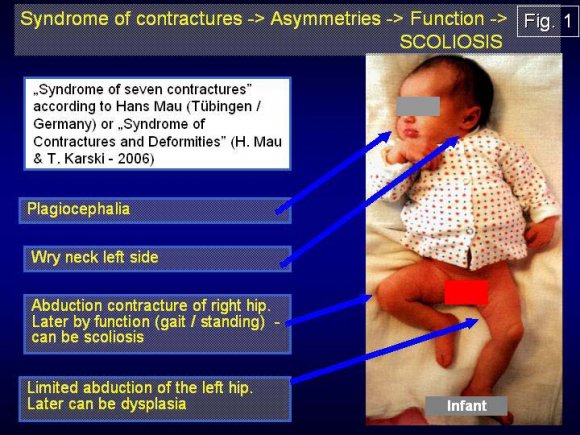
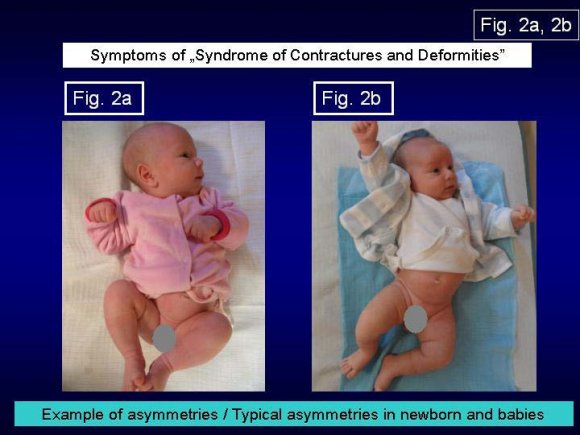
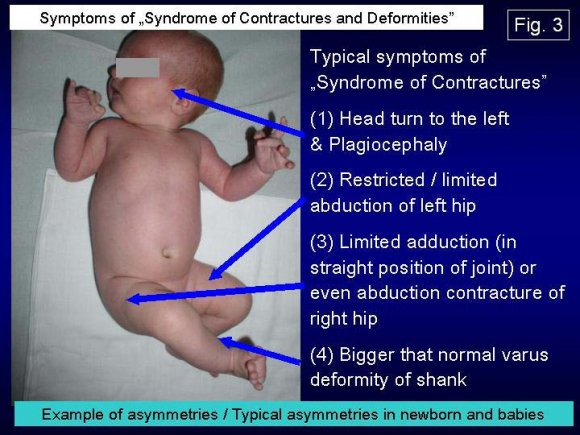
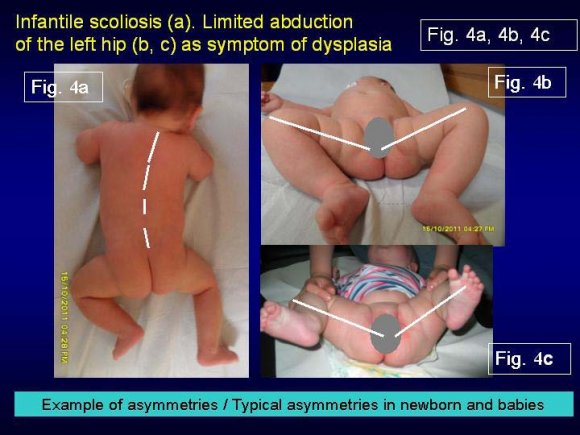
List of the old and new tests (Fig. 1, 2, 3, 4, 5, 6, 7, 8, 9, 10) and clinical changes enabling an early discovery of scoliosis. The list of the new tests and symptoms (doctor's/examination questions and answers) are important to recognize an early stage of scoliosis: Test of adduction of both hips (in extension position of joints -like the Ober test). Important is also checking the flexion contracture of the hips and the external rotation contracture of the right hip. The are three models of movements of right / left hip and in consequence three groups and four types of scoliosis. Below we describe tests using for early discovery of scoliosis (Figures 1 -10

| 4. Permanent standing 'at ease' test -checking the |
| habit of standing -on the right versus on the left |
| leg. The length of time (cumulative time) is deciding |
| in children with scoliosis. The standing on the |
| right leg is only one of causative influence in I epg |
| and II/A & II/B epg groups. |
| 5. The symmetry or asymmetry of the waist test (an old |
| test, but still very important). |
| 6. Presence of an illnesses (e.g. rickets). Rickets and |
| general laxity of joints -increase oncoming of |
| scoliosis. |
| 7. Anatomical anomalies of the spine (spina biffida |
| occulta, pectus infundibuliforme, rickets). If present, |
| the proper development of the spine is endangered. |
| 8. Body build type -asthenic and picnic (bad), athletic |
| (good). |
| 9. Willingness to participate in sports, if yes -good, if |
| no -bad. |
| Additional causes of scoliosis and presented |
| tests -connected with CNS (central nerve system) ( |
| also called Karski or Lublin test, it is a modified |
| Adams/Meyer test -more sensible as Adams test. A |
| specially -in "C" II/A scoliosis and II/B group of |
| scoliosis show very early beginning of deformity. |
| 3. Rotation movements of the body test (new test |
| since 2006). |