1. I. Introduction
uicide is one of the leading causes of death in the world. The incidence and pattern of suicide vary from country to country. Cut throat injuries can be either suicidal or homicidal. These are well recognized methods of homicide and are less commonly used in suicides and are very rarely accidental. Suicide by incising one's own throat is always associated with hesitation marks and homicidal wounds are not associated with one. Psychiatric illness, psychological stress and poverty are some of the associated factors of suicidal cut throat injury. Here are case reports of 2 patients who tried to commit suicide by cutting their own neck.
2. II. Case Report a) CASE 1
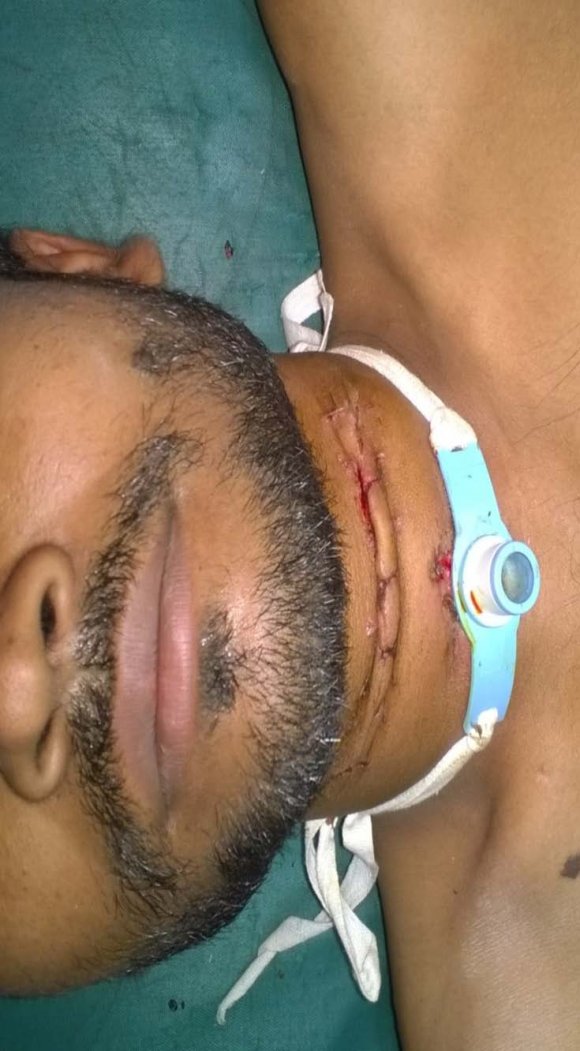
A 32 years of male patent attended ENT emergency of RG Kar medical college with alleged history of suicidal cut throat at around night 2: 00 am. There was severe bleeding from the wound site. The patient was immediately shifted to the emergency OT.
First of all tracheostomy was done to secure airway. Then wound exploration was done. No major blood vessels were injured. There was a cut injury over the thyroid cartilage. It was carefully repaired with prolenesuture. Wound was closed by layers. Patient was discharged on the tenth post-operative day and was asked to regularly follow-up in psychiatry department. The patient was followed up in ENT department after 1 month, 3 months and 6 months.
3. b) CASE 2
A 47 years old male patient attended ENT emergency with history of suicidal tendency and by cutting his own throat. There was severe bleeding from the wound site. The patient was immediately shifted to emergency OT. After securing the bleeding, it was found that the air way was opened. A part of Thyroid cartilage was found missing. Tracheostomy was done and after securing homeostasis wound was closed by layers. The injury in the cartilage was repaired with prolene 3 -0 sutures. After giving proper counselling, patient was discharged on day 14. The patient was followed up on 1month, 3 months and 6 months.
4. III. Discussion
It was an age old debate that whether penetrating neck injuries should have been explored or not in the past decade. Now with the advent of various investigations and advancement in science, now selective exploration of neck concept is getting popularized. We have to be also aware of carotid and possible cervical injury in the patient.
Hence penetrating neck trauma can be classified into (1) stab injury (2) gunshot wounds (3) blast injury (4) blunt injury. Roon and Christensen1 have classified the site of cervical trauma into zone 1, 2 and 3. 1. Zone l injuries occur at the thoracic inlet. This zone extends from the level of the cricoid cartilage to the clavicles. 2. Zone ll injuries are those occurring in the region between the cricoid cartilage and the angle of the mandible. Injuries in this zone are the easiest to expose and evaluate 3. Zone lll injuries occur between the angle of the mandible and the base of the skull.
5. S
Volume XV Issue II Version I According to Bailey 2 it was proposed that in early 1990, early exploration of neck injuries with tracheostomy and antibiotics reduced the mortality rate to seven per cent. Following that lots of controversies were aroused that without proper knowledge about the extent of the injury and missing an unsuspected vascular injury without preoperative angiography and oesophagoscopy was highly questioned.
But nowadays in recent time according to Demetriades et al 3 combination of clinical and selective investigations yielded a sensitivity of 100%. Hence in our patient once the patient attended emergency ward, primary survey was done. After making a clinical assessment they were immediately transferred to emergency operation theatre. Immediately we performed a tracheostomy. Airway to be secured is the most important part of management in cut throat injury. As primary survey suggested there is no major vessel injury and oesophageal injury we planned for immediate exploration of the wound.
Accuracy of the diagnosis of oesophageal injury is very important in the management of these injuries. According to Weigelt JA et al, if there are suspected injuries it is better to go for combination of oesophagography and oesophagoscopy, because they are having a sensitivity of 100 per cent 4 .
The planning for repair of these penetrating neck injuries will not stop with clinical primary survey. The things that we have to do in order are first to secure intra venous line. Anaesthetists play a very important role in the management process. Under local or general anaesthesia intubation must be tried, if not possible tracheostomy must be done to secure airway, that is the most important aspect. Following securing of airway, patient should be put in proper position with neck extension only if there is no cervical spine injury. Zone 2 injuries are usually easily managed. When there is zone 1 or three injury additional surgical exposures may be needed. As both of our patients had zone two injuries, additional exposure was not required. There were no major vessel injury hence vein grafting was also not necessary. If there is suspected vascular injury we have to be also prepared for saphenous vein harvesting 5 .
Our management part is not ending with the anaes the tist intervention and the surgical repair. In case of suicidal wounds proper counselling by psychiatrist plays a very important role. There are various aetiologies like schizophrenia, depression, bipolar disorder; the patient may be suffering. If after surgical intervention proper psychiatry follow-up is not done in this patient, then there are all chances of repeated suicidal attempts in these patients leading in death.
In our case both the patients were immediately taken for proper psychiatry counselling and evaluation. They were regularly followed up in the psychiatry outdoor. Not only the psychiatrist the patient's family members are also having equal responsibility, to take proper care of these patients. In our case the patient's tracheostomy was removed after 21 days and strapping was done. They recovered completely without any hoarseness of voice or vocal cord palsy. They were followed up in the 3 rd month and 6 th month respectively.
6. IV. Conclusion
Hence suicidal cut throat patients have to be monitored with proper care. When suicidal cut throat injuries occur, a multidisciplinary approach is required in the effective management of victims. This requires the close collaboration of the Otorhinolaryngologist, the anaesthesiologist and the psychiatrist. Our treatment is not ending with discharging the patient. Proper follow up is very much essential to save these patients from death.
7. Volume XV Issue II Version I