1. I. Introduction
n the perpetual fight against the pathogenic bacteria, of research were carried out by certain researchers in order to work out new molecules likely to slow down the effects of those. One could quote amongst other things, the phenolic compounds and terpenes.
The phenolic compounds gather a great number of chemical substances which have at least an aromatic nucleus. This core carries one or more functions alcohol (grouping hydroxyl). The phenolic phytomolecules have structures going of simplest (acid gallic) to most complex (tanins). The phenolic compounds have many biological activities of which antimicrobic activities [1][2][3][4][5].
Terpenes are essentials oils of many plants. They are volatile and constitute the resin and the gasolines of the plants. It is the case of the spirits of turpentine isolated starting from the resin from pine. On the structural level, terpenes are derivatives of the isoprene (C 5 H 8 ). A ntimicrobic activities of the terpenoïdes were highlighted [6][7][8].
In this search for solutions to prevent the diseases caused by the bacteria, we have in this desired work to add our contribution to the building by working out an electrode based on clay able to detect the staphylococcus aureus in aqueous mediums.
2. II. Experimental a) Products
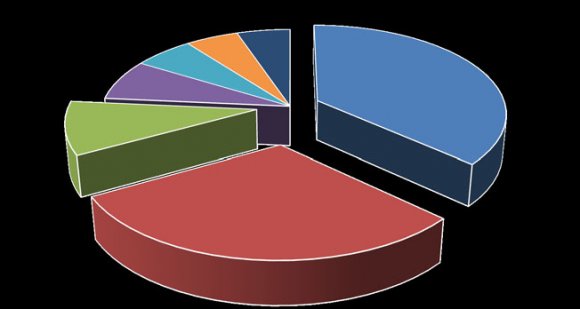
All the solutions were prepared in water having been the subject of a double distillation. The clay samples used in research were taken in the natural resources of Cameroun, more precisely in the town of Garoua, the area of the north of Cameroun [9]. The samples were washed with deionized water several times with constant agitation. After a calcination at 900°C of clay to the furnace during one hour, the samples were crushed, and finally filtered (125 µm). The chemical composition of the burnt clay is as follows [10]: SiO 2 (48.01%), Al 2 O 3 (27.41%), Fe 2 O 3 (7.34%), MnO (0.12%), CaO (0.06%), MgO (0.31%), K 2 O (0.41%), Na 2 O (0.02%), S (0.03%) and several metals in the proportions of the part per million.
The bacteria used in this study are Staphylococcus aureus. The bacteria were cultivated in medium LB (Luria Burtani) solid. After a sterilization in the autoclave of the culture medium, the bacteria were sown there and then incubation was done with 37 °C during 24 hours.
Provisions were taken for deoxygenation by splashing the solution with nitrogen gas during approximately 5 minutes. In order to obtain reliable and reproducible results, a new electrolyte was prepared for each handling.
3. b) Instrumental
The electrochemical methods used in this study are the cyclic voltammetry (VC), the voltammetry with square waves (SWV) and the spectroscopy of electrochemical impedance (EIS).
The equipment used for our measurements consists of an electrochemical cell with three electrodes (Calomel electrode saturated (ER), the platinum electrode (EC), the electrode with clay paste modified by amoxicillin (EW)) connected to a potentiostat of the type voltalab PGZ 100. The programming, the acquisition and the treatment of the results were carried out by the software voltamaster 4.
4. c) Electrodes
The clay powder was mixed with a binder (the paraffin oil) and a solvent (the absolute ethanol). The paste obtained was used to fill the cavity of the electrode of a surface of 0,1256 cm 2 . Once the worked out electrode, it is dried at ambient temperature carefully during 24 hours. Dry once, a mechanical polishing of the surface of this electrode is carried out on smooth paper before its use to eliminate all the irregularities and to obtain a regular and more reproducible surface. The modification of the electrode was done by soaking the electrode of clay paste manufactured in the solution of amoxicillin (10g/L).
5. d) Analytical procedure
The modified electrode (AMX/Clay) was immersed in a cell containing the sample of bacteria and then characterized by the voltammetry cyclic, linear, with square waves and by the spectroscopy of electrochemical impedance. The electrolyte support used for our electrochemical measurements is the sodium chloride (NaCl) to a concentration of 0,1 M. All the experiments were carried out at the ambient temperature. The voltammogramms obtained were recorded in the window of going potential of -2V with 2V, with a scanning rate of 20 mV/s, an amplitude of 2 mV and a pulsation of 50 mV. The electrochemical spectroscopy of impedance was carried out in the frequency band going of 100 mHz with 100 kHz.
6. III. Result and Discussion
7. a) Determination of ideal amoxicillin accumulation time
In order to determine the time of optimal deposit of the amoxicillin on the surface of the electrode of clay paste, we soaked it in a solution of 10 g/L of amoxicillin at various times of preconcentration.
The ideal time of amoxicillin accumulation on the clay paste electrode, corresponds, in this study, to the minimum time which causes a significant change in the cyclic voltammogram recorded.
The cyclic voltammogramms of the electrode without modification and with modification were compared (figure 1). The time of identified optimal deposit is 10 min.
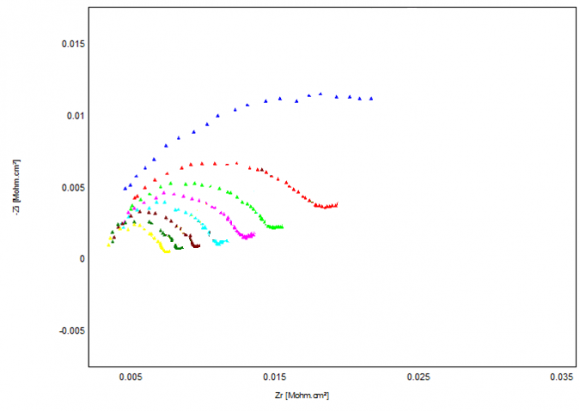
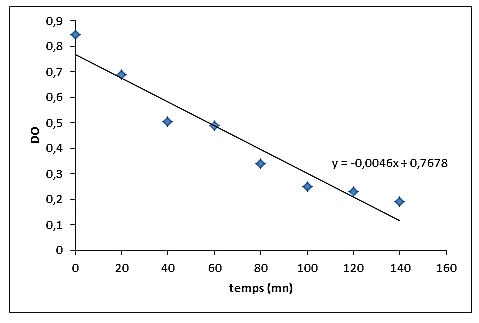
? To 10 min of preconcentration in the amoxicilline, the voltammogramm presents a considerable fall of current: There is formation of a film of amoxicillin on the surface of the electrode ? To 20 min, the density of current slightly increased, which indicates of a beginning of detachment of formed film. The time of optimal contact is 10 min. The EIS experiments were carried out in 0.1 mol L ?1 NaCl in order to confirm the mechanisms suggested in the voltammetric part of this work regarding the AMX/Clay-bacteria interaction. Fig. 4 shows the Nyquist plot for bacteria-free AMX-modified electrode and AMX/Clay/bacteria system depending on preconcentration time. The Curves included a semicircle at higher frequencies corresponding to the electron transfer limited process and the linear part at lower frequencies corresponding to the diffusion process. The In order to study the comportment electrochemical of AMX-Clay according to the time of contact with the staphylococcus aureus, we made characterizations electrochemical with intervals of 20 min. With these same intervals, taking away of the electrolyte containing the bacteria were made with an aim of measuring with a spectrophotometer the optical density of the sample. 3 showing a remarkable reduction in the optical density as the time of contact of AMX-Clay with the bacteria increases. This decrease results in the following line equation: OD = -0.0046CT + 0.7678
8. Influences of amoxicillin concentration
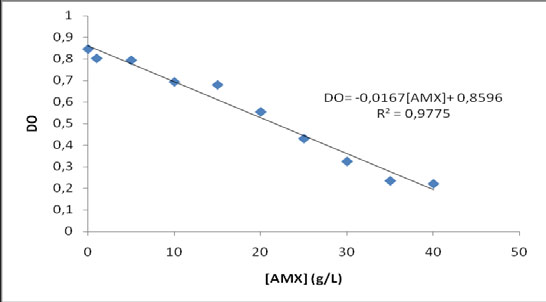
The dependence of peak current on the amoxicillin concentration was also investigated (Fig. 6). The optical density decreases with the increasing in the amoxicillin concentration. The presence of a sufficient amount of amoxicillin on the electrode surface creates a significant number of active sites.
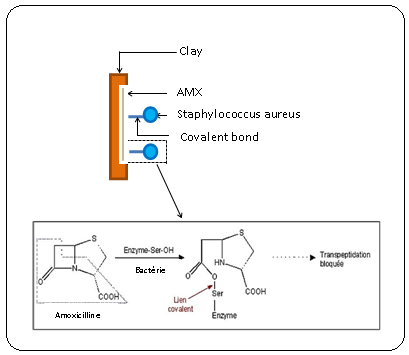
The bêtalactamines inhibit the synthesis of the bacterial wall while being fixed on proteins binding penicillins (PLP). These proteins are carboxypeptidases and transpeptidases necessary to the connection between the side chains of the peptidoglycans. The inhibition of one or more of these enzymes makes accumulate precursors of peptidoglycans which activate the system autolytic of the vat tery and involve its lysis [11].
This result could be explained by the reaction mechanism which occurs on the surface of the electrode (Fig. 7). After 140 minutes of contact with the bacteria, the electrode of clay paste modified by the amoxicillin tends towards the initial state i.e. towards the not modified electrode. The bacterium after its lysis seems to involve the molecules of amoxicillin with it.
In the end, the combination of three electrochemical methods, CV, SWV and EIS allows the many more information and the CV has allows us to have information on the mechanism of the reactions taking place on the surface of the electrode, but this method does not establish the conditions of the analysis, since the generated electric current is the sum of the capacitive current and faradic current, hence the use of the SWV that can simply remove the capacitive term electric current, while the EIS allows marring time constants and to have information on the different stages of the reaction.
9. Volume XVI Issue III Version I
10. IV. Conclusion
An electrode of clay paste modified by the amoxicillin was elaborate. It showed good results as for the spontaneous detection of the staphylococcus aureus. The study of the influence of the time of contact of AMX-Clay with this bacterium revealed that the more this time of passed, plus AMX-Clay posted an increased electroactivity translated by the packing of current. This electrochemical biosensor was characterized by stability, effectiveness and a good reproducibility of the results. In prospects, we plan to make an analytical application of this biosensor in the potato juice.

| Diameters (kohm.cm²) | C (pF/cm²) | |
| AMX -Clay withoutbacteria | 27,78 | 291,2 |
| AMX-Clay (CT = 20 mn) | 17,68 | 232,1 |
| AMX-Clay (CT = 40 mn) | 12,48 | 289,3 |
| AMX-Clay (CT = 60 mn) | 9,925 | 322,6 |
| AMX-Clay (CT = 80 mn) | 7,771 | 410,1 |
| AMX-Clay (CT = 100 mn) | 6,327 | 447,8 |
| AMX-Clay (CT = 120 mn) | 5,393 | 525,9 |
| AMX-Clay (CT = 140 mn) | 4,279 | 662,5 |
| Times (min) | 0 | 20 | 40 | 60 | 80 | 100 | 120 | 140 |
| di (?A/cm²) | 0.072 | 0,912 | 1.528 | 1.338 | 2,014 | 2,396 | 3,282 | 2,913 |