1. Evaluation of Consciousness Energy Healing
Treated Pyridoxine (Vitamin B 6 )
Dahryn Trivedi ? , Mahendra Kumar Trivedi ? , Alice Branton ? , Gopal Nayak ? & Snehasis Jana ¥
2. I. Introduction
yridoxine is a water-soluble vitamin also known as vitamin B 6 . The active form of vitamin B 6 is pyridoxal 5?-phosphate, which functions as a coenzyme in many enzyme reactions in the proteins, lipids, carbohydrates metabolism, synthesis of neurotransmitters, and steroid hormones function [1] . Along with this, it also plays a significant role in the normal function of the nervous system, endocrine system, immune system, red blood cell, and also maintain the blood glucose level in the body [1][2][3] . Pyridoxine can be inter-converted into pyridoxal (aldehyde) and pyridoxamine (amine) form. Pyridoxine, pyridoxamine, and their phosphorylated forms are pyridoxal and pyridoxal-5?-phosphate are obtained from animal food. The hydrochloride salt of vitamin B 6 is pyridoxine HCl [4] . Vitamin B 6 is commonly used as vitamin supplement or as a component of multivitamin the major forms of vitamin B 6 in plant food, while preparations to prevent and treat the vitamin B 6 deficiency, sideroblastic anaemia, pyridoxine dependency seizures, metabolic disorders, Alzheimer's disease, pulmonary tuberculosis, cardiovascular disease, hyperhomocysteinemia, anxiety, asthma, attention deficit hyperactivity disorder, cancer, depression, dysmenorrhoea, diabetes, post-partum lactation suppression, McArdle's disease, osteoporosis, etc. [2,[5][6][7][8] . Vitamin B 6 is light sensitive and degrades slowly when exposed to light. It is soluble in water and alcohol; sparingly soluble in acetone; insoluble in ether and chloroform. When it heated to decomposition, it emits very toxic fumes of oxides of nitrogen and hydrogen chloride [9] . Physicochemical properties of the pharmaceutical or nutraceutical compounds play a verycrucial role in its dissolution, absorption, bioavailability, and therapeutic profile in the body [10] . In this regards, the Trivedi Effect ®-Consciousness Energy Healing Treatment has a significant impact altering the physicochemical properties such as crystal structure, particle size, surface area, thermal behaviour, and bioavailability profile of pharmaceutical and nutraceutical compounds [11][12][13][14] . The Trivedi Effect ® is a natural and only scientifically proven phenomenon in which an expert can harness this inherently intelligent energy from the Universe and transmit it anywhere on the planet through the possible mediation of neutrinos [15] . The Biofield is a unique, infinite, and paradimensional electromagnetic energy field exists surrounding the body of every living organism, which is generated from the continuous moment of charged particles (i.e., ions, cells, blood flow, etc.) inside the body. The Biofield based Energy Healing Therapies have significant beneficial outcomes against various disease conditions [16] . The National Institutes of Health/National Center for Complementary and Alternative Medicine (NIH/NCCAM) recommend and included the Energy therapy under Complementary and Alternative Medicine (CAM) category along with other therapies, i.e., homeopathy, naturopathy, Ayurvedic medicine, acupuncture, acupressure, Qi Gong, Tai Chi, Reiki, healing touch, Rolfing, hypnotherapy, etc., which have been accepted by most of the USA people [17,18] .The Trivedi Effect ® -Consciousness Energy Healing Treatment also has the significant impact on the properties of metals, ceramics, and polymers, organic compounds, microorganisms, cancer cell, and improve
3. II. Materials and Methods
4. a) Chemicals and Reagents
Pyridoxine HCl was purchased from Tokyo Chemical Industry Co. Ltd., Japan. All other chemicals utilized in the experiments were of analytical grade available in India.
G = k?/?cos? (1)Where G is the crystallite size in nm, k is the equipment constant (0.94), ? is the radiation wavelength (0.154056 nm for K?1 emission), ? is the full-width at half maximum, and ? is the Bragg angle [33] .
Similarly, the DSC analysis of pyridoxine was performed with the help of DSC Q200, TA instruments [28,29] . The TGA/DTG thermograms of pyridoxine were obtained with the help of TGA Q50TA instruments [28,29] .
5. b) Powder X-ray Diffraction (PXRD) Analysis
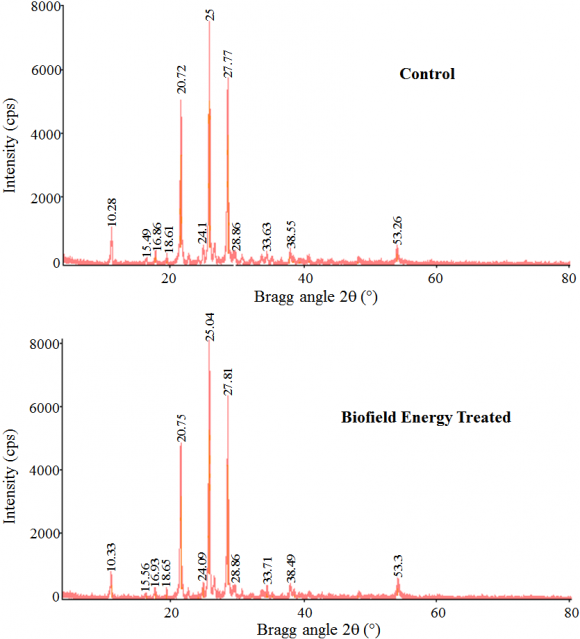
The PXRD diffractograms of the control and treated pyridoxine showed sharp and intense (Figure 1) indicated that both the samples were crystalline. The control and Biofield Energy Treated pyridoxine powder samples showed the highest peak intensity at 2? equal the overall productivity of crops [19][20][21][22][23][24][25][26][27][28] . All these outstanding results inspired the authors to evaluate the impact of the Trivedi Effect ® -Consciousness Energy Healing Treatment on the behavioural, physicochemical, and thermal properties of pyridoxine HCl using powder particle size analysis (PSA), X-ray diffraction (PXRD), differential scanning calorimetry (DSC), and thermogravimetric analysis (TGA)/differential thermogravimetric analysis (DTG).
6. b) Consciousness Energy Healing Treatment Strategies
The pyridoxine powder sample was divided into two equal parts. One part of pyridoxine was treated with the Trivedi Effect ® -Consciousness Energy Healing Treatment remotely under standard laboratory conditions for 3 minutes by the renowned Biofield Energy Healer, Dahryn Trivedi, USA, and known as a treated sample. However, the second part of the test sample did not receive the Biofield Energy Treatment and termed as a control sample. The control sample later received the treatment from a "sham" healer, whereas the "sham" healer was ignorant about the Biofield Energy Treatment. After the treatment, the Biofield Energy Treated and untreated samples were kept in sealed conditions and characterized using PSA, PXRD, DSC, and TGA analytical techniques.
7. c) Characterization
The PSA, PXRD, DSC, and TGA analysis of pyridoxine were performed. The PSA was performed using Malvern Master sizer 2000, from the UK with a detection range between 0.01 µm to 3000 µm using the wet method [28,29] . The PXRD analysis of pyridoxine powder sample was performed with the help of Rigaku MiniFlex-II Desktop X-ray diffractometer (Japan) [31,32] . The average size of crystallites was calculated from PXRD data using the Scherrer's formula (1):
The % change in particle size, specific surface area (SSA), peak intensity, crystallite size, melting point, latent heat, weight loss and the maximum thermal degradation temperature (T max ) of the Biofield Energy Treated sample was calculated compared with the control sample using the following equation 2:
% change = [Treated ? Control] Control × 100(2)III. Results and Discussion a) Particle Size Analysis (PSA)
The particle size analysis of both the control and the Biofield Energy Treated pyridoxine powder samples were performed, and the data are presented in Table 1. The particle sizes in the Biofield Energy Treated sample were significantly decreased at d 10 , d 50 , d 90 , and D(4,3) by 17%, 6.2%, 0.54%, and 0.3% respectively compared to the control sample. However, the particle size value in the Biofield Energy Treated pyridoxine was significantly increased at by compared to the control sample. The SSA of the Biofield Energy Treated pyridoxine (0.456 m 2 /g) was significantly increased by 13.72% compared to the control sample (0.401 m 2 /g).
From the results, it can be assumed that the Biofield Energy Healing Treatment acting as an external force for breaking the larger particles to smaller one in size, hence increased the surface area. The particle size, shape, and surface area have their impact on the solubility, dissolution rate, absorption, bioavailability, and therapeutic efficacy of a drug [34,35] . Thus, the Biofield Energy Treated pyridoxine would assume to enhance the therapeutic efficacy of the nutraceutical and pharmaceutical formulations. The peak intensities and crystallite sizes of the Biofield Energy Treated pyridoxine powder samples were significantly altered compared to the control sample. The peak intensity of each diffraction face of a compound changes according to the change in the crystal morphology [36] and alterations in the PXRD pattern provide the proof of polymorphic transitions [37,38] . The Biofield Energy Healing Treatment probably produced the new polymorphic form of pyridoxine through the Biofield Energy via neutrino oscillations [14] .
8. c) Differential Scanning Calorimetry (DSC) Analysis
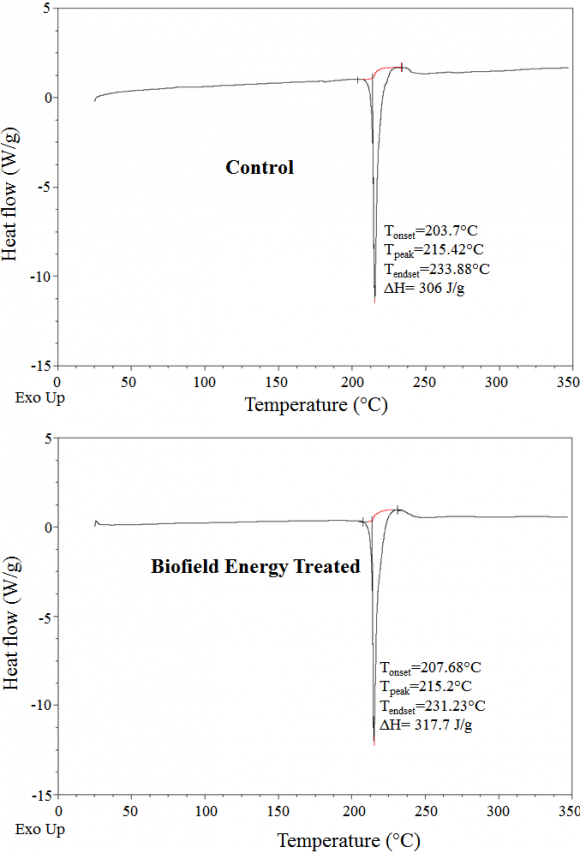
The DSC thermograms of both the control and Biofield Energy Treated pyridoxine samples showed a very sharp endothermic peak at 215.42°C and 215.2°C, respectively (Figure 2).The experimental results closely matched to the reported data [41] . The melting point of the Biofield Energy Treated pyridoxine did not alter much compared to the control sample (Table 3). Similarly, the crystallite sizes of the Biofield Energy Treated pyridoxine powder sample were significantly altered ranging from -57% to 51.33% compared to the control sample. Overall, the average crystallite size of the Biofield Energy Treated pyridoxine powder sample (311.88 nm) was significantly decreased by 6.52% compared with the control sample (333.65 nm).
Different polymorphic forms of the pharmaceuticals have significant effects on the drug performance, because of their different thermodynamic and physicochemical properties from the original one [39,40] . Therefore, it is assumed that the Trivedi Effect ® -Consciousness Energy Healing Treated pyridoxine would be better in designing novel pharmaceutical formulations for more drug performance.
9. d) Thermal Gravimetric Analysis (TGA)/ Differential Thermogravimetric Analysis (DTG)
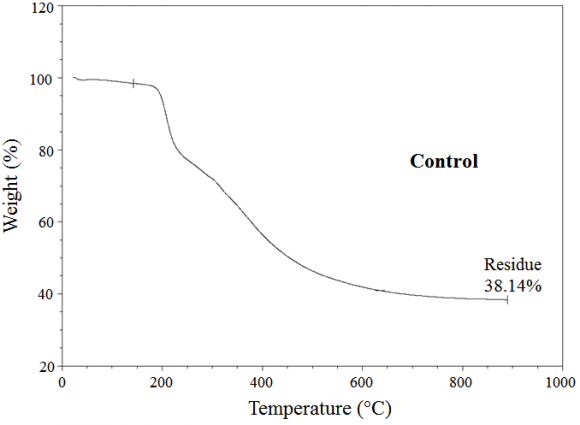
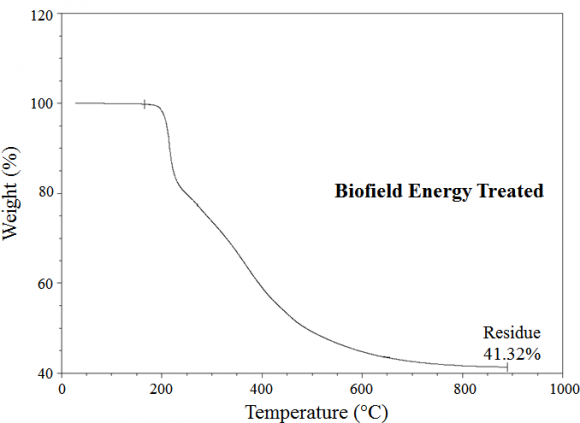
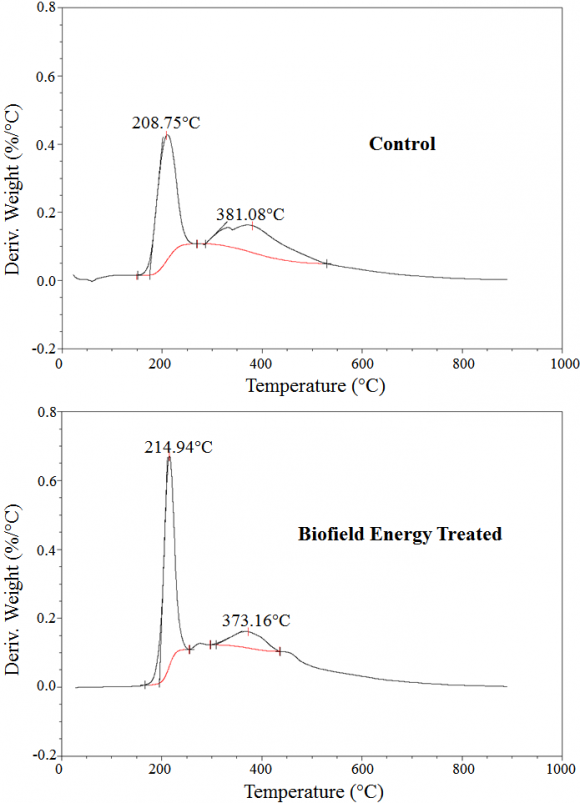
The TGA thermograms of both the control and Biofield Energy Treated pyridoxine samples showed two steps of thermal degradation (Figure 3). The total weight loss of the Biofield Energy Treated sample was significantly decreased by 5.14% compared to the control sample. Thus, the residue amount was significantly increased by 8.34% in the Biofield Energy Treated pyridoxine compared to the control sample (Table 4). The DTG thermograms of the control and Biofield Energy Treated pyridoxine also reported two peaks in the thermograms (Figure 4). The T max of the 1st peak of the Biofield Energy Treated sample was increased by 2.97%, whereas T max of 2nd peak was decreased by 2.08% compared to the control sample (Table 4). Overall, TGA/DTG analysis revealed that the thermal stability of the Biofield Energy Treated sample was significantly increased compared with the control sample. The latent heat of fusion ( ?H fusion ) of the Biofield Energy Treated sample (317.7 J/g) was increased by 3.82% compared with the control sample (306 J/g) (Table 3). Any change in the latent heat of fusion can be attributed to the disrupted molecular chains and the crystal structure of that compound [42] . Therefore, the Trivedi Effect ® -Consciousness Energy Healing Treatment assumed to have a significant impact on the molecular chains and crystal structure of the treated pyridoxine responsible for the elevation of thermal stability compared to the control sample. The Trivedi Effect ® -Consciousness Energy Healing Treatment has shown a significant effect on the crystallite size, particle size, SSA, and thermal behavior of pyridoxine. The particle sizes in the Biofield Energy Treated powder sample was significantly decreased by 17%, 6.2%, 0.54%, and 0.3% at d 10 , d 50 , d 90 , and D(4,3) respectively, compared to the control sample. Therefore, the SSA of the Biofield Energy Treated sample was significantly increased by 13.72% compared to the control sample. The PXRD peak intensities and crystallite sizes of the treated pyridoxine were significantly altered ranging from -40.45% to 154.76% and -57% to 51.33%, respectively compared to the control sample. The average crystallite size of the Biofield Energy Treated pyridoxine was significantly decreased by 6.52% compared with the control sample. The ? H fusion was increased by 3.82% in the Biofield Energy Treated sample compared with the control sample. The total weight loss was significantly decreased by 5.14%; hence the residue amount was significantly increased by 8.34% in the Biofield Energy Treated sample compared with the control sample. From the results, it is concluded that the
| Parameter | d 10 (µm) | d 50 (µm) | d 90 (µm) | D(4,3) (µm) | SSA (m 2 /g) |
| Control | 8.22 | 40.38 | 138.77 | 60.44 | 0.401 |
| Biofield Treated | 6.82 | 37.88 | 138.02 | 60.26 | 0.456 |
| Percent Change* (%) | -17.00 | -6.20 | -0.54 | -0.30 | 13.72 |
| Entry | Bragg Angle (°2?) | Peak Intensity (%) | Crystallite Size (G, nm) | |||||
| No. | Control | Treated | Control | Treated | % Change a | Control | Treated | % Change b |
| 1 | 10.28 | 10.33 | 157.00 | 129.00 | -17.83 | 344.00 | 307.00 | -10.76 |
| 2 | 15.49 | 15.56 | 22.00 | 20.00 | -9.09 | 362.00 | 443.00 | 22.38 |
| 3 | 16.86 | 16.93 | 65.00 | 57.00 | -12.31 | 353.00 | 301.00 | -14.73 |
| 4 | 18.61 | 18.65 | 39.00 | 30.00 | -23.08 | 393.00 | 444.00 | 12.98 |
| 5 | 20.72 | 20.75 | 962.00 | 899.00 | -6.55 | 413.00 | 440.00 | 6.54 |
| 6 | 24.10 | 24.09 | 63.00 | 94.00 | 49.21 | 386.00 | 498.00 | 29.02 |
| 7 | 25.00 | 25.04 | 1301.00 | 1292.00 | -0.69 | 429.00 | 437.00 | 1.86 |
| 8 | 25.77 | 25.78 | 117.00 | 110.00 | -5.98 | 306.00 | 317.00 | 3.59 |
| 9 | 27.77 | 27.81 | 1025.00 | 1075.00 | 4.88 | 431.00 | 422.00 | -2.09 |
| 10 | 28.86 | 28.91 | 125.00 | 121.00 | -3.20 | 149.00 | 143.00 | -4.03 |
| 11 | 31.34 | 31.44 | 25.00 | 16.00 | -36.00 | 529.00 | 277.00 | -47.64 |
| 12 | 33.63 | 33.71 | 42.00 | 107.00 | 154.76 | 380.00 | 223.00 | -41.32 |
| 13 | 37.09 | 37.20 | 89.00 | 53.00 | -40.45 | 261.00 | 338.00 | 29.50 |
| 14 | 37.63 | 37.74 | 28.00 | 51.00 | 82.14 | 393.00 | 169.00 | -57.00 |
| 15 | 38.55 | 38.49 | 42.00 | 39.00 | -7.14 | 134.00 | 78.00 | -41.79 |
| 16 | 47.32 | 47.36 | 41.00 | 44.00 | 7.32 | 150.00 | 227.00 | 51.33 |
| 17 | 53.26 | 53.30 | 137.00 | 160.00 | 16.79 | 259.00 | 238.00 | -8.11 |
| 18 | Average Crystallite Size | 333.65 | 311.88 | -6. | ||||
| Sample | Melting Temp (°C) | ?H Fusion (J/g) |
| Control Sample | 215.42 | 306.00 |
| Biofield Energy Treated | 215.20 | 317.70 |
| % Change* | -0.10 | 3.82 |
| Î?"H: Latent heat of fusion, *denotes the percentage | ||
| change of the Biofield Energy Treated pyridoxine with | ||
| respect to the control sample. | ||
| TGA | DTG; T max (°C) | |||
| Sample | Total Weight Loss | Residue % | 1 st Peak | 2 nd Peak |
| (%) | ||||
| Control | 61.86 | 38.14 | 208.75 | 381.08 |
| Biofield | ||||
| Energy | 58.68 | 41.32 | 214.94 | 373.16 |
| Treated | ||||
| % Change* | -5.14 | 8.34 | 2.97 | -2.08 |
| * denotes the percentage change of the Biofield Energy | ||||
| Treated sample with respect to the control sample, | ||||
| T max = the temperature at which maximum weight loss | ||||
| takes place in TG or peak temperature in DTG. | ||||
| Effect ® -Consciousness | Energy | Healing | Treated | |||
| pyridoxine hydrochloride would be very useful to design | ||||||
| novel pharmaceutical and nutraceutical formulations | ||||||
| that may offer better therapeutic response against | ||||||
| vitamin B 6 deficiency, pyridoxine-dependency seizures, | ||||||
| sideroblastic anemia, Alzheimer's disease, metabolic | ||||||
| disorders, | diabetes, | pulmonary | tuberculosis, | |||
| cardiovascular disease, hyperhomocysteinemia, cancer, | ||||||
| anxiety, | asthma, | depression, | attention | deficit | ||
| hyperactivity disorder (ADHD), dysmenorrhoea, post- | ||||||
| partum lactation suppression, McArdle's disease, | ||||||
| osteoporosis, etc. | ||||||