1. Introduction
iabetes describes a collection of chronic disorders within which insulin production is insufficient to maintain normal glucose homeostasis. Whether insulin insufficiency is due to loss of pancreatic islet beta cells or resistance to insulin action, the result the chronic elevation of systemic glucose levels, trials such as the Diabetes Control and Complications trial (for type 1 diabetes) [1]. The United Kingdom Prospective Diabetes Study (for type 2 diabetes) has demonstrated the benefits of intensive management on long-term disease complications. However, the implementation of intensive management strategies has remained a challenge particularly with the increasing number of patients with diabetes worldwide, and many patients struggle to maintain euglycemia. Also, emerging evidence suggests that in some circumstances, intensive glucose control alone may be insufficient to completely prevent the complications associated with diabetes [2].
Diabetes can lead to many sever microvascular degenerative complications (e.g., retinopathy, nephropathy, and neuropathy) resulting in an increased risk of morbidity and mortality and with this significant health care system costs. Many prospective experimental studies have made public the role of intensive glucose control in reducing the risk of microvascular complications in diabetes. A number of the necessary medication that square measure wide utilized in the treatment of T2DM square measure antidiabetic drug, sulfonylureas, and thiazolidinediones class of molecules [3,4,5]. Dipeptidyl peptidase-4 (DPP-4) inhibitors were introduced within the treatment of T2DM in 2006 [6].
UK Prospective Diabetes Study (UKPDS) reported that compared with the conventional group, the intensive group showed a significant risk reduction by 12% in any diabetes-related aggregate endpoint, which was mainly due to a 25% risk reduction in microvascular finish points [7]. Moreover, this intensive glycemic management crystal rectifier to the lower rates of cardiovascular events and diabetes-related mortality ten years later [8]. However, in the Korean diabetic population, the prevalence of diabetic complications remains high; the prevalence of diabetic nephropathy (DN) was 30.3% in 2016, and that of diabetic retinopathy (DR) was 15.9% in 2015 [9].
USA; it absolutely was calculable that nearly 21 million Americans (or approximately 7% of the US population) consummated the diagnostic criteria for diabetes mellitus. Diabetic retinopathy at the time of the diagnosis of diabetes is lower with type I being 0.4% in kind I while 7.6% in kind II [10].
2. II.
3. Microvascular Complications
Diabetes will cause several severe microvascular degenerative complications (e.g., retinopathy, nephropathy, and neuropathy) resulting in an increased risk of morbidity and mortality and with this significant health care system costs. Hence, while, ideally, the treatment of diabetes demands a holistic approach that may address varied complications related with diabetes, the first target of achieving an adequate blood glucose level as measured by hemoglobin A1c (HbA1c) level appears still essential. In fact, in previous studies in patients with T2DM, associate between the degree of hyperglycemia and a high risk of microvascular complications have been shown [11,12].
4. Diabetic Retinopathy
DR may be a major diabetic microvascular complication that may cause minimized visual acuity and sightlessness [13]. Increased vascular permeability, edema, recruitment of inflammatory cells, elevated cytokine levels, tissue damage, and revascularization have been observed in DR, implicating oxidative stress and inflammation as the key mechanisms [14].
Diabetic retinopathy is a vision-threatening process that leads to almost 10,000 new cases of sightlessness in the US each year. It is the leading cause of sightlessness between the ages of 25 to 74 years, and is responsible for about 12% of sightlessness in the US. It's reported within the T1DM population that children have a negligible risk of developing retinopathy during the first decade of life, even when diagnosed before age two years. In adults after seven years of T1DM, about 50% of patients have some degree of retinopathy; while after twenty years, approximately 90% demonstrate retinopathy [15,16].
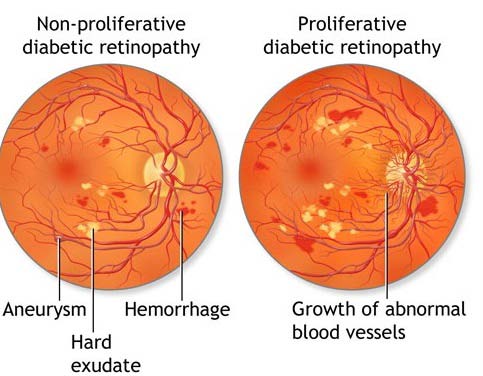
DR affects the peripheral retina, the macula, or both and is a leading cause of visual disability and blindness in people with diabetes [17]. The severity of DR ranges from non-proliferative and pre-proliferative to more severely proliferative DR, in which the abnormal growth of new vessels occurs [18]. Total or partial vision loss will occur through a vitreous hemorrhage or retinal, and vision loss will occur through retinal vessel leakage and ensuant macular lump [19].
IV.
5. Stages Of Diabetic Retinopathy
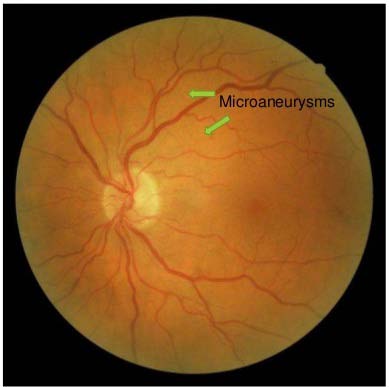
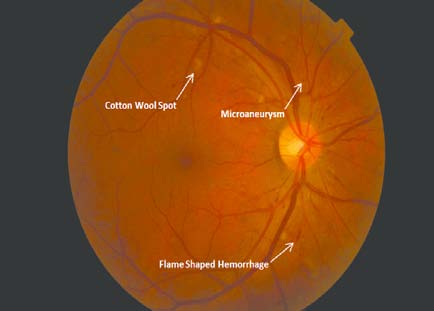
? Mild non-proliferative retinopathy (Figure 1) ? Moderate non-proliferative retinopathy (Figure 2)
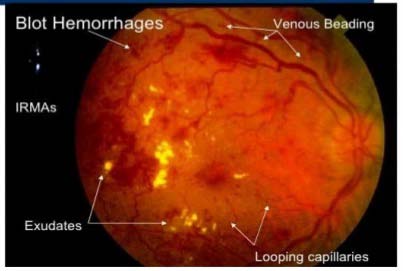
? Severe non-proliferative retinopathy (Figure 3) ? Proliferative retinopathy (Figure 4)
6. Diabetic Nephropathy
Diabetic nephropathy (DN) may be a thoughtful and progressive complication of each kind 1 DM and kind 2 DM. Diabetic nephropathy is a condition that may cause end-stage renal disease requiring dialysis and eventual transplant. Patients may initially increase microalbuminuria that can develop into gross proteinuria. Gross proteinuria is an indication of widespread microvascular disease. These patients also develop elevated blood pressures and decreased glomerular filtration, eventually leading to renal failure. In the past, diabetic nephropathy has been reported to develop in about 40% of patients with T1DM and about 20% of patients with T2DM [20].
Table 1: Different stage of kidney disease in nephropathy.
Diabetic neuropathy is the result of a slowed motor and sensory nerve conduction that most commonly develops between 5 and ten years after the onset of disease. Neuropathy can present as peripheral sensorimotor, cranial, peripheral motor, and autonomic neuropathy. The peripheral sensorimotor neuropathy is symmetric and mostly affects the feet, leading to diminished sensation and paresthesia. The diminished sensation can cause an altered perception of foot pressures and altered foot architecture. This change can result in injury, non-healing wounds, and eventual amputations. Alternatively, diabetic neuropathy can lead to painful and debilitating hyper sensation and burning dysesthesias, which makes ambulation difficult [21]. The prevalence of peripheral neuropathy in the pediatric population has been reported to range between 7% to 57% depending on the diagnostic criteria used, with subclinical neuropathy reported to occur in 57% of children and adolescents with T1DM [22].
People with diabetes also frequently have autonomic neuropathy, involuntary cardiovascular autonomic dysfunction that is manifested as abnormal vital (HR) and vascular control [23].
Physical therapists unremarkably encounter diabetesassociated PN within the analysis and treatment of balance and movement disorders as a result of these disorders frequently have an effect on lower-extremity sensation and may cause lowerextremity pain in individuals with diabetes. Loss of lowerextremity sensation let alone impaired peripheral vascular function can contribute to lower-extremity (commonly foot) ulceration [24]
7. Pathogenesis
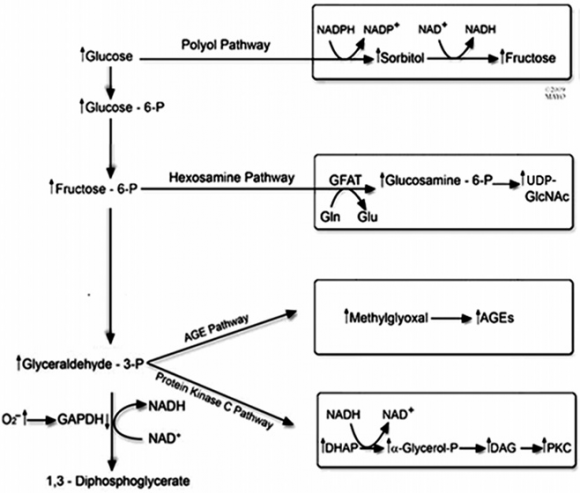
This schematic shows the four biochemical pathways that lead to diabetic retinopathy. DHAP, dihydroxyacetone phosphate; DAG, diacylglycerol; PKC, protein kinase C; GAPDH, glyceraldehyde 3-phosphate dehydrogenase; AGEs, advanced glycation end products, UDP-GlcNAC, N-acetylglucosamine.
8. VII.
9. Conclusion
Studies were performed of the effect of treating streptozotocin type 1 diabetic rats with vildagliptin, a Dipeptidyl peptidase IV inhibitor, on retinal, vascular and nerve dysfunction. We found that treatment with vildagliptin improved some neural, vascular and retinal complications. It is becoming clear that dipeptidyl peptidase IV inhibitors have multiple affects and may improve outcome by mechanisms unrelated to the preservation of GLP-1 or GIP [25].
| Stages | Chronic kidney disease | GFR | % Kidney function | |||
| Stage 1 | Kidney damage with normal kidney function | 90 or higher | 90-100 | |||
| Stage 2 | Kidney damage with mild loss of kidney function | 89-60 | 89-60 | |||
| Stage 3a | Mild to moderate loss of kidney function | 59-40 | 59-45 | |||
| Stage 3b | Moderate to severe kidney function | 44-30 | 44-30 | |||
| Stage 4 | Sever loss of kidney function | 29-15 | 29-15 | |||
| Stage 5 | Kidney failure | <15 | <15 | |||
| b) Asymmetrical/focal and multifocal neuropathies | ||||||
| Diabetic lumbosacral radiculoplexus neuropathy | ||||||
| (DLSRN; | Bruns-Garland | syndrome, | diabetic | |||
| amyotrophy, | proximal | diabetic | neuropathy). | |||
| Cervicobrachial radiculoplexus neuropathy Trunk | ||||||
| neuropathie(thoracic/abdominal radiculopathy) cranial | ||||||
| neuropathies Mononeuropathies (median, ulna, fibular). | ||||||
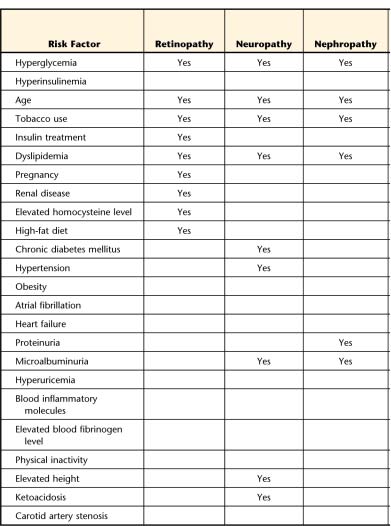
| i. Risk factors | ||||||
| There are plenty of risk factors connected | ||||||
| microvascular complications. Retinopathy, neuropathy | ||||||
| and nephropathy diabetes have many risk factors like | ||||||
| hyperglycemia, hyperinsulinemia, age, tobacco use, | ||||||
| insulin treatment, etc. | ||||||
| There is a table which explains different factors | ||||||
| for different types of diabetic complications (retinopathy | ||||||
| diabetes, neuropathy diabetes, nephropathy diabetes). | ||||||
| D D D D ) | ||||||
| ( | ||||||
| a) Symmetrical polyneuropathies | ||||||
| i. Relatively stable conditions | ||||||
| ? Symmetrical distal sensory polyneuropathy (SDSP) | ||||||
| Variants: acute, severe SDSP in the beginning of | ||||||
| diabetes, | pseudosyringomyelia | neuropathy, | ||||
| pseudodiabetic | neuropathy, | autonomic | ||||
| neuropathies. | ||||||
| ? Episodic (transient) symptoms: Diabetic cachexia | ||||||
| neuropathy Hyperglycemic neuropathy Treatment- | ||||||
| induced diabetic neuropathy or insulin neuritis | ||||||
| chronic inflammatory demyelinating polyneuropathy | ||||||
| (CIDP-plus) hypoglycemic neuropathy. | ||||||