1. Introduction a) Aims and Objectives
Removing ovarian tumours vaginally.
2. b) Selection Criteria
Patients with more than 35 years of age and have completed their family and wanted hysterectomy along with cystectomy.
Patients who have an ovarian mass with investigations suggestive of benign etiology.
Author ? ?: Grant Government Medical College and JJ Group of hospitals, Mumbai-08. e-mail: [email protected] c) Exclusion Criteria Pts with ovarian mass suggestive of neoplastic etiology.
Pts less than 35 years of age and want further child bearing.
3. II.
4. Materials and Methods
Study period: April 2014 to april 2018. Place: JJ Hospital, Mumbai. 18 women presented with pelvic mass. History and clinical examination was done.
Trans vaginal ultrasound was done to know the nature of the cyst, excluding the malignant ones; multilocular appearance, irregular border, intracystic papillary projection or the presence of as cites. Color doppler to rule our the increased blood flow in malignancy. (Picture1)
CT/MRI was done to confirm the benign nature in doubtful cases. (Picture 2) Tumour markers s/o benign etiology.
Preoperatively, the patients were counseled and written consent was obtained for the surgery to be performed vaginally. In 10 women (55.6%) vaginal hysterectomy was performed for heavy menstrual bleeding. As these women came from remote areas where follow up was difficult, they wished for a hysterectomy. All the women consented to possible laparotomy, oophorectomy and hysterectomy.
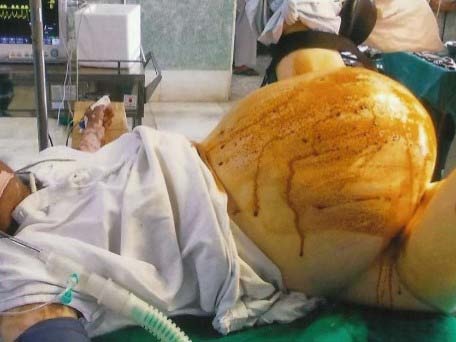
Pre anesthesia fitness obtained .After careful clinical examination, mobility of the uterus and the cyst was checked for adhesions. This was further as curtained and reassessed under anesthesia. (Picure 3, 4)
Vaginal hysterectomy/non descent vaginal hysterectomy done. Endometriomas required adhesiolysis which was done digitally along with fine dissection. The cyst was gently pulled down with the help of a allis forceps or babcocks and the cyst fixed abdominally. The head end was raised (Reversed Trendlenberg position) to assist gravitational forces in bringing the cyst down in the pouch of douglas.
For cystic masses a veress needle was used for cyst aspiration vaginally, the veress needle was attached to a tubing leading to a suction apparatus. The cyst would come down to the pouch of douglas after volume reduction; there after cystectomy was done. Using the veress needle for aspiration reduces Removing Ovarian Tumours Vaginally:
The Odyssey of a Gynaecologist ost ovarian tumours (80 to 85%) are benign and two thirds of these occur in women between 20 and 44 years. Normal functioning ovary produces cysts 4-5 times every year. In most cases, these functional masses are self limiting and will resolve within 2-3 cycles. Sometimes, they persist longer or become larger than 5 cm size and transforms into pathological condition. The chance of a primary ovarian tumor in a patient younger than 45 years of age is less than 1 in 15. 1 In postmenopausal women the incidence of malignant ovarian tumours increases to about 30 %. 2 M the chances of spillage of the cyst contents in the peritoneal cavity. Image (Image 5, 6, 7)
Cystic wall was sent for frozen analysis in doubtful cases Image (Image 8). All frozen analysis were s/o benign etiology.
Prophylactic bilateral salphingectomy was done on all. In postmenopausal women, prophylactic b/l salpingo-oophorectomy was done .
Extra-peritonization of pedicles done. Vault closure done.
Histopathological examination of the excised specimen was done by the pathology department of the hospital.
Average blood loss was 150 ml to 200 ml. Average time taken for surgery was 1.5 to 2 hrs. (Image 9) Patients were discharged day 5 post operatively.
Image Pre-operative assessment in ot reveals a III.
5. Results
Table 1 shows the age distribution .Maximum women belonged to the age group of 46 to 55 years who underwent vaginal hysterectomy with removal of benign ovarian cyst vaginally. They compromised about 44.5 % and least were in the age group of 66 to 75 years. 1 show the parity distribution. Maximum women were multiparous, 50 % had 3 to 4 live issues.
6. Figure 1
Table 3 shows the association with previous surgeries. 5 women had tubal ligation done and 3 had a previous LSCS. Table 4 and figure 2 depicts that maximum women had pelvic mass upto 14 weeks size. Though there were 2 women with 30 weeks size pelvic mass.
Table 5 and figure 3 illustrates that most of the ovarian cysts were simple cysts and serous cystadenoma 55.6%. Mucinous cystadenoma fall the next with 22.2% and then endometriotic cyst 11%. There was 1 corpus luteal cyst and 1 cystic teratoma. Endometriomas 11% required adhesiolysis to access the peritoneal cavity. It was done digitally and with sharp dissection.
Table 6 shows that 4 ovarian cysts had undergone torsion. There were no intraoperative complications including rectal / bladder injury.
Average blood loss was 150 ml, no patient required blood.
7. IV.
8. Discussion
Robert Glassgow is credited for the first cystectomy in 1701 AD. Since then cystectomies have been performed either via the vaginal route or abdominal route.
Earlier ovarian cyst aspiration was done by vaginal ultrasonography 3 ultrasound-guided culdotomy using a renal balloon dilator catheter for transvaginal ovarian cystectomies 4 has been done .Here in this study veress needle is used after vaginal hysterectomy to aspirate the contents of the cyst and extract it vaginally. Intraperitoneal spillage of cyst contents is minimized because of direct puncture of the ovarian cyst wall.
Though maximum number of women were multiparous, there was 1 nullipaous patient. Nulliparity and even virginity should not themselves be considered as contraindications to VH or as an indication for the abdominal route or laparoscopic assistance. 5 16.7% of women had previous LSCS. It was possible to perform vaginal hysterectomy safely in patients with previous cesarean sections. 6 Vaginal hysterectomy is not contraindicated per se after previous abdominal pelvic operations. 7 There have been studies, where women with dermoid cysts were operated on vaginally via the posterior cul-de-sac without laparoscopic assistance. 8 They had concluded that the vaginal route offers an excellent alternative to laparoscopic surgery and eliminates, in most cases, the need for invasive laparotomy. We had 1 case of a teratoma (5.6%), where cystectomy along wiith vaginal hysterectomy was done successfully.
4 Ovarian cysts that were removed had undergone torsion.
In postmenopausal women, prophylactic salpingo-oophorectomy on the opposite side should be performed 9 .
Vaginal ovarian cystectomy is the only cystectomy procedure that leaves no surgical scars on the abdomen.
If vagina is the gateway to the abdomen a big fibroid uterus, large ovarian cysts can be easily removed vaginally. Every hysterectomy unless absolutely contraindicated should begin by vaginal route. 5 . A uterus with a volume up to 300 cm 3 or uterine size up to 12 weeks should be dealt vaginally, and as surgeons become more experienced larger uteri and also the adnexa can be approached in the same manner, at least as trial vaginal hysterectomy. 10 Proponents and practitioners of vaginal hysterectomy have widened their indications and decreased the contraindications through liberal usage of debulking, performing oophorectomy, laparoscopic evaluation and trial vaginal hysterectomy. 11 VH with better outcomes and fewer comlications than laparascoic/TAH. 12 Cochrane Review concluded VH is far superior to other technique and has the best outcomes. 13 V.
9. Conclusions
Cystectomies through the vaginal route paves the way for a scarless surgical technique. It offers less blood loss, with less operative time.
With minimum intraoperative complications, minimum hospital stay and a swift recovery.
There were no ureteric or bladder /bowel injuries. From pelvic masses of 14 wks to 30 wks size pelvic masses can be removed vaginally .irrespective of size of tumour. After all surgery through the vaginal route is the prerogative of a gynaecologist.
| Age | Frequency | Percentage |
| 35 to 45 Years | 22.2 | |
| 46 to 55 Years | 44.5 | |
| 56 to 65 Years | 22.2 | |
| 66 to 75 Years | 11.1 |
| D D D D ) E | ||
| ( | ||
| 4 | ||
| 8 | ||
| 4 | ||
| 2 | ||
| Parity | Frequency | Percentage |
| Nulliparous | 1 | 5.6 |
| P1L1-P2L2 | 5 | 27.7 |
| P3L3-P4L4 | 9 | 50 |
| P5L5-P6L6 | 1 | 5.6 |
| P7L7-P9L9 | 2 | 11.1 |
| Frequency | Percentage | |
| Upto 14 wks | 6 | 33.3 |
| 14 to 18 wks | 3 | 16.7 |
| 18 to 22 wks | 3 | 16.7 |
| 22 to 26 wks | 4 | 22.2 |
| 26 to 30 wks | 2 | 11.1 |
| Types | Frequency | Percentage |
| Simple cyst | 5 | 27.8 |
| Serous cystadenoma | 5 | 27.8 |
| Mucinous cystadenoma | 4 | 22.2 |
| Corpus luteal cyst | 1 | 5.6 |
| Cystic teratoma | 1 | 5.6 |
| Endometriotic cyst | 2 | 11 |
| Volume XIX Issue II Version I |
| D D D D ) E |
| ( |
| Research |
| Medical |
| Global Journal of |
| Frequency | Percentage | |
| Serous | 1 | 5.6 |
| Mucinous | 1 | 5.6 |
| Simple cyst | 2 | 11.1 |