1. Introduction
atients undergoing limb amputation surgery are at risk of postoperative pain. Phantom limb pain (PLP) is a painful sensation referred to the absent limb after amputation; but it's not limited to the extremities, phantom pain has also been reported after loosing almost any body part, for example, nose, tongue or breast. 1 The onset time of PLP varies from days to years, but it´s common to be experienced between the first 24 hours to one week after amputation. 1 In longterm studies, it´s been observed a decrease in the frequency and duration of pain attacks over the years, which is accompanied by a decrement in its intensity, although in some cases, a worsening may occur. 2,3,4 a) Etiology and risk factors for PLP Up to date, the exact reason that some patients develop PLP and others do not is unknown. It has been observed that its development is multifactorial, involving from peripheral, central and also psychological mechanisms. 5 There is not a clear relationship between age or sex and the appearance of PLP in the literature, and it's more likely to appear when it's a bilateral amputation and how proximal it is. 6 There are studies about the influence of previous pain on an extremity as a factor for the development of PLP. 6,7,8 There are reports that more than 50% of patients described PLP as similar to the pain they suffered before amputation. 9,10 At our country, type 2 Diabetes is the most common pathology causing amputation, referred as vascular diseases, it contributes to 81% of cases. On the other hand, traumatic amputations represent 16%, tumors, and congenital diseases account for 3%. 11
2. b) Pathophysiology
We may assume that PLP is an example of neuropathic pain since it occurs mainly as a result of an attempt to reorganize the nervous system followed by the deference of all sensory information involving amputation with nerve section.
There are three mechanisms involved: "peripheral" given by the massive lesion discharge and the loss of nerve impulses towards the spinal cord. 12 "spinal" Experimental studies have provided evidence of structural, physiological and neurochemical changes in the deferential neurons of the medullary dorsal horn. And it also causes alterations in "central" processing like transneuronal changes at the level of the nucleus of the thalamus. 1,13 There are many pharmacological therapies to treat PLP once it appears, and some others are trying to prevent it, without consistent results that allow us to have a standardized treatment regimen. Madabhushi et al. Made a case report of a patient undergoing femoral supracondylar amputation, using bupivacaína (local anesthetic) and clonidine (?2 agonist) with excellent results, the patient didn´t report any pain in the stump and neither PLP 12 months after surgery. 14 There are also systematic reviews about the use of dexmedetomidine (?2 agonist) as an adjuvant to the local anesthetic for neuraxial and peripheral nerve blocks, to prolong the duration of analgesia compared to local anesthetic only. Cataloging Dexmedetomidine as a potential adjuvant and with more favorable pharmacodynamic and safety profile than Clonidine. 15,16 Due the incidence of chronic pain or symptoms related to phantom limb, which may determine disability, a very poor quality of life by the dependence on consumption of opioid and non-opioid analgesics or neuropathic medications to decrease pain, we proposed preventive analgesia in this case, consisting in the application of an anesthetic and analgesic before the surgical incision of the sciatic nerve with the mainly aim to reduce the magnitude and duration of acute postoperative pain and so, assess the appearance or not of PLP, which it implies a decrease in morbidity and improvement in the quality of life; benefiting the patient, family and health institutions.
3. II.
4. Materials and Methods
We carried out this study in Guadalajara´s Civil Hospital ¨Fray Antonio Alcalde¨, México. Our study was a controlled, simple randomized, double-blind, clinical trial, conducted within a period of one year, from January 2018 to January 2019.
Inclusion criteria: Adult patients, scheduled for femoral supracondylar amputation, being due to traumatic cause, chronic disease and malignant tumor. Neuraxial block as anesthetic technique. American Society of Anesthesiologists´s physical status I-III. With signed informed consent. The exclusion criteria were: Refusal of the patient to participate, allergies known to any of the medications used, chronic hepatopathy disease, chronic renal disease, branch block or bradycardia and coagulation disorders.
Sample size calculation. We considered the total supracondylar amputations (110) performed at the Guadalajara´s Civil Hospital during 2017, and established a significance level of 5% (0.05) and a statistical power of 80%. We obtained a total of 30 patients (15 per group).
RD Group. Perineural administration of 0.5% ropivacaine 10 ml adding dexmedetomidine 50 mcg, and maintenance with perineural catheter infusion connected to an elastomeric pump with 0.15% ropivacaine for 24 hours.
RS Group. Perineural administration of 0.5% ropivacaine 10 ml adding 0.5 ml saline solution 0.9%, and maintenance with perineural catheter infusion connected to an elastomeric pump with 0.15% ropivacaine for 24 hours.
Prior authorization by the Ethics and Research Committee of our Hospital, we assigned the patients in two groups randomly per sealed envelope.
Anxiolysis was given if required, with IV Midazolam 30 mcg/kg. Antibiotic prophylaxis with Cephalothin 1 gr IV. Preemptive analgesia with Paracetamol 1 gr IV. Subarachnoid neuraxial block was administered, using hyperbaric bupivacaine 30 mcg/kg and intraoperative analgesia Parecoxib 40 mg IV.
After dissection by the surgical team and before the section of the sciatic nerve, they identified the perineurium and infiltrated 10 ml of 0.5% ropivacaine + 50 mcg dexmedetomidine (RD Group) or 0.5% ropivacaine + 0.9% saline solution (0.5 ml). We asked the surgeon to wait 5 minutes before performing the sciatic nerve section. After the amputation of the pelvic limb and before the surgical team closed by planes, a perineural catheter (20 G) was placed and laterally exteriorized through a separate skin incision, connected to an elastomeric pump with 0.15% ropivacaine was placed in both groups for 24 hours.
We measured heart rate, blood pressure, sedation level (Ramsay Scale), at the end of the procedure, at PACU (Post-Anesthesia Care Unit), 8 hours, and up to 24 hours after. Also we recorded the pain in the stump, phantom pain using VAS (Visual Analogue Scale) in case of presenting at PACU, 8 hours, 24 hours, 30 days and up to 3 months after the surgery, all patients were followed by phone call after discharge from hospital. We recorded the rescue analgesia, and it was given with tramadol 1mg/kg when VAS > 4. We also monitored side and adverse effects associated with the use of dexmedetomidine such as bradycardia, hypotension, nausea, vomiting, and respiratory depression in PACU, 1 hour, 8, and 24 hours postoperatively.
We used the Statistical Package for the Social Sciences version 21 17 for statistical analysis.
5. III.
6. Results
During January 2018 to January 2019, there were included 30 patients (15 per group) scheduled for supracondylar femoral amputation at our Hospital, under the anesthetic technique of subarachnoid block and perineural block of the sciatic nerve, which met the inclusion criteria from the study.
According to demographic data, of the 15 patients in the RD group were 2 women (13%) and 13 men (87%) with a mean age of 57.4 years (SD 20.7). We classified them according to physical status in ASA I: 1 patient (7%), ASA II: 1 patient (7%), ASA 3: 13 patients (86%), with the following preoperative diagnoses: diabetes mellitus 60%, arterial occlusion 27%, cancer 7%, electric burn 7%.
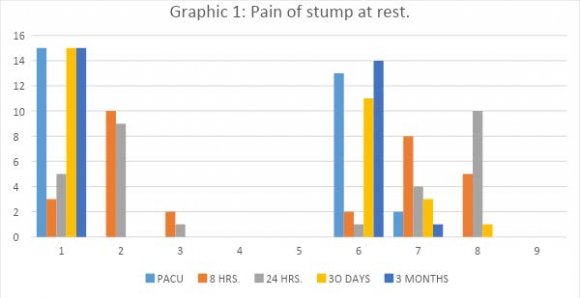
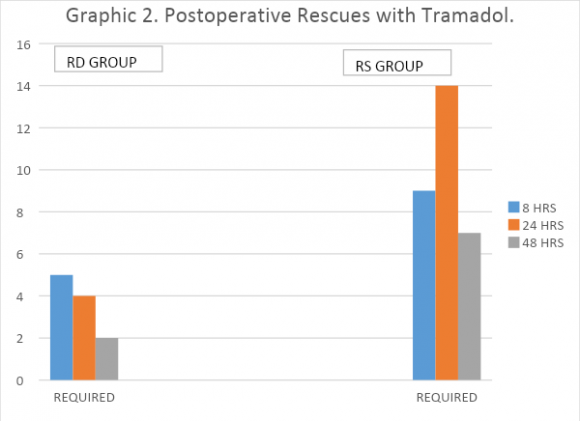
Of the 15 patients in the RS group, were seven women (47%) and eight men (53%) with a mean age of 60 years (SD 17.4). We classified them according to physical status in ASA I: 2 patients (13%), ASA II: 1 patient (7%), ASA 3: 12 patients (80%), with the following diagnoses: diabetes mellitus 53%, arterial occlusion 33 %, cancer 7%, fracture exposed 7%. (Table 1). During the postoperative period, both groups were evaluated for pain intensity, both at rest and in movement, of the stump and phantom limb, from PACU, at 8 hours, 24 hours, 30 days, and up to 3 months. Pain values with VAS 4 and above, had the prescription of rescue with Tramadol at 1mg / kg. In the RD group, at 8 hours, five patients required Tramadol, at 24 hours four patients, and 48 hours 2 of them. In the RS group at 8 hours, nine patients were given tramadol rescue, at 24 hours fourteen patients, and at 48 hours, 7 of them. Then it is possible to demonstrate with statistical significance that the perineural administration of dexmedetomidine does reduce the postoperative opioid requirements. (Table 3, Graph 2). Abbreviations: RD (Ropivacaine + Dexmedetomidine), RS (Ropivacaine + Saline Solution).
We evaluated the appearance of phantom limb pain at rest and movement, which was not reported by any patient of the RD group from the moment of evaluation at PACU up to 3 months of follow-up. It is worth mentioning that two patients of the RD group presented prior amputation, one by contralateral first toe, and another ipsilateral transtibial, none reported previous phantom limb pain.
From the RS group, up to 30 days, one patient reported mild phantom limb pain and one more patient moderate resting pain; on movement three patients reported mild pain at 30 days and only one patient mild pain at 3 months, who we referred to the Hospital Pain Clinic for evaluation and treatment. Without being these statistically significant values. (Table 4) We decided to measure the possible side effects of perineurally administered medications on systemic blood pressure and heart rate in PACU, as well as the level of sedation (Ramsay scale) and oxygen saturation in PACU up to 24 hours after surgery.
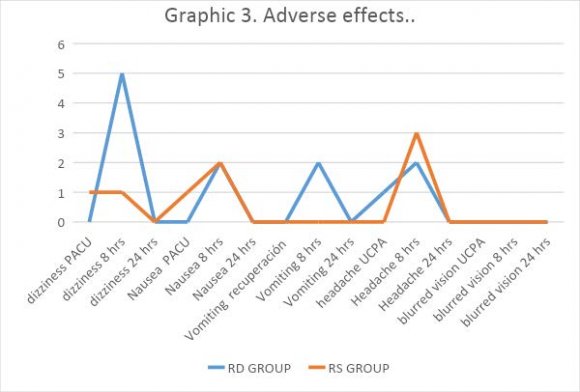
We didn´t find statistically significant differences in the values of systemic blood pressure, heart rate, and oxygen saturation after the intervention. About sedation in the postoperative care unit, we found significant difference (p <0.025) with a higher degree of sedation in the RD group with an average of 2.8 on the Ramsay scale. 2.4 in the RS group. Of the possible adverse effects of the drugs used in our study, dizziness, nausea, vomiting, headache, and blurred vision were evaluated the first 24 hours after the perineural block. It was observed mainly in the RD group, dizziness in 13% at 8 hours, against 7% in the RS group (p = 0.068). Nausea in 13% at 8 hours in both groups. And headache 13% in the RD group against 20% in the RS group at 8 hours (p = 0.62). However, we didn´t find statistically significant difference for any of the adverse effects measured.
| Variable | RD Group. Ropivacaína + Dexmedetomidina. N=15 | RS Group. Ropivacaína + Solución Salina. N=15 | P (CI 95%) |
| (Mean ± SD) | (Mean ± SD) | ||
| Edad | 57.4 ± 20.7 | 60 ± 17.4 | 0.56 |
| Género | |||
| Masculino | 13 | 8 | |
| Femenino | 2 | 7 | |
| ASA | 0.83 | ||
| I | 1 | 2 | |
| II | 1 | 1 | |
| III | 13 | 12 |
| Variables Evaluated Period | RD Group N = 15 | RS Group N = 15 | p (CI 95%) | |
| Pain Level | (Main ± SD) (Main ± SD) | |||
| Rest | PACU | 0 | 0.13 ± 0.35 | 0.143 |
| 8 hrs. | 0.93 ± 0.59 | 1.2 ± 0.67 | 0.426 | |
| 24 hrs. | 0.73 ± 0.59 | 1.60 ± 0.63 | 0.003 | |
| 30 days | 0 | 0.33 ± 0.61 | 0.099 | |
| 3 months. | 0 | 0.06 ± 0.25 | 0.303 | |
| Movement | PACU | 0 | 0.20 ± 0.41 | 0.068 |
| 8 hrs. | 1.40 ± 0.73 | 1.60 ± 0.73 | 0.066 | |
| 24 hrs. | 1.33 ± 0.48 | 1.73 ± 0.45 | 0.022 | |
| 30 days. | 0 | 0.33 ± 0.72 | 0.189 | |
| 3 months. | 0 | 0 | - | |
| Variables | Evaluated period | RD Grup N = 15 | RS Grup N = 15 | p (CI 95%) |
| Tramadol rescue. | Percent. Percent. | |||
| 8 hrs. | 33% | 60% | 0.143 | |
| 24 hrs. | 27% | 93% | 0.0002 | |
| 48 hrs. | 13% | 47% | 0.046 | |
| Statistical significance when obtaining P <0.05. Abbreviations: hrs (hours). | ||||
| Variables Evaluated period | RD Group N = 15 | RS Group N = 15 | p (CI 95%) | |
| Pain Score | (Main ± SD) (Main ± SD) | |||
| Rest | PACU | 0 | 0 | - |
| 8 hrs. | 0 | 0 | - | |
| 24 hrs. | 0 | 0 | - | |
| 30 days. | 0 | 0.20 ± 0.56 | 0.343 | |
| Three Months. | 0 | 0.13 ± 0.51 | 0.309 | |
| Movement | PACU | 0 | 0 | - |
| 8 hrs. | 0 | 0 | - | |
| 24 hrs. | 0 | 0 | - | |
| 30 days. | 0 | 0.20 ± 0.41 | 0.068 | |
| Three months. | 0 | 0.06 ± 0.25 | 0.309 | |
| RD Group | RS Group | |||
| Variables | Evaluated Period | N = 15 | N = 15 | p (CI 95%) |
| (Main ± SD) | (Main ± SD) | |||
| Mean arterial pressure (mmHg) | PACU | 82.9 ± 13.12 | 83.5 ± 12.04 | 0.341 |
| Heart rate (Bpm) | PACU | 75.2 ± 10.56 | 74.0 ± 8.4 | 0.555 |
| Pulse-oximetry (%) | PACU | 96.4 ± 2.02 | 95.7 ± 1.90 | 0.552 |
| 8 hrs. | 94.93 ± 0.96 | 95.33 ± 0.72 | 0.261 | |
| 24 hrs. | 94.86 ± 0.80 | 95.06 ± 0.59 | 0.057 | |
| Sedation (Ramsay) | PACU | 2.80 ± 0.41 | 2.40 ± 0.50 | 0.025 |
| 8 hrs. | 2.20 ± 0.41 | 2.00 ± 0.41 | 0.068 | |
| 24 hrs. | 2.00 ± 0 | 2.00 ± 0 | - | |
| Statistical significance when obtaining P <0.05. Abbreviations: N (patients per group); SD(Standard | ||||
| deviation), PACU (PostAnesthetic Care Unit) hrs (hours). | ||||