1.
presence of keystone pathogens, such as Porphyromonas gingivalis, is one of the main causes of dysbiosis, although the host response is preponderant in the beginning and the progression of the disease. The periodontal treatment is based on the mechanic scaling of the biofilm but using of chemicals adjuvants has been preconized. However, there are many restrictions related to the antibiotics and other chemical adjuvants usage, which makes the use of herbal medicines for this purpose very promising. In addition, many herbal medicines have been used in the folk medicine, with various biologic effects.
Objective: To evaluate in vitro the effect of linalool in the periodontitis.
Material and Methods: 61 volunteers with and without periodontitis were evaluated. Peripheral blood mononuclear cells were cultured in presence of the crude extract of Porphyromonas gingivalis and in the presence of linalool for 48h. The lymphoproliferation and the cell death were evaluated by flow cytometry and the concentration of IL-6, IL-10, IL-17 and IFN-gama were evaluated by enzyme-linked immunoassay (ELISA).
Results and discussion: The individuals with periodontitis produced higher levels of IL-6 than those without the disease, when peripheral blood mononuclear cells were cultured with linalool (p=0.02). In addition, the concentration of the four cytokines evaluated were higher in the culture supernatants of the peripheral blood mononuclear cells stimulated with Porphyromonas gingivalis (p<0.01), when compared to those cultured with linalool only. The linalool alone induced low production of IL-6, IL-10 and IFN-gama than when the peripheral blood mononuclear cells were cultured in presence of the linalool and the Porphyromonas gingivalis extract concomitantly (p<0.01). Individuals without periodontitis showed higher proliferation rates of T lymphocytes when these cells were cultured with no stimulus (p=0.04) or in the presence of the crude extract of Porphyromonas gingivalis (p=0.03). There was no difference among the stimulus in the apoptosis induction.
2. Introduction
eriodontitis is an inflammatory disease caused by an interaction between a dysbiotic subgingival biofilm and the host immuno-inflammatory response (HUANG and GIBSON, 2014). It is known that Porphyromonas gingivalis (Pg), a bacteria presente in the oral microbioma, induces the production of proinflammatory cytokines, promoting inflammation of the periodontal tissues (HAJISHENGALLIS, 2014) and progressive periodontal breakdown (ZHOU et al., 2017).
This disease has been associated with a variety of other disorders, such as cardiovascular diseases (LOOS et al., 2000) Due to the local effects and the association with other disorders, the prevention, treatment and control of the periodontitis are needed. The main treatment involves the mechanic control of the subgingival biofilm through scaling and root planning. However, the chemic control can be added in order to reduce the bacterial pathogenicity (MORO et al., 2017).
3. P
The use of antibiotics and mouthwashes based on chlorhexidine or triclosan are the most commonly used chemical agents in periodontal treatment. Nevertheless, the use of these agents should be restricted due to the toxicity, since they can be converted in toxic compounds by photodegradation and methylation, and due to their ability to bioaccumulate (CORTEZ, 2011). In addition, the systemic use of antibiotics can promote adverse effects, such as bacterial resistance, a very important problem in public health (HAJISHENGALLIS and LAMMONT, 2014).
Because of these disadvantages, the study of phytotherapy, specially the use of extracts and essential oils has been increased (MANAOUZE et al., 2017). Furthermore, the results from the use of natural products in integrative medical practices as adjuvants to pain, inflammatory processes and anxiety disorders treatments have reinforced this search (OLIVEIRA et al., 2017).
Among the components of the essential oils of several plants, such as lavender, sage, rosewood and basil, stands out linalool, a monoterpene alcohol (CHENG et al., 2017) that possess analgesic, antiinflammatory, anticonvulsant and neuroprotective properties (ELISABETSKY et al., 1995;PARK et al., 2016). In vitro studies showed that linalool can inhibit the growth of Porphyromonas gingivalis (JUIZ et al., 2016).
Thus, the present study aimed to evaluate the in vitro effect of linalool in the production of IL-6, IL10, IFN? e IL-17, as lymphoproliferation and the cell death in context of periodontitis.
4. II.
5. Material and Methods
This research was approved by the Institutional Review Board of Feira de Santana State University through CAAE no 46267915.8.0000.0053.
The in vitro experimental study was conducted through the analysis of peripheral blood mononuclear cells (PBMC) of 61 individuals attended at the School of Dentistry of the Feira de Santana State University, Bahia, Brazil. The exclusion criteria consisted of individuals with a history of systemic diseases, current gestation, previous periodontal treatment, smoking, antibiotic and anti-inflammatory use in the six and two months before data gathering, respectively.
A pilot study was performed to determine the minimum error of 950 pg/mL and standard deviation of IL-6 levels of 1260 pg/mL. The level of significance and power of the test adopted was of 5% and 80%, respectively, in a ratio of 1: 4. In addition, 10% was added to predict losses.
After the periodontal evaluation, which included probing depth, clinical attachment level and bleeding on proing, the individuals were separated into two groups: 12 individuals with the diagnosis of periodontitis (P) and 49 individuals without periodontitis (WP).
Individuals with periodontitis were the participants who had at least four teeth with at least one site with probing depth greater than or equal to 4 mm; clinical attachment loss greater than or equal to 3mm; and bleeding on probing concomitantly (GOMES- FILHO et al., 2007).
Linalool compound was obtained commercially (Sigma, SP, BR), racemic mixture (+/-), lot STBD6780V. Porphyromonas gingivalis strain ATCC 33277 was grown in Brucella broth supplemented with 0.5% yeast extract, 0.1% hemin, 0.1% menadione and 0.05% L-cysteine under anaerobic conditions (85% N2, 10% H2, 5% CO2). The immunogenic extract was produced by a protocol standardized by Trindade et al (2008).
Previosly to the execution of sandwich-type Enzyme-Linked Immunosorbent Assay (ELISA), cell culture was performed in 24-well plates (10 6 cells per well) with Roswell Park Memorial Institute (RPMI) culture medium with 1% antibiotic/antimycotic and 10% fetal bovine serum. Cultivation was carried out at 37°C, in humidified atmosphere and in the presence of CO 2 . The PBMC of the individuals were cultured with the following stimulus conditions: (1) cells in RPMI medium as a negative control (white); (2) addition of pokeweed mitogen (PWM) as a positive control at 2.5 ?g/mL; (3) addition of the extract of Porphyromonas gingivalis at a concentration of 0.5 ?g/mL; (4) addition of 10 ?g/mL linalool previously standardized from the cellular cytotoxicity test, a 3% methanol/DMSO solution was used to solubilize the compounds and (5) addition of linalool at a concentration of 10 ?g/mL and extract of Porphyromonas gingivalis at the concentration of 0.5 ?g/mL. Following cell culture, for cytotoxicity assessment, PBMC were distributed in 96 well plates in RPMI culture medium with 1% antibiotic/antimycotic and 10% fetal bovine serum. The linalool was added at different concentrations 100 ?g/mL, 50 ?g/mL, 25 ?g/mL, 10 ?g/mL, 5 ?g/mL, 2 ?g/mL and 1 ?g/mL. After 48 h, the plate was removed and centrifuged at 1000 rpm for 5 minutes at 4°C. The supernatant was aspirated and then 100?l of the solution of MTTtetrazolium [3-(4,5-dimethazol-2-yl-2,5-diphenyltetrazolium bromide)] (Sigma Chemical Co., St. Louis, MO, USA) at 6 mg/mL was added to the well. The cells were again incubated for 4 hours in a humid chamber at 37° C and 5% CO2, then centrifuged at 1000 rpm for 5 minutes at 4°C. After removal of the culture medium, 100 ?L of dimethylsulfoxide (DMSO, Sigma-Aldrich Co., SP, BR) was added to the well. The reading absorbance value was determined at wavelength at 570 nm using a microplate reader. The assay was carried out in six-fold. Compounds that allowed a cell viability greater than or equal to 90% were considered non-toxic.
The concentrations of the cytokines, IL-6, IL-10, IL-17 and IFN-gama in cell culture supernatants after 48 hours of culture, in the presence of pokeweed mitogen (PWM) (2.5 ?g/mL); of the antigen, extract of Porphyromonas gingivalis (0.5 ?g/mL); of linalool (10 ?g/mL) and linalool (10 ?g/mL) in addition to the Porphyromonas gingivalis extract (0.5 ?g/mL) were measured by enzyme immunoassay using commercially available kits (R & D, Systems, Minneapolis, USA). The assays were performed using 96-well flat-bottomed adsorption polystyrene plates (COSTAR, Coornig Life Science, Tewksbury, MA, USA). All steps were also performed according to the manufacturer's instructions. After development with tetramethylbenzidine (TMB) and quenching of the reaction with H2SO4, optical density was determined in ELISA Reader (ELx 800 -Bio-Tek) adjusted to a wavelength in the 450 nm range.
Previosly to the evaluation of apoptosis/necrosis induction by flow cytometry, PBMC were cultured in 24well culture plates (10 6 cells per well) for 18 h at 37°C, 5% CO2 in RPMI medium containing antibiotic and antimycotic, in presence of pokeweed (2.5 ?g/mL); dexametasona (1?M); of the extract of Porphyromonas gingivalis (0.5 ?g/mL); of linalool (10 ?g/mL) and linalool (10 ?g/mL) with the extract of Porphyromonas gingivalis (0.5 ?g/mL), added concomitantly. After incubation, the programmed cell death identification assay was performed using a detection kit, by identification of phosphatidylserine expression in the cell membrane, by the addition of annexin V conjugated to fluorescein isothiocyanate (FITC), (SIGMA-USA) in concentration of 25 ?g/mL in cells post-cultured with the antigens for 5 min at room temperature.
For detection of necrotic cells, 50 ?g/mL propidium iodide was added to the cells one minute prior to acquisition to read the reaction on the flow cytometer (Facscalibur, Franklin Lakes, USA).
For the verification of the cell proliferation capacity, the PBMC were labeled with the cell proliferation marker 5-carboxy-29, 79 dichlorofluoresceoxyacetatesuccinimidyl ester (CFSE) (Invitrogen, Carlsbad, USA), diluted in dimethylsulfoxide (DMSO) added to the well at a final concentration of 2 mM, then they were incubated for 10 minutes at 37°C. After this step, labeled PBMC were distributed at a concentration of 10 6 per well in cell culture dishes in RPMI culture medium added 1% antibiotic/antimycotic and 10% fetal bovine serum in the presence of poke weed (2.5 ?g/mL); of the extract of Porphyromonas gingivalis (0.5 ?g/mL); of linalool (10 ?g/mL) and linalool (10 ?g/mL) and Porphyromonas gingivalis extract (0.5 ?g/mL), concomitantly. The negative control contains only with culture medium. Cultivation was carried out at 37°C, humidified atmosphere and in the presence of CO2. After 48 h the samples were collected and read by flow cytometry (Facscalibur, Franklin Lakes, USA).
The distribution of the data was tested by using the Kolmogorov-Smirnov test. The comparison between the groups was performed with the Student's Tparametric test for the data that presented normal distribution and with the non-parametric Mann-Whitney test for those who did not present normality in the distribution. Following the same criterion, the comparison between the stimuli was done using the ANOVA test with Games-Howell posthoc for normal distribution and the Kruskall-wallis test, followed by the Bonnroni-corrected Mann-Whitney test, in absence of normal data distribution.
6. III.
7. Results and Discussion
Participants in this study were 61 individuals who met the eligibility criteria. The group with periodontitis (P) was composed of 12 participants (19.68%), while the group without periodontitis (WP) was composed of 49 participants (80.32%). The mean age of participants in the P group was 43.67±10.23 years, while the mean age of the participants in the WP group was 32.29±8.88 years. Regarding the sex of the volunteers, 58.33% (07) and 59.18% (29) of the participants in the P and WP groups were female, respectively. There was a statistically significant difference in mean age (p = 0.000), but this difference did not remain in relation to gener (p=0,957).
The periodontal condition of individuals can be seen in Table 1. There was a statistically significant difference between the two groups in all the clinical descriptors evaluated. Except for the number of teeth present, the other descriptors were larger in individuals with periodontitis. To ensure the quality of cellular responses obtained in the present study, cellular toxicity tests were performed, which revealed potential cytotoxic activity of linalool at a concentration of 100 ?g/mL (Figure 1). The results discarded the significant cytotoxic effect generated by linalool at the concentrations of 10, 5, 2 and 1 ?g/mL in PBMC. Although no statistical difference, there was a cytotoxic tendency in the concentration of 25 ?g/mL. Based on these data, the 10 ?g / mL concentration was chosen for use in the experiments. It is worth mentioning that, in osteoclasts, linalool present in Ocimum basilicum oil was considered non-toxic at concentrations less than or equal to 300 ?g/mL (JUIZ, 2013; JUIZ et al., 2016).
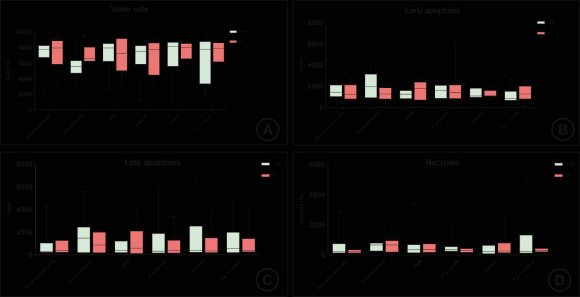
The cell death assay showed no statistically significant difference among the diverse condition of growing tested in this study (namely, without stimulus, dexamethasone, PWM, Pg, linalool and Pg + linalool), in the quantity of viable cells (p = 0.369), cells in initial apoptosis, (p = 0.681), in late apoptosis (p = 0,892) and in necrosis (p = 0.098) process (Figure 2).
In general, the cells had high viability rates, regardless of the culture conditions. In contrast, a previous study, showed the capability of linalool to induce apoptosis in osteoclast culture at concentrations of 50 ?g/mL (JUIZ, 2013; JUIZ et al., 2016).It's important to note that the extract of Porphyromonas gingivalis was expected to induce higher rates of apoptosis, since the results found by TRINDADE et al. ( 2012), showed that the extract of Porphyromonas gingivalis induced higher levels of apoptosis. The most observed form of death was the initial apoptosis, in which the cell shows the inversion of the membrane, without the loss of its integrity when there is exposure of the phosphatidylserine (TRINDADE et al., 2012).
Additionally, individuals with periodontitis presented higher rates of viability among dexamethasone-stimulated cells (p=0.033) than individuals without the disease (Figure 3), showing some showing some ability to protect from apoptosis death, what may have occurred due to the greater expression of BCL 2 (CARVALHO-FILHO et al., 2013) or increase of HSP in the cytoplasm (MASCARENHAS and ROCHA, 2018). However, the mechanism of this protection remains unclear.
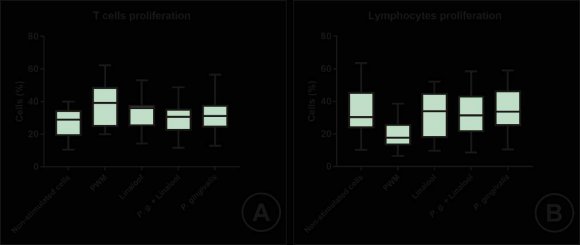
In the cell proliferation analysis, pokeweed, a polyclonal activator of T lymphocites (ROITT et al., 2003) induced higher rates of these cells proliferation than p. gingivalis (P=0.005), linalool (P=0.001) and linalool + Pg (P=0.008). However, when the other populations of lymphocytes were evaluated, pokeweed demonstrated low capacity of inducing proliferation (p=0,001), as demonstrated in figure 4.
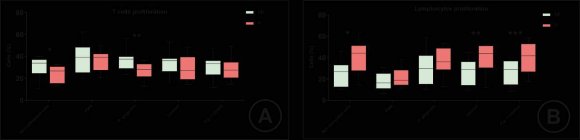
In relation to the difference between P and WP groups (Figure 5), individuals without periodontitis had a higher rate of proliferation of T lymphocytes when they were cultured without stimulus (p = 0.043), or in the presence of Pg (p = 0.032). In the other lymphocyte populations, proliferation rates were higher in individuals with periodontitis than in those without the disease in the following culture conditions: without stimuli (p = 0.026), in the presence of linalool (p = 0.033) and in the presence of linalool and Pg (p = 0.043). It is worth noting that P. gingivalis induced lymphoproliferation in peripheral blood mononuclear cells in a previous evaluation (TRINDADE et al., 2012), but the behavior of linalool in this biological response is still poorly studied.
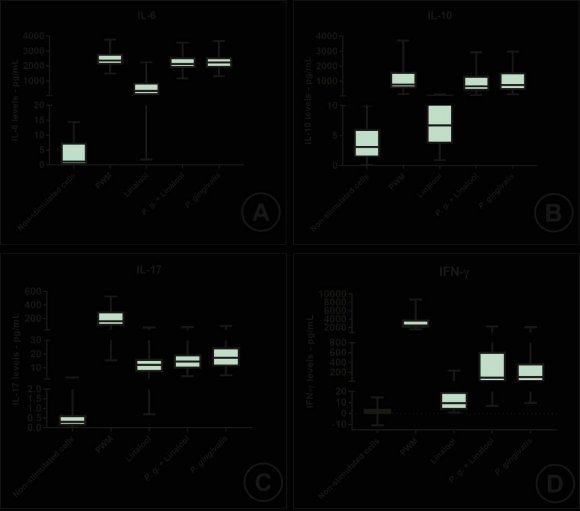
Regarding to the cytokines evaluation, it was observed that P. gingivalis, linalool and linalool+PG induced the production of IL-6, IL-10, IL-17 and IFN-?, since the levels of these four cytokines were higher when cells were cultured with the above-mentioned stimuli than the cells cultured without stimulus (p = 0.000). Moreover, cells submitted to the concomitant stimulation of Pg and linalool had lower levels of IL-17 in relation to the cells under stimulation only of Pg (p = 0.031) and linalool (p = 0.015). However, the concomitant stimulation with Pg and linalool induced higher production of IL-6, IL-10 and IFN? than the stimulus alone with linalool (p=0.000).
Comparing the concentrations of cytokines produced by PBMCs from individuals without periodontitis (WP) and diagnosed with periodontitis (P), there was a statistically significant difference in IL-6 levels when cells were stimulated with linalool alone, that is, individuals with periodontitis produced higher levels of IL-6 than those without the disease (Figure 7a), (p = 0.018). There were no differences when IL-10, IL17 and IFN? levels were compared between the WP and P groups (Figures 7b, 7c and 7d).
Expression of the IL-6 gene is increased when macrophages are infected with Porphyromonas gingivalis (GMITEREK et al., 2016), which occurred when linalool was used in PBMC cultures concomitantly with the bacteria extract, indicating that this substance had a limited modulating effect. However, the decrease in IL-6 production by the presence of linalool may be a favorable factor for the control of periodontitis, since IL-6 is a cytokine involved in bone resorption because it acts unfavorably on the RANK-RANKL-OPG axis (SINGH et al., 2012).
The antinflamatory activity of linalool activity was previously demonstrated in a study with diabetic rats, which had their serum IL-6 and insulin concentrations reduced when linalool was given (DEEPA e ANURADHA, 2011). On the other hand, prior contact of the diseased individuals with key pathogens of periodontal dysbiosis, such as Porphyromonas gingivalis, may have induced a more effective memory immune response with the increase, therefore, in the production of IL-6 (HAJISHENGALLIS, 2014;TRINDADE et al., 2013). Periodontitis is associated with the G allele in the IL-6 gene (position -174), which seems to confer a phenotypic profile of high production of this cytokine. Under stimulation of Porphyromonas gingivalis PBMC of individuals with periodontitis produced more IL-6 than individuals without the disease (TRINDADE et al., 2013), which may explain these higher levels observed in this study, even with the use of linalool.
With respect of IFN?, the Th1 profile signature cytokine, cells cultured with the extract of Porphyromonas gingivalis produced high concentrations of IFN-gamma and co-cultivation with linalool was not able to inhibit this production. Although Porphyromonas gingivalis is an extracellular microorganism, studies have shown its penetration into macrophages (GMITEREK et al., 2016) and fibroblasts (BENGTSSONA et al., 2015), and can be recognized by toll-type receptors 7 (TLR-7), increasing NFkB expression, which may promote the polarization of the immune response to this profile. The reduced concentration of these cytokine in the culture supernatant in the presence of linalool demonstrate that it is not inducing the immunoinflammatory response characteristic of this profile, which may be favorable, since IFN? is a potent macrophage activator and induces bone resorption (SILVA et al., 2015).
8. F
The presence of linalool in conjunction with the extract of Porphyromonas gingivalis was also not able to inhibit the production of IL-10, a cytokine that plays an important role in regulating the immune response and contributes to attenuation of tissue destruction (ZHANG et al., 2014;TRINDADE et al., 2012). Cells cultured only with linalool at the concentration employed did not produce high concentrations of this cytokine. The use of some monoterpene compounds, such as linalool, in splenocyte culture increased the IL-10/IL-2 secretion ratio but decreased the levels of IL-2. Thus, treatments with monoterpere compounds, including linalool, have an anti-inflammatory potential in vitro (KU e LIN, 2013).
As aforementioned P. gingivalis, linalool alone and linalool used with the extract of P. gingivalis induced higher concentrations of IL-17 than the nonstimulated cells. The participation of this cytokine in the pathogenesis of periodontitis has been reported (ZENOBIA e HAJISHENGALLIS, 2015) and Porphyromonas gingivalis can induce its production by host cells (CHENG et al., 2016). Since IL-17 is a cytokine with kinetics characterized by later peak concentrations (CHEN et al., 2015), it is possible that differences between individuals with and without periodontitis could be observed in longer cultures. In addition, except for IL-6, groups with and without periodontitis showed no differences in cytokine production, possibly due to the small number of diseased individuals evaluated.
9. IV.
10. Conclusions
Linalool has been shown to be poorly aggressive to host cells, but its use as adjuvant in periodontitis control needs to be better studied, with higher concentrations and more empowered sample size in distinct groups. In addition, studies are required to verify its hepatotoxic capacity and to determine optimal concentrations in possible topical administration vehicles.
11. Competing interests
There is no conflict of interest to declare.
12. Authors' contributions Ana Carla Montino

![Figure 1: Cytotoxic effect of peripheral blood mononuclear cells (PBMC). Cell viability assessment of PBMC for 48 hours at 37 ° C and 5% CO2 by the technique of MTT-tetrazolium [3-(4,5-dimethazol-2-yl-2,5-diphenyltetrazolium bromide)]. * p, ** p, *** p <0.05](https://medicalresearchjournal.org/index.php/GJMR/article/download/1954/version/101279/2-In-Vitro-Immunomodulatory_html/21203/image-3.png)