1. Performance of Avian Influenza Surveillance
System, Ogun State Nigeria, 2015-2019
Abstract-Background: In 2019, two Highly pathogenic avian influenza (HPAI) A(H5N8) outbreaks in poultry establishments in Bulgaria, two of wild birds in Denmark and one low pathogenic avian influenza (LPAI) A(H5N3) in captive birds in the Netherlands were reported. Nigeria recorded the first outbreak of Highly Pathogenic Avian Influenza (HPAI) in February 2006 in a commercial poultry farm. Nigerian Pandemic Preparedness and Action Plan for Avian Influenza were then used to respond.Although influenza sentinel surveillance has been established in several African countries including Nigeria, data about the performance of established surveillance systems are limited on the continent.We described the avian influenza (AI) surveillance system in Ogun State, accessed veterinary health workers and farmers knowledge, evaluated all its attributes and made recommendations to improve the AI surveillance system.
Methods: We adopted 2001 CDC Updated Guidelines for Evaluating Public Health Surveillance Systems. We reviewed and analyzed passive surveillance data from Ogun State Ministry of Agric, key informant interviews were conducted for relevant stakeholders at the state level and Local Government divisional veterinary clinics and farms to obtain additional information on the operations of the system. A scale from 1 to 3 was used to provide a score for each quantitative indicator: < 60% scored 1(Weak); 60-79% scored 2 (Moderate); ?80% scored 3(Good). Thereafter the scores assigned to each indicator were averaged for all indicators evaluated within each attribute to provide an overall score. The 7 evaluated attributes were then average to get an overall score for the surveillance system.
Results: A total of 99,923 birds were affected during the period under review. The knowledge of AI and the six attributes of the Ogun State AI surveillance system evaluated include knowledge (2.4), simplicity (2.5), flexibility (2.3), acceptability (2.2) which were (moderate to good), sensitivity (1.7), stability (1.2) were (weak to moderate) and timeliness (1.0) was (weak).
The overall score of the surveillance system was averaged at (1.9) indicating (weak to moderate).
Conclusion: AI surveillance system in Ogun State is simple, flexible and acceptable with good knowledge by officers, but requires improvement in timeliness of data, sensitivity of system, and stability. More training should be conducted quarterly, for all surveillance officers and system's ability to detect cases of AI should be improved by involving more
2. Introduction
ighly pathogenic avian influenza (HPAI) is a global threat to human and animal health, having high impacts on poor livestock keepers; it has the capacity to cripple the production line of even the most industrious poultry farmer(1). While billions have been spent on the disease by the WHO, FAO and other health partners, response to the epidemic remains fragmented and information channels slow (1), thereby leading to an increase in zoonotic emerging diseases. With the increasing human population over the years, encroachment into the normal habitats of animals keeps occurring and hence increased contacts between humans and their animal domestic and wild neighbors. As these interfaces between wildlife, domestic animals and humans increase an increase in wildlife involvement in emerging diseases can be envisaged (1), Expansion of livestock production, as a result of increase human agricultural needs, especially when the expansion is in proximity to wildlife habitats, has been responsible for disease transmission from wildlife to livestock and vice versa (2)this has increased the likelihood of livestock being reservoir for the evolution and transmission of infections normally restricted to wild life in the sylvatic cycle to human (2). Some wildlife species have adapted to and thrived in the ecological landscape created by human settlement and agriculture and has become reservoirs for disease in livestock and humans. These and other factors are responsible for the occurrence of HPAI and other emerging diseases.
Influenza A viruses is one of the five genera in the Orthomyxoviridae family. They possess an eight-segment, negative-sense, ssRNA genome which is approximately 13 kb in size(3)(4). There are two main groups of influenza A viruses that are responsible for infecting poultry, subtypes H5 and H7, but not all of this two subtypes cause HPAI (5). Other viruses have been known to cause LPAI unless exacerbated by other factors like low immunity, in years past, HPAI viruses were rarely isolated from wild birds, but for LPAI viruses, extremely great isolation rates have been recorded in surveillance studies (6). Humans are solemnly responsible for the secondary spread of the disease, usually through movement of infected bird products from one farm to another or by facilitating transfer of infected bird feaces to susceptible birds, but sometimes wild birds could be involved. Different case definitions for AI were proposed by European Union and WHO stating that "For the purposes of this Terrestrial Code, avian influenza in its notifiable form (NAI) is defined as an infection of poultry caused by any influenza A virus of the H5 or H7 subtypes or by any AI virus with an intravenous pathogenicity index (IVPI) greater than 1.2 (or as an alternative at least 75% mortality)"(7)(6) (8).
In Europe, no HPAI infection have been detected in human due to wild birds and poultry outbreaks going on and the risk of zoonotic transmission to the European population is considered to be low (9).The initial incidence of the disease in Hong Kong, 1997 was prelude to the 2003 sporadic outbreaks in Asia. This was the precursor of the virus that was detected in Nigeria which also spread to other African countries like Egypt, Togo and Ivory-coast (10).
Nigeria recorded the first outbreak of HPAI in February 2006 in a commercial poultry farm in Northern Nigeria. The outbreak was not unexpected in the country, because many countries in the world has already started experiencing outbreaks of HPAI and already responded, hence providing Nigeria several templates on emergency preparedness (11). The preparedness plan were intended to be both flexible and dynamic, and includes preparedness and response components that are consistent with the general principles of disaster response and surveillance (8).
Surveillance of animal populations is critical to public health. Since any human pandemic virus is expected to first develop within an animal population and then cross the human-animal interface, the best hope of preventing an influenza outbreak is the early detection of such a virus within the affected animal population. Once identified, operations can be conducted to cull or vaccinate the animal population in which the disease is present and thus inhibit its ability to cross the human-animal interface and develop into a human influenza pandemic. Such surveillance system must be developed with attributes like; usefulness, sensitivity, data quality and the rest(12). Although influenza sentinel surveillance has been established in several African countries, data about the performance of established surveillance systems are limited on the continent(13) (14) (15). Such evaluations would enable countries to assess the performance of their surveillance systems, identify areas for improvement and provide evidence of data reliability for policymaking and public health interventions as well as compliance with international surveillance standards. The objective of Ogun state AI surveillance system includes; enabling quick response to outbreak; detecting trends of disease spread and containment of possible AI spread. We II.
3. Methods
This surveillance system evaluation was conducted with guidance from2001 CDC Updated Guidelines for Evaluating Public Health Surveillance Systems (16).
4. a) Study Area
Ogun State is one of the 36 states in Nigeria, located in the southwestern geopolitical zones. It was created in 1976; it borders Lagos State to the south, Oyo and Osun states to the north, Ondo to the east and the Republic of Benin to the west. Abeokuta is the capital and largest city in the state. It has a total estimated population of 5,685,799 as at December 2019. The major occupation of the indigenes is farming and many are also civil servants. The state is divided into 3 senatorial districts with only 20 local government areas (LGA). There are 8 functional government veterinary clinics in the state which also function as reporting site, although each LGA had a reporting site in the past but all have collapsed due to lack of funds.
5. b) Study Population
We interviewed the Director of veterinary services and their assistants, veterinary officers at the state and zonal veterinary clinics, the state veterinary epidemiologist and poultry farmers with previous outbreak of AI in selected LGAs.
conducted Ogun state AI surveillance system evaluation from January 2015 to December 2019 to describe surveillance system, assess veterinary health workers and farmers knowledge of AI surveillance, assess key systems attributes and make appropriate recommendations on how to improve the surveillance system.
6. c) Sampling Technique
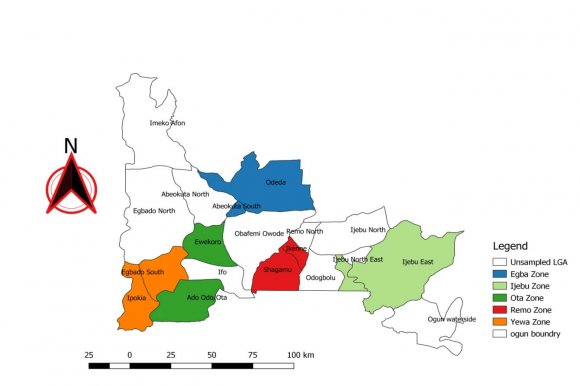
For this study, we divided Ogun state into five zones based on the availability of a government owned veterinary clinic and AI surveillance centre, these zones includes Remo, Ijebu, Yewa, Ota and Egba. Two LGA per zone was randomly selected with one farm and one veterinary health facility per LGA sampled. Farms selected include those with previous history of AI outbreak or those that regularly report related disease to the local veterinary authority (Figure 1).
7. Medical Research
8. III. Data Collection and Management
We reviewed available records on AI between 2015 and 2019. We extracted data from NADIS disease outbreak reporting forms and data collected from electronic reporting with ODK from the state, LGA, veterinary health facilities and local farms.
We conducted analysis using Microsoft Excel 2007 and Epi-Inf 7.0. Data output was summarized into descriptive forms using charts and tables.
We analyzed the questionnaires and scored the responses for various system attributes; Knowledge, Usefulness, Simplicity, Acceptability and Stability. For consistency and comparability of findings, we used the evaluation method and scoring system utilized for influenza surveillance evaluations conducted in other African countries (17). A scale from 1 to 3 was used to provide a score for each quantitative indicator as follows: < 60% scored 1 (poor performance); 60-79% scored 2 (moderate performance); ?80% scored 3 (good performance) (17). Thereafter the scores assigned to each indicator were averaged for all indicators evaluated within each attribute to provide an overall score. The 7 evaluated attributes were then average to get an overall score for the surveillance system.
IV.
9. Result a) Operation of the AI surveillance system
In Ogun State, the AI surveillance system makes use of both active and passive surveillance methods to operate a multilevel and multi directional system.
The passive surveillance makes use of previsitation to farms by surveillance officers and state veterinary officers to check on their bio-security and also administer questionnaires to examine their knowledge, attitude and practice about AI. Workshops are conducted with farmers and other stake holders where new information about AI is disseminated and discussion on source of possible outbreaks are made. They are also regularly introduced to their surveillance agents (2 per LGA) for each zonal levels, who they will contact on the eventuality of an outbreak.
The Active surveillance however makes use of all veterinary officers in the 9 health facilities across the zonal levels in Ogun State. Informants (2per LGA) will first inform the closest veterinary health facility within their jurisdiction of the outbreak and veterinary doctors will then be deployed to collect samples from affected farm. This will then be forwarded to the veterinary research institute VOM by the AI desk officer and the state director of veterinary services (DVS), also a notification is forwarded to the National Avian influenza desk officer and the CVO. Results and feedbacks are sent by the reference lab VOM to the national AI desk officer, the affected state DVS and the national CVO. Feedback is also generated downwards towards the farmer (Figure 4).
10. Socio-demographic characteristics
11. Discussion
The AI surveillance system in Ogun State between 2015 to 2019 can be said to have an average level of performance with an overall surveillance system evaluation score of 1.9 (poor to moderate) out of a scale of 3.0 (Table 9), and total number of affected birds of 99,923 within 5 years of surveillance (Figure 2), the system is presently not performing at its optimum to meet up with the objective of its establishment, which may be evident in the absence of reported cases and outbreaks in the year 2016, 2018 and 2019 which will hinder its contribution to the regional and global understanding of influenza epidemiology, including sharing of clinical samples with WHO collaborating center for annual selection of vaccine strains (18) (19) (20). This finding is different from that found in the national avian influenza surveillance evaluation published in 2014 (21) which suggested that AI surveillance systems across Nigeria were meeting the objectives of their establishment, a contrary result for Ogun state presently, however suggestive that the system is not receiving as much attention as it use to.
A key component of any surveillance system is the competency of surveillance officers in terms of knowledge of the basic objectives of the surveillance system and how the system should be operated (22). This is best learned through training of the surveillance officers, the Ogun State AI surveillance system has well trained staffs comprising 50% veterinary doctors (Table1) and other highly skilled professionals, with 61.1% of them having received formal training on AI surveillance (Table 2).However, there is still a large portion 38.9% that have not received formal training, this will definitely affect their eventual performance in the system.
The simplicity of this system and its processes engenders compliance which can facilitate the delivery of effective public health responses and ensure diseases are controlled in time to prevent further spread (23). All four indicators used to access the simplicity of Ogun State AI surveillance system showed between moderate to good score (Table 3) and all respondent to the questionnaire agreed that the form used for reporting are very easy to fill. This is also contrary to earlier studies (21)which was suggestive of a complex AI surveillance system. It may however be because this earlier studies were national based studies and the complexities were introduced at the federal level of the surveillance system.With an optimal staff strength and very simple reporting process other attributes of the surveillance system like acceptability and validity will be positively influenced (22) (24).
Similar to previous studies, the Ogun State AI surveillance system is flexible, having a second highest score of 2.3 among all the attributes (Table 4). The existence of optimal staff strengthis an advantage for the system, majority of whom agreed that forms used in collecting data can accommodate any change in the surveillance system. The lack of supervision noticed in the system is a set-back as staffs need to be supervised regularly to optimize the AI surveillance system in the state.
Majority of the respondents said they will continue with the surveillance system, giving a good score for the indicator (Table 5) and acceptability of the system. However, quite a substantial number said there were challenges in the AI surveillance system and finance was the most common challenge 88.8%. Compensation to farmers that have outbreaks of AI were 27). This will have adverse effect on willingness of farmers to report any outbreaks of AI in their farms; hence many are resorting to vaccinating their birds (28) (29) which will be inimical to effort to eradicate the disease. Timeliness of surveillance data was one of the weakest attribute with a score of 1.7. All the 3 indicator used to measure this attribute except timeliness of monthly reporting scores 1 (Table 6) this finding is similar to that published in 2014 where timeliness of AI surveillance data was also poor (21). With only 47% of the respondent having knowledge of the existence of a written policy on timeliness of data, meeting the first 2 week's monthly set target now becomes more un attainable.
Two out of the three indicators used to measure sensitivity had moderate to good score except for the indicator measuring the ability of the surveillance system to detect all cases which had a weak score (Table 7). With a weak to moderate sensitivity, more AI outbreaks go unnoticed, and this is capable of increasing the risk of occurrence of zoonotic human influenza which may progress to a global pandemic like the ongoing novel corona virus infection in china.
Of the five indicators used to evaluate for stability, four had weak score (Table 8), this is particularly due to the poor funding and lack of financial encouragement generally accorded surveillance officers in the veterinary services and animal disease surveillance systems (30) (31), which needs to change if the morale of surveillance officers towards AI surveillance in Ogun State is to be improved.
12. VI. Conclusions and Recommendation
This study showed that the existing AI surveillance system in Ogun State Nigeria is simple, flexible and acceptable with good knowledge by surveillance officers, but requires improvement in area of timeliness of data, sensitivity of the system, and stability through substantial funding to make it efficient for prevention and control of AI in Ogun state and avoid potential zoonotic transmission to man.
The study suggest that more training should be conducted, at least quarterly, for all surveillance officers, this will keep them abreast with present competencies in AI surveillance, including existing policies on timeliness. The system's ability to detect cases of AI should be improved by involving more farm workers in the AI surveillance system. More funding is also advocated for and collaboration of international partners such as FAO in terms of provision of stipends for surveillance officers to improve the stability of the system.
| 1,00,000 | ||||||
| 90,000 | ||||||
| 80,000 | ||||||
| 70,000 | ||||||
| 60,000 | ||||||
| 50,000 | ||||||
| 40,000 | ||||||
| Number | 0 10,000 20,000 30,000 | |||||
| 2015 | 2016 | 2017 | 2018 | 2019 | ||
| Characteristics | Frequency (n=36) | Proportion (%) | ||||
| Sex | Male | 23 | 63.9 | |||
| Female | 13 | 36.1 | ||||
| Organization | Government hospital | 29 | 80.6 | |||
| Poultry farm | 7 | 19.4 | ||||
| Cadre of staff | Vet. doctor | 18 | 50.0 | |||
| Vet. technician | 8 | 22.2 | ||||
| Vet. nurse | 7 | 19.5 | ||||
| Administrative staff | 3 | 8.3 | ||||
| Years in service | <10 years | 24 | 66.7 | |||
| ?10 years | 10 | 27.8 | ||||
| Unknown | 2 | 5.5 | ||||
| b) System Attributes | ||||||
| Knowledge of AI and system attribute; | ||||||
| Simplicity, | Flexibility, | Acceptability, | Timeliness, | |||
| Sensitivity and Stability were evaluated using extracted | ||||||
| data and questionnaires. | ||||||
| Year 2020 |
| 29 |
| Volume XX Issue I Version I |
| D D D D ) |
| ( |
| Medical Research |
| Global Journal of |
| Indicator | Calculation/data input | Indicator value | Score | ||||
| Training | |||||||
| Perception of surveillance | Number of surveillance staff within each | Yes: 52.9% | 1 | ||||
| staff on whether training is | reported category/number interviewed | ||||||
| compulsory with policy. | No : 41.7% | ||||||
| Unknown :5.5% | |||||||
| Perception of surveillance | Number of surveillance staff within each | Yes: 80.6% | 3 | ||||
| staff on whether they have | reported category/number interviewed | ||||||
| been | trained | on | AI | No : 19.4% | |||
| surveillance. | |||||||
| Perception of surveillance | Number of surveillance staff within each | Formal : 75.9% | 2 | ||||
| staff on the type of training | reported category/number with training | ||||||
| received. | Informal : 24.1% | ||||||
| Perception of surveillance | Number of surveillance staff within each | Yes: 90.3% | 3 | ||||
| staff on whether training | reported category/number with training | ||||||
| improved performance | No : 9.7% | ||||||
| Perception of surveillance | Number of surveillance staff within each | Yes: 97.2 | 3 | ||||
| staff on needs for more | reported category/number interviewed | ||||||
| training. | No : 2.8 | ||||||
| An estimate of 80.6% of the respondents has | 35(97.2%) of the respondent affirmed there is need for | ||||||
| received some form of training on AI surveillance, | more training; and (38.9%) agreed that the training | ||||||
| however only 61.1% were formally trained. A total of | should be Quarterly. | ||||||
| Simplicity | |||||||
| Performance of Avian Influenza Surveillance System, Ogun State Nigeria, 2015-2019 | |||||
| Year 2020 | |||||
| 30 | |||||
| Volume XX Issue I Version I | |||||
| D D D D ) G | |||||
| ( | |||||
| Medical Research | Indicator Simplicity | Calculation/data input | Indicator value | Score | |
| Global Journal of | Perception of surveillance staff on whether surveillance forms are easy to fill. Perception of surveillance staff on time used in data collection. | Number of surveillance staff within each reported category/number interviewed Number of surveillance staff within each reported category (< 2 hours, 2-8 hours, > 8 hours) / Number of surveillance staff interviewed | Yes: 100.0% No : 0.0% ?2 hours : 24.2% 3 -8 hours : 66.8 >8 hours : 9.0% | 3 2 | |
| Perception of surveillance | Number of surveillance staff within each | ? 2 staff:30% | 2 | ||
| staff on staff strength. | reported category (? 2 staff, ?3 staff) / | ? 3 staff:70% | |||
| Number of surveillance staff interviewed | |||||
| Perception of surveillance | Number of surveillance staff within each | Yes: 83.3% | 3 | ||
| staff on whether staffs are | reported category/number interviewed | No : 13.9% | |||
| optimal. | Unknown: 2.8 | ||||
| All 36 respondent to the questionnaire agreed | editing, storing and analysis of surveillance data is | ||||
| that the forms used for AI surveillance were easy to fill. | 4(1-24) hours. | ||||
| The median estimated time for collection, entering, | |||||
| © 2020 Global Journals | |||||
| Indicator | Calculation/data input | Indicator value | Score | ||
| Flexibility | |||||
| Perception of surveillance | Number of surveillance staff | Yes: 94.4% | 3 | ||
| staff on whether forms can | within each reported category/ | : 2.8% | |||
| accommodate change in | number interviewed | Unknown: 2.8% | |||
| system. | |||||
| Perception of surveillance | Number of surveillance staff | Yes: 91.7% | 3 | ||
| staff on availability of staff | within each reported category/ | No : 2.8% | |||
| for | validating | and | number interviewed | Unknown: 5.5% | |
| completeness of data. | |||||
| Perception of surveillance | Number of surveillance staff | Yes: 33.3% | 1 | ||
| staff on whether they have | within each reported category/ | No : 63.9% | |||
| been supervised before. | number interviewed | Unknown: 2.8% | |||
| Acceptability | |||||
| Indicator | Calculation/data input | Indicator value | Score | |||
| Acceptability | ||||||
| Perception of surveillance | Number of surveillance staff | Yes: 94.4% | 3 | |||
| staff on willingness to | within | each | reported | No : 5.6% | ||
| continue participation in | category/number interviewed | |||||
| surveillance. | ||||||
| Perception of surveillance | Number of surveillance staff | Yes: 55.6% | 1 | |||
| staff on presence of | within each reported category | No : 44.4% | ||||
| challenges. | /number interviewed. | |||||
| Perception of surveillance | Number of surveillance staff | Yes: 72.2% | 2 | |||
| staff on whether they are | within each reported category | No : 27.8% | ||||
| appreciated by system. | /number interviewed. | |||||
| Perception of surveillance | Number of surveillance staff | Yes: 61.1% | 2 | |||
| staff on whether they have | within each reported category | No : 33.3% | ||||
| contributed to system. | /number interviewed. | Unknown: 5.6% | ||||
| Perception of surveillance | Number of surveillance staff | Yes: 81.3% | 3 | |||
| staff on whether suggestion | within each reported category/ | No : 18.7% | ||||
| was taken. | number | that | had | made | ||
| contribution | ||||||
| 20 (55.Timeliness | ||||||
| Indicator | Calculation/data input | Indicator value | Score | ||
| Timeliness | |||||
| Perception of surveillance | Number of surveillance staff | Yes: 47.2% | 1 | ||
| staff on availability of policy | within | each | reported | No : 47.2% | |
| on timeliness. | category/number interviewed. | Unknown: 5.6% | |||
| Perception of surveillance | Number of surveillance staff | ?30min: 36% | 1 | ||
| staff on time it takes for data | within each reported category | >30min: 30% | |||
| collation. | (?30min, >30min)/ number | Unknown: 34% | |||
| interviewed. | |||||
| Perception of surveillance | Number of surveillance staff | ||||
| staff on how soon monthly | within each reported category/ | ||||
| report completed in new | number interviewed. | ||||
| Indicator | Calculation/data input | Indicator value | Score | |||||
| Sensitivity | ||||||||
| Perception of surveillance | Number of surveillance staff | Yes: 61.1% | 2 | |||||
| staff on whether they have | within | each | reported | No : 36.1% | ||||
| submitted | AI | sample | category/number | Unknown: 2.8% | ||||
| before. | interviewed. | |||||||
| Perception of surveillance | Number of surveillance staff | Good: 63.6% | 2 | |||||
| staff | on | laboratory | within | each | reported | Average : 36.4% | ||
| diagnosis. | category/number that have | |||||||
| submitted sample. | ||||||||
| Perception of surveillance | Number of surveillance staff | Yes: 36.1% | 1 | |||||
| staff on whether system | within | each | reported | No : 55.6% | ||||
| was able to detect all | category/number | Unknown: 8.3% | ||||||
| cases. | interviewed. | |||||||
| Stability | ||||||||
| Indicator | Calculation/data input | Indicator value | Score | |||||
| Stability | ||||||||
| Perception of surveillance | Number of surveillance staff | Data recording:66.7% | 1 | |||||
| staff | on | duties | with | within | each | reported | Data storage:47.2% | |
| dedicated staff. | category/number | Data analysis:25.0% | ||||||
| interviewed. | Data transfer:25.0% | |||||||
| Perception of surveillance | Number of surveillance staff | Yes: 55.6% | 1 | |||||
| staff on feedbacks from | within | each | reported | No: 38.9% | ||||
| next level. | category/number | Unknown: 5.5% | ||||||
| interviewed. | ||||||||
| Perception of surveillance | Number of surveillance staff | Yes: 22.2% | 2 | |||||
| staff on Interruption of | within | each | reported | No: 75.0% | ||||
| system by inadequate staff. | category/number | Unknown: 2.8% | ||||||
| interviewed. | ||||||||
| Perception of surveillance | Number of surveillance staff | Yes: 69.4% | 1 | |||||
| staff on Interruption of | within | each | reported | No: 27.8% | ||||
| system | by | inadequate | category/number | Unknown: 2.8% | ||||
| funds. | interviewed. | |||||||
| Perception of surveillance | Number of surveillance staff | Yes: 8.3% | 1 | |||||
| staff on availability of | within | each | reported | No: 88.9% | ||||
| stipends for surveillance | category/number | Unknown: 2.8% | ||||||
| duty. | interviewed. | |||||||
| Only 3(8.3%) of the respondent said they store their data electronically in computer system 22(61.1%) use | ||||||||
| files and paper. | ||||||||
| Attributes | Number of evaluated indicators | Mean score | Performance |
| Knowledge | 5 | 2.4 | Moderate to good |
| Simplicity | 4 | 2.5 | Moderate to good |
| Flexibility | 3 | 2.3 | Moderate to good |
| Acceptability | 5 | 2.2 | Moderate to good |
| Timeliness | 3 | 1.7 | Poor to Moderate |
| Sensitivity | 3 | 1.7 | Poor to Moderate |
| Stability | 5 | 1.2 | Poor to Moderate |
| Overall | 23 | 1.9 | Poor to Moderate |
| V. |