1.
Single-Breath Counting: An Alternative to Evaluate the Evolution of Pulmonary Function in the Postoperative Period of Cardiac Surgery Introduction he cardiac surgery (CS) is an invasive and high risks process that finds the valvulopathies correction, arterial aorta diseases, congenital heart disease and revascularization of the myocardium. The incidence of these surgeries has increased in developing countries, and although it has evolved enough, the procedure also is related to many risk factors for postoperative complications [1]. Among these risks, is the decrease in ventilatory function, which may predispose to the occurrence of complications, such as hypoventilation, with consequent hypoxemia [2,3].
In cardiac surgery, the lung function evaluation is fundamental, because helps in differential diagnostic of the disease, moreover being a prognostic marker of the surgical procedure, since postoperative pulmonary complications are important causes of morbidity and mortality in this population [4]. Among the existing methods for this evaluate, the Slow Vital Capacity (SVC) is one of the most important procedures. It is defined by the maximum amount of air exhaled by lungs from the full breath in. However, for this measurement it is necessary to use equipment like ventilometer and/or espirometers that cannot always are available in the practice's clinical, beyond being expensive and need qualified professionals to realize the evaluation.
As the phonation is directly related-to respiratory system, some authors have proposed other technique that use the speech to evaluate the SVC [5][6][7], owing to would need just the voice to evaluate, besides being a simple technique, without cost and that would be realized at any ambient. The Single-breath Counting (NCT) is conceited like the maximum numeral the person can count during a full breathe out after a deep breath in. This technique already done described in hospitalized patients [8,9], however there is a lack in evaluate in different populations, especially in surgery cardiac's patients.
Because it is an objective measure, SBC can serve as a parameter for prognosis and evaluation of the evolution of pulmonary function after a CS, especially in locations that don't have equipments like the espirometers and/or ventilometers. Beyond that, can be a useful tool in discharge from hospital, where the patient can be guided to looking for a specialized service in the moment to identify the SVC and SBC T evolution in cardiac surgery's period postoperative and to evaluate a possible association between both.
2. II.
3. Methods
It is about a longitudinal research, that the choice among the techniques (SVC and NCT) was realized in a random way (aleatory numbers' technique). This research was realized in a surgical recovery unit from a heart surgery's reference hospital, between the years 2015 and 2016. The project was agreed for the Research ethics committee involving human beings from the University of Pernambuco (Comitê de ética em pesquisa envolvendo seres humanos da Universidade de Pernambuco -CAAE. Protocol Number 20222613.5.0000.5207).
The criteria of inclusion was volunteers in the immediate postoperative period of cardiac surgery, conscious, oriented, extubated more than 24 hours ago end between 18 to 80 years old. We excluded individuals with consciousness' level altered (Glasgow coma scale ? 13), hemodynamically instables, with pulmonary comorbidities' history, that show cardiovascular and/or lung complication's postoperative, like such as high throughput measured through thoracic drains, dyspnea (respiratory frequency -RF > 30 ipm), Signs of hypoxemia (peripheral oxygen saturation -SpO 2 <90%, partial arterial oxygen pressure -PaO 2 <80 mmHg), bronchospasm and the individuals unable to assimilate the techniques, or perform them as a result of pain. The evaluations should be suspended if the individuals show consciousness' level altered (Glasgow coma scale ? 13), get worsening clinical which prevents the evaluate, difficulty to execute the techniques or any discomforts in the course of the conduct, including change of mean arterial pressure -MAP > 20mmHg, SpO 2 < 90% and variation ± 20 bpm in heart rate, any day of hospitalization.
First, was collected variables about age, sex, height, weight, time and kind of surgery, Extracorporeal Circulation, time of anoxia, time of extubating, use of vasoactive's drugs, type and number of thoracic drains. The SVC and SBC was daily evaluated, always at morning, during all period of hospital internment. The patient was oriented to sit comfortable on the hospital bed to evaluate. An interval of 10 minutes was respected between the two evaluation modalities [5] The SBC was chosen for phonation maximum time evaluation. The patient was asked to perform a maximum inspiration, and next begins the full breathe out, then starts the numerical count in crescent order, starting by number one until the biggest number possible arrived, in which the tone and the intensity of the voice show naturalness [9]. Three measurements were taken, respecting a time interval of one minute between the maneuvers, taking as reference the highest value obtained.
The SVC was evaluated using the Wright Mark 8 Ventilometer (nSpire Health Ltd -England), connected to the individual by a buccal and a nasal clip so that there was no air leakage [10]. The volunteers were stimulated to realize a full breathe in, followed by a complete expiration until to obtain the residual volume [10]. Three measurements were also realized, respecting a time interval of one minute between the maneuver, taking as reference the biggest value obtained. The SVC was adjusted for predicted body weight (relative form), calculated from height using the standard formulas: predicted body weight (males) = 50 + 0.91 (cm of height ? 152.4); or predicted body weight (females) = 45.5 + 0.91 (cm of height ? 152.4).
4. a) Statistical analysis and sample calculation
The sample calculation was made starting by the Gpower 3.0.10 software, considering a ? = 0,05, a power of 95% (? = 0,05), and a correlation coefficient identified in a previous study of 0.75 [8]. Based in these data, came to a minimum sample of 11 individuals. Considering that in the year of the study, 197 surgical procedures were performed and considering possible losses, we chose to more than triple the sample, reaching a total of 35 patients. These patients were selected from the natural admission in the first months of collection.
The data were processed and analyzed using the GraphPad Instat program (GraphPad Inc., San Diego, USA, Release 3.06, 2003). Initially, they were submitted to normality criteria (Shapiro-Wilk test). Mean and standard deviation (SD) were used to present continuous variables, while categorical data were presented using absolute and relative frequencies. The relationship between the variables was established through the linear correlation of Pearson and Spearman. The comparisons between the medians were performed using the Friedman test and the Dunn post-test. Bilateral 'p' values were calculated, and the significance level adopted was 5%.
5. III.
6. Results
Initially 35 patients was included on the research in which 11 were discontinued (one because presents asthma, six had clinical worse or consciousness' level altered during the hospital internment and four had difficulty performing the technique correctly.) The 24 remaining patients (70,8% from masculine sex) were accompanied until hospital discharge.
On the Values were expressed as mean ± standard deviation and absolute numbers (%)
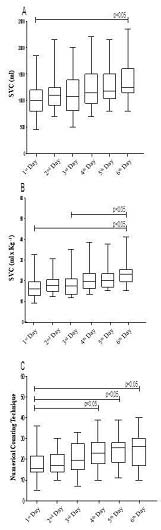
Figure 1 shows the behavior of SVC (ml) , SVC (ml/Kg) and NTC during the first six days after extubation. The two techniques were able to identify difference on the sixth day when compared to the first day evaluated. The SVC (ml/Kg) also shows a difference between the third day (figure 1B) and the SBC between the fourth and fifth day (figure 1C).
Kruskal-Wallis Test and Dunn's post-test. The correlations between SBC and SVC relative and absolute are shown in table 2. A positive correlation can be verified between the second and fifth day techniques, in absolute form, and from the second to the sixth day in relative (ideal weight) form.
7. Discussion
In this study, the Single-breath Counting, as well as the SVC, was able to identify an objective improvement in pulmonary function on the sixth day when compared to the first postoperative day of patients undergoing cardiac surgery. This suggests that the proposed technique, as well as established methods, is able to follow the evolution of pulmonary function, perceiving its alterations and showing a positive correlation with SVC on most days evaluated.
It is described in the literature that pulmonary function is compromised up to the fifth postoperative day of CS [11,12]. According to the authors [11,12] this injury mainly occurs due to surgical incision, anesthesia, pain and impaired pulmonary mechanics. Larsen et al. [13] evaluated the third and sixth day after the surgical procedure and visualized that in the sixth there was improvement of vital capacity. According to Borges-Santos et al. [14], the restitution of Forced Vital Capacity (FVC) values to those found in the preoperative period occurs only between the 15th and the 30th day in elective thoracotomy patients. As in the studies described previously [11][12][13], the present research was able to find improvement in vital capacity from the sixth day.
Like the SVC, the SBC was also able to identify this difference from the sixth day. This finding is important because it opens the possibility of using another simpler and cheaper technique and does not need specific equipment to evaluate the pulmonary function of patients in the postoperative period of cardiac surgery, especially when there is no availability of more consecrated methods such as spirometry. This result is valid under study in the population proposed in the study, patients in the postoperative period of CS, in which it is already expected that lung volumes and capacities are decreased. In addition to being an audience, the evaluation of pulmonary function is extremely important [15], since the monitoring of these measures allows early identification of possible ventilatory dysfunctions, avoiding greater complications and reducing morbidity and mortality rates [14,16,17].
This improvement in the postoperative pulmonary function identified in the two techniques suggests a direct relationship between them. Other authors have reported a positive correlation between SBC and SVC in healthy individuals [5] and hospitalized [8,9], indicating that this technique can be used in varied populations, obtaining good results. However, studies evaluating SBC versus SVC with cardiac surgery patients were not found. In our study, a moderate to strong positive correlation was found [18] between SBC and SVC from the second to the fifth day (in relative form) and from the second to the sixth day (in absolute form).
Palmeira et al. [8] also found a positive correlation between SVC and SBC in hospitalized patients when evaluated in an absolute (r = 0.75) and relative (r = 0.76). Cardoso et al. [9] showed that the correlation occurred for both sexes (r = 0.856), and for males (r = 0.870) and females (r = 0.818) individually. However, unlike the present study, which evaluated patients undergoing cardiac surgery, excluding those with a history of prior pulmonary comorbidities, in these studies [8,9], the disease presented by the patients was not used as a criterion in the evaluation, thus, a diversified sample.
Despite presenting an attractive alternative to methods already established in the literature [5,8,9], the use of this technique should be used with caution by health professionals and further studies should be performed in this population to assess whether the behavior of this technique is capable to detect differences in lung function as well as spirometry. A possible limitation of this study may have been the great loss of patients due to the daily follow-up, since some patients altered the level of consciousness or even presented clinical worsening and had to be excluded. In addition, the severity of the clinical picture after the surgery and lack of understanding of the technique were factors that prevented the recruitment to the research. Anyway, this research makes an important contribution to the monitoring of pulmonary function in patients undergoing cardiac surgery in places that do not have specific devices for evaluation, and opens a range of options in scientific research. It presents, therefore, a technique that is proving viable to follow the behavior of the pulmonary function of these patients, aspect of great importance for the prognosis and evolution of these individuals, and without the need of any additional device or resource. In addition, it can be performed in any environment and by the patient himself, who can follow his evolution and still identify a possible functional limitation, being previously advised to look for a specialized service, if this happens, to prove the change and to looking for treatment.
V.
8. Conclusion
In this research was possible to identify a difference between the first and the sixth day in both SBC and SVC. In addition, there was a moderate to strong positive correlation between the two techniques from the second to the fifth day, in absolute form, and from the second to the sixth day in the relative form.
| is exposing the general | ||||
| description of the sample. The most of sample was | ||||
| constituted | by | surgery | of | myocardium's |
| revascularization (20%), following by valve change | ||||
| (12,5%). The patients had an average surgery time of | ||||
| 201 minutes, with an average time to extubation of 1.212 | ||||
| minutes. | ||||
| Variáveis | n = 24 |
| Age (years) | 59 ± 9.0 |
| Ideal Weight (Kg) | 61.2 ± 7.6 |
| Height (cm) | 166 ± 7.0 |
| Surgery Time (min) | 201 ± 57 |
| Time to Extubation (min) | 1212 ± 2193 |
| Extracorporeal circulation time (min) | 80 ± 29 |
| Time of anoxia (min) | 44 ± 18 |
| Extracorporeal Circulation | 20 (83.3%) |
| Sex | |
| Female | 07 (29.1%) |
| Masculine | 17 (70.8%) |
| Type of Surgery | |
| Valve Change | 03 (12.5%) |
| Revascularization of the myocardium | 20 (83.3%) |
| Two procediments | 01 ( 04.1%) |