1.
the ?-3 family) acids, which are essential for humans and must enter the organism with food [2].
The main representatives of PUFAs are linoleic, ?-and ?-linolenic, arachidonic, eicosapentaenoic, docosahexaenoic acids. Linoleic and linolenic acids are predecessors of more long-chain fatty acids. Arachidonic acid is the substrate for the synthesis of eicosanoids, leukotrienes and prostaglandins, which are biological regulators of the cardiovascular, nervous, reproductive and immune systems.
Polyunsaturated fatty acids are widely used in medicine, pharmaceutical industry, cosmetics, nutrition etc. They are necessary for normal development of the human body and especially children. They are essential for preventing immune, inflammatory, cardiovascular diseases (rheumatoid arthritis, coronary heart disease, cancer).
The main sources of PUFAs of the ?-6 family are mainly various vegetable oils, PUFAs of the ?-3 family are found in large quantities in fish, seafood, egg yolk [3,4]. Linoleic and ?-linolenic polyunsaturated fatty acids are essential acids, they are not synthesized de novo and must enter the body externally with food or as part of dietary products. Most dietary supplements contain PUFA in the form of triglycerides, which accumulate in adipose tissue, where, as needed by the body, they undergo lipolysis to form free fatty acids. The latter enter the bloodstream into cells where energy is required.
The most promising, in our opinion, is the use of PUFA in the form of organic acids, which have greater bioavailability, as they bypass the complex process of formation of triglycerides. Short-and medium-chain fatty acids (but not fatty acids with longer chains, which are too large to get directly through the small openings of the intestinal capillaries), entering the body are directly absorbed into the blood through the capillaries of the intestinal tract, pass through the portal vein, and others nutrients get into different organs.
In connection with the above, the staff of the limited liability company (LLC) "STAR TRADE COMPANY" has developed a technology for production of double distilled fatty acid concentratr "BIOIL" by bidistillation of various vegetable oils in the ratio ?-3: ?-3:: ?-9 acids -1: 2.5: 3, respectively.
The purpose of this study was to study the reparative and anti-inflammatory properties of the concentrate of PUFA "BIOIL", produced by LLC "STAR TRADE COMPANY".
The study is standardized by regulatory documents and included in a set of pre-clinical studies required for the registration of medicines. The study was conducted by the guidelines and requirements of GLP and the Orders of MOH of Ukraine ? 944 dated 14.12.2009 and ? 95 dated16.02.2009 [5,6].
2. II.
3. Materials and Methods
Research of pharmacological activity of PUFAs concentrate "BIOIL" was performed on 3-4 months mature male inbred rats of 180-200 g. Before the experiment, animals had acclimatization for seven days in a room for testing. During the acclimatization everyday review of each animal was performed (assessing behavior and general physical condition). Healthy animals, which met the selection criteria, were distributed in experimental groups. Groups were formed by randomization (random selection) using body weight as the main criteria for distribution (deviation of initial weight between groups and within groups did not exceed ±10%).
The animals were kept in rooms with controlled microclimate parameters: air temperature +20-24 °C, humidity 45-65%, light regimen "12 hours day/night", in plastic cages of 6 animals. Airing of rooms and air sterilization were performed using quartz lamps daily. Animals had free access to water. Tap water was used for drinking. The animals consumed pelleted balanced feed (??.?15.7-2123600159-001:2007). The animals were cared for according to standard operating procedures.
Estimation of reparative properties of PUFAs concentrate "BIOIL" was conducted on a model of fullsurface stencil wounds in rats. Animals in research groups were anesthetized with sodium thiopental in the dose of 35 mg/kg. On the back area of 4×5cm was cleaned, outlined using marker stencil in order to receive wound of size 1,5×1,5 ??. Then with a pair of scissors, cut the contour of full-surface wounds [1]. Treatment with TS was started within 2 hours after surgery, and it was continued once daily until complete healing of wounds.
The test sample was applied as a thin layer using a pipette in quantities of 1 ml/animal. Methyluracil ointment was chosen as a reference agent, pronounced reparative activity. The efficiency of the samples was assessed by planimetric indices: area of wounds and speed of wounds healing, which were determined on 3, 5, 8, 11, 14 days of the experiment.
Anti-inflammatory properties of PUFAs concentrate "BIOIL" was studied on a model of acute paw inflammation in rats weighing 180-200 g, caused by carrageenan. Acute edema in rats was caused by sub-plantar injection in right rear foot of carrageenan (0,1 ml/animal) [7,8,16].
According to Di Rosa et all, the dynamics of swelling caused by carrageenan [9], de-pends on the action of various transmitters: biogenic amines, kinins and prostaglandins, that are being released during the experiment. However, the leading role in the mechanism of acute inflammation in this model plays a release of prostaglandins as a result of activation of cyclooxygenase pathway of arachidonic acid oxidation [10,11].
Gel diclofenac sodium 1% of JSC "Farmak", Kiev, Ukraine, was used as a reference agent (RA). Studied agents were applied on the damaged leg twice: once after injection of phlogogenic agent and after 1 hour. The development of edema was observed in dynamics: within 1, 2, 3, 4 and 5 hours (in terms of carrageenan edema). The volume of paws was measured using mechanical oncometer.
Antiexudative activity (AEA) of agents was determined by the degree of reduction of edema in experimental animals compared to control, and was calculated by the formula and is expressed in %:
??? = Î?"Vc -Î?"Vt × 100%, Î?"Vcwhere: ??? -antiexudative activity in %; Î?"Vc -the average difference in volume between the legs with edema and without edema control group; Î?"Vt -the average difference in volume between the legs with edema and without edema in test group.
Experiments were performed on 24 white female inbred rats weighing 170-220 g. Suppositories "Relief" were chosen as a reference agent.
Experimental proctitis was simulated by twotimes administration of 5% formalin solu-tion in dose of 0,2 ml/animal (at intervals of every other day) in rectum to a depth of 1.5 cm. Damaging agent administered in the morning fasting through metal probe after reflectory bowel evacuation [13]. The frequency of administration and concentration of formalin solution was selected so as to simulate inflammation and damage of rectal mucosa and to minimize general toxic effect of chemical substance.
Investigated agents were administered 24 hours after the first injection of formalin and 1 hour after the second administration of formalin, and later -once a day for the entire period of the experiment. The duration of treatment was ten days. PUFAs concentrate "BIOIL" was administered intragastric at a dose of 1 ml/kg and rectal (1 ml/kg).
Pharmacotherapeuic effect was evaluated by their effect on the clinical course of the disease comparing to intact and control groups. Efficacy criteria were: general condition of the animals, the presence and severity of clinical manifestations of disease (swelling of soft tissues around anus, purulent discharge from the anus). The dynamics of body weight and rectal temperature (using an electronic thermometer, model ?PEM-1) were estimated before proctitis was simulated on 7 and 10 days. Complete blood count was made on 7 and 10 day of treatment [14].
On day 10 of the experiment macroscopic changes of rectal mucosa were evaluated. The planimetric indices were determined: condition of rectal mucosa in points and area of affected part of rectal mucosa (mm 2 ). Semiquantitative evaluation of certain signs of inflammation was performed in points according to severity of edema, hyperemia, hemorrhage availability: 0 points -no signes; 1 point -a sign expressed slightly; 2 points -a sign expressed moderately; 3 points -a sign expressed pronounced.
Degree of damage was assessed by summing the scores for these parameters.
For statistical conclusions when comparing samples of variables was used one-way anal-ysis of variance (or Kruskal-Wallis test for variables that are not subject to the normal law of distribution), which revealed differences between the experimental groups, and after Newman-Keuls test or Mann-Whitney test. Differences between groups were considered statistically significant at p <0,05 [15,16,17]. Standard statistical software package Statistica 6.0 and Excel were used for the mathematical and statistical calculations.
4. III.
5. Results of the Study
6. Research of the reparative activity of PUFAs concentrate "BIOIL"
It was established that in rats, which received applications of PUFAs concentrate "BIO-IL", one day after simulation of full-surface stencil wounds there was observed an improvement of condition of wound surface: wound edges and wound itself were clean and tidy, the area of the wound was smaller than in animals that were not treated (Figure 1). Later on reparative activity of the TS increased. According to the received data, the highest reparative activity PUFAs concentrate "BIOIL" showed at 5-8 day of observation, an evidence of this was a significant reduction in wound area in rats by 1,8 and 2,3 times comparing to rats that were no treated (figure 1). Rate of wound healing in this group increased 2 and 1.5 times correspondingly (figure 2). In terms of long-term followup (11-14 days), the rate of healing under influence of TS slightly decreased, but was significantly higher than in rats from the control group. It should be emphasized that PUFAs concentrate "BIOIL" was not inferior to that reference agent methyluracil ointment, which has a pronounced reparative effect (figure 1, 2). In the initial stage of PUFAs concentrate "BIOIL" application its reparative activity was even more effective than methyluracil ointment.
Thus, established expressive reparative activity of PUFAs concentrate "BIOIL" on a model of full-surface stencil wounds is achieved by presence in test-sample of omega-6 class, in particular linoleic, which is the basic component of the intercellular lipids and is contained in structural elements of membranes' phospholipids. Long-chain ceramides are up to 40 % of the lipid matrix. They contain linoleic acid [18]. Gammalinolenic acid, which is formed from linoleic acid under the influence of the enzyme delta six desaturase, controls the homeostasis of the skin by supporting the barrier function, fluidity and permeability of membranes, preventing transepidermal water loss. It was established that even at minor violations of transdermal barrier keratinocytes induce release of cytokines that regulate the process of restoring the horny layer of the skin. If there is excessive damage to the horny layer of the skin, an inflammatory reaction starts [19]. Application of PUFAs concentrate "BIOIL" on the wound surface protects layers of the skin, that surround the wound surface, and prevents transepidermal water loss. In addition, another essential PUFA -arachidonic acid is formed from ?-linolenic acid. This acid is a substrate for the synthesis of eicosanoids (prostaglandins, leukotrienes), that regulate the inflammatory and immunological processes. Hence, at PUFAs "BIOIL" complex entry in the dermis, it starts the repair processes that contributes to faster wound healing in rats.
7. Research of antiexudative activity of PUFAs concentrate "BIOIL" at skin application on a model of paw inflammation caused by carrageenan
Results of the study listed in Table 1 showed that reference agent (RA) gel "Ortofen", 1% had stable antiexudative activity starting from one hour of the experiment (Table 1). The average anti-inflammatory activity (AIA) of reference agent was 55% (????. 1).
PUFAs concentrate "BIOIL" has a uniform antiinflammatory activity by reducing the severity of edema in an average of 20% (Table 2). It is known that PUFAs of ?-3 and ?-6 class are precursors to eicosanoids forming -biologically active substances of lipid nature (prostag-landins, leukotrienes, thromboxane, etc.), that regulate local cellular and tissue functions, including inflammatory reactions, functioning of platelets, leukocytes and erythrocytes, constriction and vasodilatation etc. [20,21]. Carrageenan activates the metabolism of arachidonic acid and prostaglandin synthesis, which causes the development of inflammation of the paw of rats. When applied to the leg by penetration through the skin barrier ?-linolenic acid, which is part of PUFAs concentrate "BIOIL", replaces arachidonic acid in phospholipids of cell membranes and contributes to the synthesis of eicosanoids of an anti-inflammatory action. It is known that the functional properties of eicosanoids, synthesized from arachidonic acid and ?3 fatty acid (?-linolenic acid), have opposite effects. For example, prostacyclin 3, formed from ?3 fatty acids, has a vasodilatory effect and decrease arterial pressure. Prostacyclin 2, which is synthesized from arachidonic acid, on the contrary, is a vasoconstrictive agent. These differences are also found in leukotrienes synthesis (LS). Leukotrienes of Series 5 (LT5), synthesized from ?3 fatty acids, have an antiinflammatory effect, while Leukotrienes of Series 4 (LT4), synthesized from ?6 fatty acids (arachidonic acid), are an inductor of inflammatory reactions cascade. But intensity of anti-inflammatory action of eicosanoids, formed from ?3 fatty acids, is less pronounced, which causes a mild anti-inflammatory effect [22,23]. This explains the stable anti-inflammatory action of PUFAs concentrate "BIOIL" in experiment.
Thus, on the model of paw inflammation caused by carrageenan in rats it was established that PUFAs concentrate "BIOIL" has a stable anti-inflammatory activity, which on average was up to 20%.
8. Table 1: Influence of PUFAs concentrate "BIOIL" on dynamics of paw edema in rats induced by carrageenan, n=6, M (?in÷ Max)
Notes:
1. *-differences statistically significant comparing to control group, ?<0,05; 2. ** -differences statistically significant comparing to control group, ?<0,05; 3. t -tendency to statistical significance, 0,05<?<0,100; 4. ?V -difference between the swollen paws and its original size, cu 5. AIA -anti-inflammatory activity.
9. Determination of anti-inflammatory action of PUFAs concentrate "BIOIL" on a model of proctitis in rats
The course of destructive and inflammatory diseases of the rectum (hemorrhoids, procti-tis, paraproctitis, proctosigmoiditis) is a relevant problem in modern medicine, due to the severity of these diseases and their prevalence [13]. Because of uncertainty in etiology and absence of a unified pathogenesis theory, pharmacotherapy for this group of diseases is complex and often inefficient, which determine the rationale for finding and developing new drugs to treat diseases of the rectum. Natural compounds are interesting as objects for research -unsaturated fatty acids, which have low toxicity and have a wide range of pharmacological activity [1,14].
Taking into account pathogenetic mechanisms of proctitis, valuable are antioxidant, anti-inflammatory, membrane-stabilizing, antibacterial and reparative properties of polyunsaturated fatty acids [1,6]. The literature data and research results show pronounced reparative properties of PUFAs in various pathologies.
Expressive anti-inflammatory properties of PUFAs concentrate "BIOIL" were established in the previous experiment and justify assumption of its effectiveness in experimental proctitis.
According to the data presented in Tables 2-5, experimental proctitis was characterized by severe clinical signs of the disease. In animals of the control group diarrhea, swelling of the soft tissues around the anus, purulent discharge from the anus, weight loss (Table 2), increased rectal temperature (Table 3) were observed, which indicated a severity of inflammation and reduction of trophic processes due to a general toxication of animals. Notes:
1. *-differences statistically significant comparing to intact group, ?<0,05; 2. **-differences statistically significant comparing to control group, ?<0,05.
10. Notes:
1. *-differences statistically significant comparing to intact group, ?<0,05; 2. **-differences statistically significant comparing to control group, ?<0,05.
The severity of the pathology was confirmed by pronounced leukocytosis: on the 7 th day the number of leukocytes statistically significant increased by 2,3 times, and on 10 th day -by 1,7 times. This is an evidence of the development of systemic inflammation (Table 4).
Treatment with test agents significantly weakened the course of experimental pathology. The combined administration of PUFAs concentrate "BIOIL" in terms of proctitis in rats, contributed to the improvement of tissues trophic and general condition of the animals. Reduction in severity of clinical signs of disease, statistically significant increase in body weight and decrease of body temperature to a level of intact animals was an evidence of this (Tables 2-3).
When using PUFAs concentrate "BIOIL" there was a reduce of number of white blood cells and hemoglobin count recovery, indicating anti-inflammatory properties of the investigational product (Table 4).
??ble 4: Influence of PUFAs concentrate "BIOIL" on dynamics of hematological parameters in rats under the experimental proctitis, Mean±St.er. By the use of suppositories "Relief" a similar dynamics of investigated parameters was observed (Tables 2-4).
11. Indices
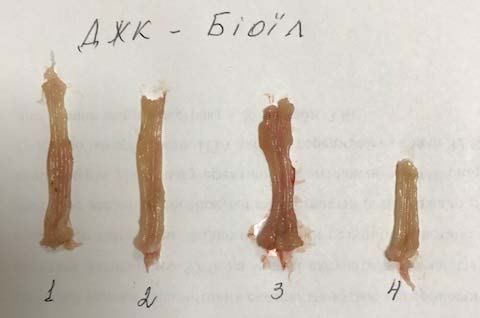
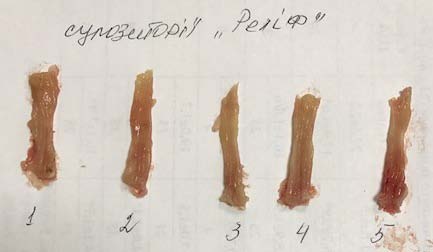
Results of clinical observations are consistent with the macroscopic data. Significant damage of colon was revealed at autopsy in animals from control group at autopsy: lesion area was equal to 415,80 mm 2 , the severity of inflammation was assessed at 6,4 points (Table 5, figure 3).
While using PUFAs concentrate "BIOIL" colon mucosa quickly came back to normal, no signs of necrosis, hemorrhage or congestion were detected at any animal from the group (Table 5, figure 3).
Suppositories "Relief" did the same expressive effect as test-sample: mucosa colon was in normal condition without congestion and edema (Table 5, figure 3).
??ble 5: Influence of PUFAs concentrate "BIOIL" on planimetric indices of colon dam-age severity in rats in terms of experimental proctitis, Mean±St.er.
12. Animal groups Planimetric indices
Affected area, mm 2 Total point Control group 415,80±80,27 6,40±0,68 PUFAs concentrate "BIOIL" 0,0±0,0* 0,0±0,0* Suppositories "Relief" 0,0±0,0* 0,0±0,0* Notes:
1. *-differences statistically significant comparing to Control group, ?<0,05; 2. **-differences statistically significant comparing to control group, ?<0,05.
Therefore, the experimental model of proctitis in rats showed pronounced efficacy of PUFAs concentrate "BIOIL". PUFAs concentrate "BIOIL" was not inferior than reference agent suppositories "Relief" within influence on trophic processes, severity of inflammation. It proves that test agent has distinctive antiinflammatory, reparative and general metabolic properties.
Analyzing received data and based on literature data, we can assume that efficacy of PUFAs concentrate "BIOIL" on a model of experimental proctitis was caused by reduction of production of proinflammatory eicosanoids (prostaglandin E2, leukotriene B4) from arachidonic acid, increase of production of anti-inflammatory eicosanoids (prostaglandin E3, leukotriene B5), reduction (due to inhibition of leukotriene B4 synthesis) of synthesis of platelet aggregation factor, interleukin-1 and tumor necrosis factor -cytokines that play a leading role in diseases of the rectum and various inflammatory diseases. Received results provide the background for promising usage of PUFAs concentrate "BIOIL" in the treatment and prevention of various inflammatory diseases with autoimmune and/or allergic component such as rheumatoid arthritis, systemic lupus erythematosus, Crohn's disease, ulcerative colitis, asthma, atopic dermatitis, inflammatory diseases of the line colon and others. 2. On the model of acute inflammation PUFAs concentrate "BIOIL" had moderate anti-inflammatory effect, reducing paw edema in experimental rats. 3. On a model of experimental proctitis in rats, it was determined an expressive efficacy of PUFAs concentrate "BIOIL". PUFAs concentrate "BIOIL" was not inferior than suppositories "Relief". According to influence on trophic processes, intensity of inflammation in colon mucosa of animals from PUFAs concentrate "BIOIL" was not inferior than suppositories "Relief". This is an evidence of its profound anti-inflammatory, reparative and general metabolic action.
13. List of

| Me (25Q;75Q) | |
| Animal groups | Gain of body weight, g |
| Intact group | 10,8 (0; 20) |
| Control group | -9 (-45; 35)* |
| PUFAs concentrate "BIOIL" | 10 (10;30)** |
| Suppositories "Relief" | 14 (0; 25) |
| Animal groups |