1. Introduction
Author ? ? : Faculty of Pharmacy, Babylon University.
2. II.
3. Subject and Methods
4. a) Animals
This study was carried out at animal house in college of medicine Babylon University in May 2012. A total of 35 adult male Albino Swiss rats aged 16 -24 weeks with body weight of (170 -255g) were used. The animals were obtained from Animal Resource Centre, College of Veterinary Medicine/ Baghdad University. The animals were apparently healthy and they were housed in individual cages at temperature controlled environment (25±5?C) with an ambient humidity. Lights were maintained on a 12-h light/dark cycle. The rats received standard chow diet with water (ad libitum). Rats used in the study were maintained and handled in accordance with the Guide for the Care and Use of Laboratory Animals USA (1996).
( D D D D )ardiotoxicity is the most feared adverse effect of anticancer therapy, due to the fact that life expectancy obtained as a result of the anticancer treatment, may be reduced by the death rate determined by cardiac problems arising as a consequence of the treatment (1) cisplatin is an antineoplastic drug widely used for the treatment of several human malignancies (as standard component of treatment regimens) including bladder cancer (2) cervical cancer (3) , non-small cell lung cancer (4) ovarian cancer (5) squamous cell carcinoma of the head and neck (6) testicular cancer (7) . Nephrotoxicity of cisplatin was the main complication of cisplatin (8) . Earlier studies reported cardiotoxicity with cisplatin treatment (9) . Cisplatin cardiotoxicity can present in a number of ways. However, the most serious complication of the toxicity includes electrocardiographic changes, arrythmias, myocarditis, cardiomyopathy and congestive heart failure (10) (11) . Several investigators hypothesized that the C oxidative stress mechanism of cisplatin induced toxicity is related to: K a. Many studies found that rats treated with cisplatin show significant elevation in plasma, heart, kidney and liver thiobarbituric acid reactive substances (TBARS) while the activities of antioxidant enzymes (SOD and CAT) and the levels of glutathione (GSH) were decreased. (12) b. Many report show that treatment of rats with cisplatin results in a significant increase in NO production in the cardiac tissues (10) .
i. Pilot study design After 4 weeks acclimatization period, the animals were randomly divided into 2 groups each of (7 rats/group) and treated as follows:
In the first treated group, all rats received cisplatin (10 mg/kg, i.p.) in a single dose, while in the second treated group, all rats received cisplatin (10mg/kg, i.p.) in four divided doses every 2 days.
ii. Active study design After 4 weeks acclimatization period, the animals were randomly divided into 6 groups (7 rats/ group) and treated as follows:
The study design was divided into two patterns: a. Normal saline (N.S) treated group All rats of this group received normal saline (1ml/kg, orally) by oral gavages once daily for 14 days.
5. b. Cisplatin treated group
All rats of this group received cisplatin (10mg/kg, i.p.) in 4 divided doses. c. Amlodipine treated group (5mg/kg) plus cisplatin All rats of this group were given amlodipine (5mg/kg, orally) by oral gavages once daily for 14 days before and during cisplatin (10mg/kg, i.p.) injection regimen.
6. b) Sample collection and preparation
After 24hr from the last injection of any treatment, the rats were anesthetized with phenobarbital (50mg/kg) subcutaneously. Blood samples (3ml-5ml) were obtained from each rat by an intra cardiac puncture (18) . Each blood sample was placed in a plain tube and left for 15 -20 minutes at room temperature for promote blood coagulation. Serum was obtained after centrifugation at 3000 rpm for 10 minutes and preserved at -20 °C until the determination of serum troponin I, CK-MB.
7. c) Statistical analysis of data
Statistical analyses were performed using SPSS version 18 (19) computer program. Independent sample t test was used to compare means between two groups. Data are expressed as means ± standard deviation (M±SD). The (p<0.05) level of probability was chosen as a criterion for the lowest level of significance.
8. III.
9. Results
a) The effect of cisplatin (10mg/kg, i.p. single dose) on rats serum troponin concentration
The administration of cisplatin (10mg/kg, i.p. in single dose) showed no significant increase in serum troponin concentration of treated rats (0.063µg/l ± 0.005) when compared with that of the control group (0.05µg/l ± 0.005).
b) The effect of cisplatin (10mg/kg, i.p. in 4 divided doses) on rats serum troponin concentration
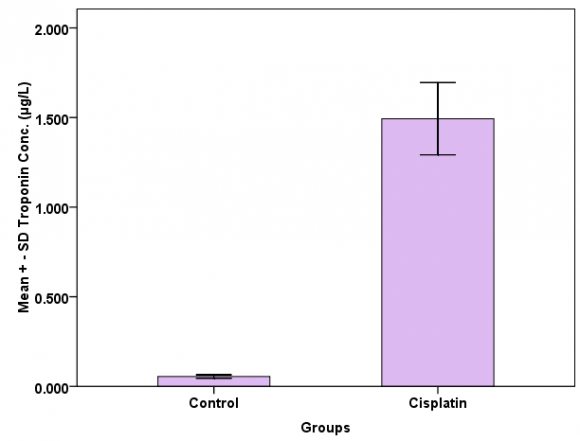
The administration of cisplatin (10mg/kg, i.p. in 4 divided doses) significantly (p<0.001) increased serum troponin concentration of treated rats (1.49µg/l ± 0.1) when compared with that of the control group (0.05µg/l ± 0.005), figure 1.
c) The effect of amlodipine (5mg/kg, orally) on cisplatin treated (10mg/kg, i.p in 4 divided doses) rats serum troponin concentration
The administration of amlodipine in a dose (5mg/kg, orally) once daily for 2 weeks before and during cisplatin (10mg/kg, i.p.) administration, significantly (p<0.001) reduced serum troponin concentration of treated rats (0.09µg/l ± 0.04) when compared with cisplatin treated groups (1.49µg/l ± 0.1) figure 2.
d) The effect of cisplatin (10mg/kg, i.p. single dose) on rats serum CK-MB concentration
The administration of cisplatin (10mg/kg, i.p., single dose) showed no significant increase in serum CK-MB concentration of treated rats (26.48 The administration of amlodipine in a dose (5mg/kg, orally) once daily for 2weeks before and during cisplatin (10mg/kg, i.p.) administration, significantly (p<0.001) reduced serum CK-MB concentration of cisplatin treated rats (29.06IU/l ± 2.2) when compared with cisplatin treated groups (98.26IU/l ± 5.15) figure 4.
10. IV.
11. Discussion
Renal toxicity of cisplatin was insured by many authors such as (20) (21) . The main mechanism behind this selective organ toxicity is the generation of free radicals such as (¬ O2.-, HO., NO) which in turn damaged the renal tissues. However, cisplatin cardiotoxicity was rarely indicated. In our pilot study, we follow cisplatin induced toxicity as it was introduced by (22) . Our results showed a high mortality rate due to renal toxicity rather than cardio-toxicity as indicated by the normal levels of cardio-selective markers (CK-MB and Troponin) unlike the results of (22) . From the results presented in this study, we can confirm the resistibility of cardiac tissues to the Volume XIII Issue II Version I Year 013 2
12. ( )
Evaluation of the Protective Properties of Amlodipine, on Cisplatin Induced Cardiotoxicity in Male Rats K free radical generating property of cisplatin when administered in a high dose/ single shoot. This cardiac resistibility was not insured when the drug cisplatin administered in a low dose but with more frequency and duration. These results are consistent with studies presented by (22) (23) (10) , although they used a different protocol in the dose, frequency of administration and the duration (10 mg /kg, 7 mg /kg, 7 mg /kg i.p, all in single dose) respectively.
It seems obviously, that the oxidative stress plays an important role in the mediation of cardiotoxicity and this in return would influence the levels of serum cardiac markers. This fact had been proven by many worker such as (22), ( 23), (10) . The proposed mechanism of induced cardiotoxicity of cisplatin could be explained as in the following: During the physiological process, the mitochondrial respiratory chain continuously generates ROS. Approximately 2% of the electrons which flow along the respiratory chain escape from the chain and partially reduces molecular oxygen, originating superoxide anion (O2??).
Superoxide anion, the precursor of most of the reactive oxygen species generated in mitochondria as for example hydroxyl radicals HO (24) (25) . An efficient mitochondrial antioxidant defense system maintains the balance between ROS generation and detoxification. Cisplatin unbalances the oxidant-antioxidant ratio by (i) Augmenting ROS generation, mainly hydroxyl radical and (ii) Inhibition of the antioxidant defense system which are SOD, CAT and GSH (26)) 27) . These radicals can evoke extensive tissue damage, reacting with membrane lipids, proteins and nucleic acids. This will lead sequencelly to an increase in leakage of cardiac enzymes such as CK-MB and troponin I, which were released from damaged myocytes and considered as sensitive indicators of cardiac injury (24) (28) . Also, when cisplatin generates reactive oxygen species, it triggers the opening of the mitochondrial permeability transition pore that permits the release of cytochrome c from mitochondria to cytosol and hence it will activate the mitochondrial dependent pathway leading to apoptosis (29) (30) . Additionally, once in a cell, cisplatin is equated into a highly reactive form, which can rapidly react with the thiol-containing molecules namely glutathione. Depletion of glutathione and related antioxidants by cisplatin shifts the cellular redox status, leading to the accumulation of endogenous reactive oxygen species within the cells (31) . The decline in GSH level in cisplatintreated rat resulted in an enhanced lipid peroxidation which is supported by an increment in MDA could be another pathway for the cardiac cells damage (32) .
The results of this study confirm the protective activity of the calcium channel blocker ; amlodipine (5mg/kg, orally) as indicated by the levels of studied serum cardiac biomarkers In fact, the protective effect of amlodipine can be explained according to its antioxidant property which was previously provoked by (33) (34) . Amlodipine antioxidant activity could be related to its endogenous property as a dihydropyridine compound (physicochemical properties) which has a reductant nature or hydrogen donor properties, respectively -The ability of donating protons and electrons to the lipid peroxide molecules, thereby blocking the peroxidation process (33) . Also, the antioxidant activity of amlodipine was attributed to both of its high lipophilicity and a chemical structure that facilitates proton-donating and resonance-stabilization mechanisms that turn off the free radical reaction (34) .
V.
13. Conclusion

| 1. Low doses of cisplatin with more frequency and | |
| duration can induce cardiotoxicity rather than high | |
| dose/single shoot. | |
| 2. Oxidative stress has a role in cisplatin induced | |
| cardiotoxicity. | |
| 3. The protective effect of amlodipine is evident by the | |
| significant reduction in serum troponin, CK-MB. | |
| 013 | 013 |
| 2 | 2 |
| Year | Year |
| Volume XIII Issue II Version I | Volume XIII Issue II Version I |
| ( ) | ( D D D D ) K |
| Vermorken, J.B. (1999); Randomized study of a | |
| short course of weekly cisplatin with or without | |
| amifostine in advanced head and neck cancer. Ann. | |
| Oncol.10 (6): 693-700. | |
| 7. Loehrer, P. J., Gonin, R., Nichols, C. R., Weathers, | |
| T. and Einhorn, L. H. (1998); Vinblastine plus | |
| ifosphamide plus cisplatin as initial salvage therapy | |
| in recurrent germ cell tumor. J. Clin. Oncol.: 16(7): | |
| 2500-2504. | |
| © 2013 Global Journals Inc. (US) |