1. Introduction
apsicum (Capsicum annum L.) popularly known as 'Shimla Mirch'is among the world's most popular vegetables belonging to family Solanaceaeafter potato and tomato. Peppers are extensively cultivated throughout tropical Asia and equatorial America for their edible fruits. It is widely distributed throughout the tropical and subtropical areas of the world particularly Malaysia, India, Pakistan, Thailand, Indonesia, Philippines, tropical Africa, North Africa, South America as major capsicum producing countries (Tindal, 1983).
In world, capsicum (including hot peppers) is grown in an area of 17, 03,486 hectare with a production of 2,60,56,900 tonnes and productivity of 15.03t/ha. China is the largest capsicum producing country (1,40,33,000 tonnes) in the world followed by Mexico (16, 90,000 tonnes) (FAO, 2009). In India Bellpepper is grown over an area of 5,761 hectare with the production of 53,198 tonnes and productivity of 9.23 t/ha (FAO, 2009). The major bell pepper growing areas of India includes Himachal Pradesh, Jammu and Kashmir, Arunachal Pradesh and Hills of U P and Darjeeling district of West Bengal during summer months and as autumn crop in Maharashtra, Karnataka, Tamil Nadu and Bihar (Singh et al., 1993). In Himachal Pradesh, capsicum covers an area of 2,503 ha with a production of 33,923 tonnes including hot pepper. The major belts of capsicum cultivation in HP include districts of Solan, Kullu, Shimla, Mandi, Sirmour, Chamba and Kangra (Anonymous, 2009).
Bell pepper occupies an important place among the commercial vegetable crops of Himachal Pradesh. It ranks third after pea and tomato as far as remuneration is concerned, since it is exported to the plains during June to September. But several abiotic and biotic stresses affect the productivity of capsicum crop' worldwide. Among biotic factors besides fungal, bacterial and nematodes, viral diseases attract considerable attention because they impose significant production constraints affecting both yield and quality and are difficult to control (Nono-womdim, 2001). Viruses have become the most devastating diseasecausing agents of capsicum, causing serious losses, thus putting the farmer to the great loss every year (Kang et al, 1973;Lockhart and Fischer, 1974). The major viruses infecting capsicum are Cucumber mosaic virus (CMV), Pepper mottle virus (PeMV), Potato virus Y (PVY), Tobacco mosaic virus (TMV) Alfalfa mosaic virus (AMV) and Tomato spotted wilt virus (TSWV). Among them Tomato spotted wilt virus is one of the most important virus worldwide.
2. II.
3. Materials and Methods
An extensive survey of different bell pepper (Capsicum annuum L.) growing localities in Solan district of Himachal Pradesh was conducted during 2009-2010 cropping seasons to determine the distribution and incidence of virus diseases in the state.Incidence counts were made mostly at flowering to fruiting stage of the crop on at least 100 plants by choosing 4-5 locations in the field at random and observations on the number of healthy and diseased plants were recorded.
The per cent disease incidence was calculated by using following formula:
Per cent disease Incidence = Number of diseased plants Total number of plants observed × 100The isolates collected from different bell pepper growing localities of Solan district on the basis of symptoms were maintained on their natural hosts under insect proof glasshouse conditions. Young symptomatic leaves form infected bell pepper plants of each location were used for preparing the inoculum of respective isolates. Commercially available immunoreagents [Tospovirus (serogroup I, II, III), BIOREBA-AG Switzerland] by following protocols of suppliers of ELISA Kits with little modification, if any, were followed for the detection of the virus isolates.
The isolateswere mechanically transmitted to different plant species belonging to families Amaranthaceae, Asteraceae, Chenopodiaceae, Cucurbitaceae, Compositae, Malvaceae and Solanaceae. Both localized and systemic infections were observed. These plants species could serve as potential reservoirs of virus under natural conditions.The isolates infecting bell pepper ware easily transmissible to Nicotianadeneyii, N. tabaccumvar White Burley and N. tabaccumvar Samsun hosts and have been found to be good diagnostic hosts because of the production of distinct localized and systemic symptoms.
Healthy test plants of the same age and uniform size were raised by sowing seeds for mechanical transmission studies. Test plants of bell pepper and other indicator plants were inoculated at 4-5 leaf stage by leaf rub method. The standard extract was applied by rubbing the sap with fore finger or by cotton swab method. Inoculated leaves were washed thoroughly with distilled water immediately after inoculation to eliminate the excess of inoculum and abrasive form leaf surface. During the mechanical transmission test, every possible care was taken to avoid lethal injury to leaves by abrasive or through hand pressure.
For the aphid transmission tests, virus free colonics of aphid species viz., MyzuspersiceaSulz., Aphis craccivoraKoch., A. fabae and Brevicorynebrassicae Linn. Most commonly encountered in and around bell pepper fields were examined for their possibility to act as vectors. Few adults of these species were collected from their healthy host plants and maintained on Capsicum annuumL. and Nicotianatobacumvar. White Burley in isolation chambers of 3'x3'x3' size covered with nylon net of 80 mesh.
Apterous form of each aphid species were removed from their colonies with gentle tapping and by moist camel hair brush in separate Petri dishes. These were then given one hour pre acquisition access. Sections of leaf tissue infested with 6-10 aphids were placed on the leaf of the test plants. For each isolate, ten plants were inoculated and kept in separate insect proof cage. After 24 hours of inoculation access, the plants were sprayed with 0.1 per cent Malathion to kill theaphids. These plants were observed for 3-4 weeks for symptoms development under glasshouse conditions.
To check the possibility of seed borne nature of isolates, one hundred seeds of variety Capsicum annuum var. California Wonder from fruits of infected plants were collected during 2009. These seeds were sown during the growing season of 2010 in pots having sterilized potting mixture. The plants thus germinated were allowed to grow under insect proof conditions and were observed for symptom expression up to 40 days. Plants raised form seeds collected form healthy plants were kept as control.
4. III.
5. Results and Discussion
6. a) Survey and Incidence
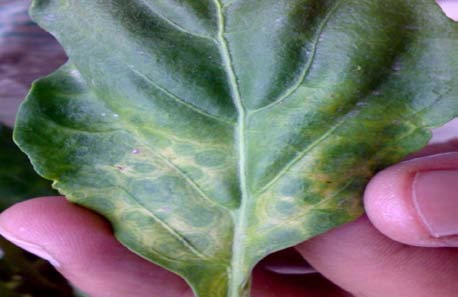
Surveys were conducted to determine the occurrence and distribution of tospovirus affecting bell pepper in Solan district of Himachal Pradesh during 2009 and 2010. Typical symptoms were observed on bell pepper. The symptoms included stunting of plants, rossetting of leaves and formation of ringspots (Plate I). Leaves developed concentric rings of different sizes were observed. The bell pepper fruits produced on infected plants were misshapen and developed irregularly shaped brown spots.
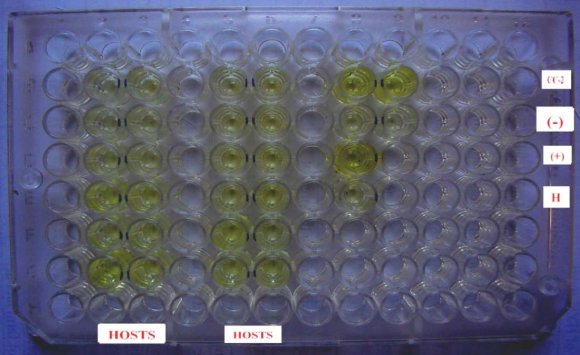
During surveys, incidence of ringspot disease was recorded at different vegetable growing areas of Solan district (Table 1). The data presented in table indicates that during year 2009, bell pepper crop was more affected especially in Kandaghat, Kumarhatti, Naganji and Pandah. Though ringspotting symptoms repoted form Pandah, Naganji farm, Kandaghat during year 2010, the incidence of the disease was relatively low than the year 2009. DAS-ELISA tests conducted on both the isolates revealed that the isolates reacted positively and strongly with the antiserum against tospovirus (sero group I, II, III). Since isolate CC-2 had higher O.D. value of 1.012 at A405nm, this isolate was used for further studies (Table 3). On the basis of nucleocapsid (N) protein serology, tospoviruses have been classified into TSWV and WSMV serogroupsand a group containing serologically unrelated viruses (Moyer, 2000). Similar observations were also recorded under present investigations wherein direct DAS and indirect DAC-ELISA were both found to be highly efficient for the detection of the isolates infecting bell pepper. The first manifestation of the disease on the inoculated plants was observed after 14-21 days of inoculation. Symptoms of tospovirus vary depending largely upon the age of the plant at the time of infection. Initially, infected plants showed vein clearing, curling, necrotic spots and rings on the leaves. The plants were small and stunted as compared to the healthy plants. In bell pepper, chlorotic and necrotic lesions, vein chlorosis and rugosity followed by leaf chlorosis, severe growth reduction and stem necrosis were the most striking symptoms observed (Plate I). Fruits produced on infected bell pepper plants were misshapen with nail head symptoms (Plate I). Tomato plants showed bronzing, curling, necrotic streaks and spots on the leaves. The ripe fruit shows pale red or yellow areas on the skin often appearing as ringspots of alternate colors. Symptoms resulting from mechanical inoculation were similar to those observed on naturally infected plants (Plate I).Tospovirus infections are generally characterized by a variety of symptoms like necrotic and chlorotic lesions, stunting, systemic necrosis, systemic wilt, spots, mottling, leaf distortion, vein yellowing and ringspot (Peters and Goldbach, 1995;Moyer, 2000). Under the present investigations bell pepper plants showed also similar type of symptoms (plant stunting, rosetted leaves, ringspots, and misshaped fruits with browning and nail head symptoms) during surveys conducted at different localities of Solan district of Himachal Pradesh.
7. Transmission Through Sap
The standard extract of the plant virus prepared form infected leaves of bell pepper showing prominent symptoms were inoculated on healthy test plants. The inoculated plants were kept under observations for six weeks for the development of symptoms. The results of the mechanical sap inoculation experiment revealed that the isolate was easily sap transmissible with incubationperiod of 18 to 20 days. Using mechanical inoculation, plant species representing seven families were virus infected. Infected plants showed chlorotic and/or necrotic spots and rings on inoculated leaves, followed by systemic veinal mottle or necrosis. The virus infected systemically many solanaceous species, including D. stramonium, N. rustica, N. glutinosa, Chenopdium album and N. tabacum var. Samsun. These species reacted with local lesions or rings on inoculated leaves followed by mosaic or systemic necrosis (Plate II).
8. Plate II : Symptoms on Leaves of Different Hosts under Glasshouse Condition ii. Transmission Through Insect Vectors
In order to test the transmission of tospovirus by Aphids vectors, namely four aphid species Myzusp-ersicaeSulz, A. craccivoraKoch, A. fabaeand Brevicoryne brassicae Linnwere tested. The results of the experiment have been presented in the table 4 and it is evident from the table that none of the aphid species tested transmitted the virus isolate form infected plants to healthy plants.It is well documented that the tospoviruses are easily transmissible by mechanical sap inoculation and there are no reports that support the transmission of tospoviruses through aphid vectors and seeds (Pappuet al., 1999a).
9. Table 4 : Transmission of virus isolate by aphids
10. Aphids Reaction
11. MyzuspersicaeSulz. (-)
A. craccivora Koch. (-)
A. fabae (-) Brevicorynebrassicae Linn. (-) (-) = No reaction IV.12. Conclusion
During an extensive survey of Solan district, the incidence and distribution of ringspot disease was recorded. Incidence of ringspot disease on bell pepper ranged between 20 to 90 %. Suspected tospovirus infected bell pepper samples from Solan district, showed positive reaction with tospovirus (serogroup I, II, III) antisera in direct antigen-coated enzyme-linked immunosorbent assay. On the basis of serology, the virus isolate under study has been found to be a tospovirusas the antigen reacted positively with tospovirusantiserum (serogroup I, II, III) in DAS-ELISA.
The virus was found to be transmissible through sap but not through aphid vectors and seeds of bell pepper. Bell pepper tospovirusisolatewas mechanically transmitted to different plant species belonging to families Amaranthaceae, Asteraceae, Chenopodiaceae, Cucurbitaceae, Compositae, Malvaceae and Solanaceae. Both localized and systemic infections were observed. These plants species could serve as potential reservoirs of virus under natural conditions. Tospovirus isolate infecting bell pepper was easily transmissible to Nicotianadeneyii, N. tabaccumvar White Burley and N. tabaccumvar Samsun hosts and have been found to be good diagnostic hosts because of the production of distinct localized and systemic symptoms.
13. Global Journals Inc. (US) Guidelines Handbook 2013
www.GlobalJournals.org

| optical density (O.D) i.e. absorbance value at 405 nm is | ||
| presented in | ||
| Per cent disease | ||
| SOLAN | incidence (%) | |
| 2009 | 2010 | |
| Rangah | 60 | 20 |
| Kalaghat | 40 | 20 |
| Kandaghat | 90 | 40 |
| Kumarhatti | 50 | 20 |
| Naganji Farm (UHF, campus) | 80 | 40 |
| Pandah | 90 | 40 |
| b) Collection, Maintenance and Immunoassay of Virus | ||
| Isolates | ||
| Present investigations were based on the | ||
| ringspot disease in bell pepper. Infected bell pepper | ||
| samples were collected form Naganji Farm (UHF, | ||
| Nauni) and Pandah designated as isolates CC-1 and | ||
| CC-2, respectively (Plate I). The association of | ||
| tospovirus with infected bell pepper plants was | ||
| confirmed by biological and immuno-assays. After | ||
| confirmation, the virus isolates were maintained under | ||
| glass house conditions on Nicotiana. The virus isolate | ||
| collected form Pandah was selected and redesignated | ||
| for further detailed investigations such as symptom- | ||
| matology, transmission, and serology.These results go | ||
| in line with the findings of Verhoevenet al (1995) who | ||
| have also reported Nicotiana sp. to be the best indicator | ||
| for the maintainance of Tospovirus. | ||
| Out of the three polyclonal antisera viz. Pepper | ||
| veinal mottle virus, Cucumber mosaic virus, Tospovirus | ||
| (serogroup I, II, III) directed against nucleocapsid (N) | ||
| protein of different viruses, only tospovirus antisera | ||
| showedpositive reaction with bell pepperisolate in direct | ||
| antigen coated (DAC) form of ELISA. The data on | ||
| Table 2 : Serological reaction of bell pepper virusisolate | |||
| (pandah isolate) with different antisera in direct antigen- | |||
| coated enzyme-linked immuno-sorbent assay | |||
| (DAC-ELISA) | |||
| Antiserum | Reaction | Absorption | |
| values at 405 nm | |||
| CC-1 | CC-2 | ||
| Tospovirusserogroup | ++ | 0.753 | 0.943 |
| I,II,III | |||
| Pepper veinal mottle virus | - | 0.019 | 0.141 |
| Cucumber mosaic virus | - | 0.026 | 0.207 |
| Positive control | +++ | 1.021 | |
| Negative control | - | 0.114 | |
| (-) = No reaction; (++) = Strong positive | |||
| reaction; (+++) = Very strong positive reaction | |||
| Isolate | Host | Place of Collection Mean O.D value (A405nm ) | ||
| / serological reaction | ||||
| CC-1 | Bell pepper (C.annuum L.) | Naganji farm | 0.945 | (++) |
| CC-2 | Bell pepper (C.annuum L.) | Pandah | 1.012 | (+++) |
| Positive controle | - | - | 2.012 | (+++) |
| Negative Controle | - | - | 0.315 | (-) |