1. Introduction
he aim of surgical treatment of anal fistulas is to cure the disease by preventing recurrence while ensuring that faecal continence is maintained. Normally, a 'lay-open' fistulotomy or fistulectomy technique is used for inter-sphincteric or low transsphincteric fistulas, but high trans-sphincteric or suprasphincteric fistulas would require division of a large portion of the external sphincter, thereby increasing the chance of faecal incontinence. Many procedures have been described. Current management remains dependent on surgeon preference between options like fistulotomy, fistulectomy, loose or cutting Seton insertion, advancement flaps, fibrin glue or anal plugs with variable results.
The use of Seton in the treatment of anal fistulas has been ongoing for centuries. One of the earliest papers written by Hippocrates in 400 BC described fistulotomy as well as the use of a cutting Seton made of horse hair wrapped with lint threads 1 .
The Seton works by several mechanisms. Firstly, it helps to identify and mark the fistulous tract. Secondly, it promotes fibrosis in the surrounding tissue. Thirdly, it encourages drainage and prevents formation of new abscesses. And finally it decreases the risk of incontinence as scarring prevents retraction of the sphincter.
Seton can be used for long term palliation to avoid septic and painful exacerbations by establishing effective drainage; most often in patients with Crohn's disease 2 or it can be used as part of a staged fistulectomy before use of advanced techniques (fistulectomy, advancement flap). Such strategy protects against the consequences of cutting the sphincter. The goal of this study is to report our experience in treating anal fistulas using the preliminary Seton technique before fistulectomy and compare the safety and efficacy of reduction of incontinence and recurrence in this method as compared to other methods in the literature.
2. II.
3. Method
Data collected from the records of 56 patients who underwent preliminary Seton placement followed 2-4 months later by fistulectomy and sphincter repair during the period of March 2011 -March 2013. Fistulae were characterized using Parks' classification. Perianal fistulas were defined as complex if they had multiple external openings, high fistulas if the internal opening which was at the level of the dentate line and low fistulas if the internal opening was below the dentate line. Patients with concomitant anal pathology and patients with inflammatory bowel disease were excluded from the study.
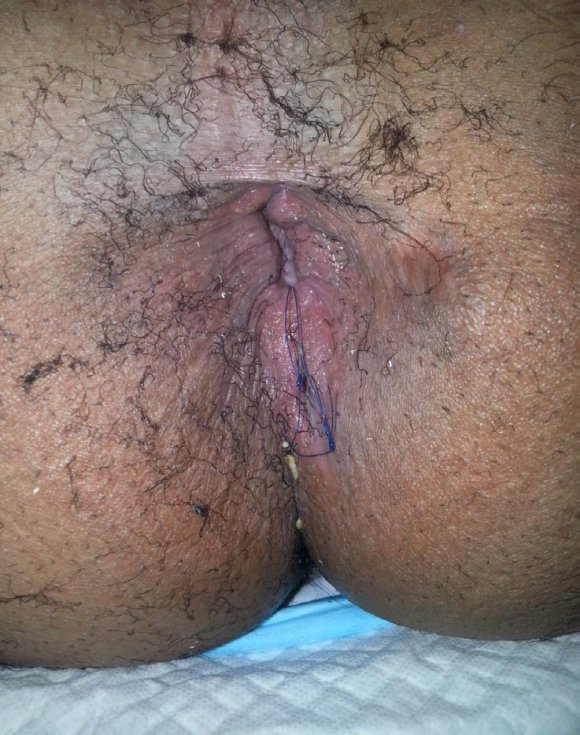
The entire procedure was performed under general anaesthesia with the patient in the lithotomy position. After initial evaluation, the external and internal openings were located using a probe and air injection along the track. A loose Seton using 2 braided, nonabsorbable sutures (4/0 prolene) was looped around the fistula tract, (Figure 1). It was not tightened at any time during the follow-up and was not removed. During a follow-up period of 12-36 months details of healing (i.e. no signs of discharge), recurrence, and complications were gathered. Patients were followed up at the clinic after 1 week, 3 months and after 1 year. Continence was evaluated according to Cleveland Clinic score 3 . The excised fistulas were sent for histopathology to rule out inflammatory bowel disease or cancer.
The data were analyzed using IBM SPSS STATISTICS BASE 21.
4. III.
5. Results
After obtaining the ethical committee approval, the record of 56 patients with transsphincteric and complex anal fistula who were managed with preliminary loose Seton followed by fistulectomy and sphincteroplasty were reviewed.Fifty-four (96.4%) of the patients were men and Two (3.6%) were women. The overall mean age was 39.5 (range 25-61).The types of fistulas are depicted in Table 1. Twenty-nine (52%) of the patients gave history of previous surgery, 25(45%) had incision & drainage of perianal abscesses and four (7%) had previous fistula surgery. The entire procedure was done under general anaesthesia. Preliminary Seton insertion was done as a day case surgery. The Seton was kept in situ for a period of 2-5 months (average 2.6M). The second procedure was fistulectomy and sphincter repair for which49 (88%) were done as a day case surgeries.
The mean follow up was 20.5 months (12-36 months). Six (10.7%) patients experienced postoperative pain which required analgesia while three (5.3%) developed bleeding; requiring surgery in one patient and only pressure dressing in the other two. The complete wound healing time (i.e. no more need for wound dressing) was between 2-8 weeks (mean 3.7 weeks).
While two patients (3.6%) reported a transient incontinence of gas in the immediate postoperative period (score 3 and 4, respectively according to the Cleveland Incontinence Score), which lasted for 3 months there was no incontinence in any of the patients in the longer follow up. The fistulas were completely cured in 54(96.4%) of patients. Recurrence occurred in two patients (3.6%); one was re-operated again for which the same procedure was repeated again -loose Seton for 4 months followed by fistulectomy and sphincter repair-and during the follow up he didn't show any signs of recurrence while the other patient did not attend the follow up; he was contacted by phone and reported that he had been re-operated on in another hospital but six months later he had recurrence.
IV.
6. Discussion
Surgical treatment of fistula-in-ano is associated with the risk of incontinence and recurrence. Several operative techniques were established to reduce these complications but till today none has been shown to be 100% successful. Post-operative anal incontinence after fistulotomy has been reported to be 20.3% 4 . Arroyo A et al 5 , who combined fistulotomy with sphincter reconstruction concluded that continence were improved in incontinent patients and were not jeopardized in continent ones. The patients who reported postoperative incontinence in his study were 16.6%. Several risk factors are associated with the postoperative incontinence, including recurrent or complex fistulas, multiple previous drainages 6 , and type of operative procedure 7 .
In a prospective audit,Sileri P et al 8 demonstrated that a high number of complex anal fistulae has been treated by seton placement and a good outcome was achieved in the majority of patients. The selection of Seton type and technique depends on surgeon preference. Gokulakkrishna Subhaset al 9 d escribed all the available variations in materials and techniques for seton treatment.
The use of loose Seton alone in the treatment of complex anal fistulas has been reported in several studies with variable results. Some patients were cured by this technique but the success rate tumbled over time. This approach avoids the risk of incontinence complications that may arise due to division of the external sphincter but many patients develop further sepsis that usually requires surgery 10 .
The use of Seton drainage before definitive surgery has been used in an attempt to decrease the risk of incontinence and recurrence. Several reports have found Seton to be safe, with low incidence of recurrence and incontinence. Different surgeons use the Seton in different ways. Russell K et al 11 , performed staged fistulotomy using a Seton. They applied the Seton around the distal half of the intact external sphincter after dividing the cephaled portion of the tract; followed 6-8 weeks later by dividing of the remaining external sphincter, and a recurrence rate of 3% was noted. Kennedy and Zegarra 12 did the same first stage fistulotomy and Seton placement but in the second stage the Seton was removed rather than performing the second stage division of muscles. It minimized the risk of incontinence and primary healing occurred in 78%. Fung AK et al 13 also used the technique of laying open the subcutaneous tract and insertion of loose seton for the part of the tract related to the sphincter complex which was removed after a median length of 7 months Volume XIV Issue V Version I Year ( ) with a recurrence rate of 19%. In the study by Ratto C et al 14 , he used Seton drainage in 40.3% of the patients followed later by fistulotomy and end to end primary sphincteroplasty. There was no significant change in the fecal incontinence score and the fistula recurrence was observed in 3 out of 72 patients (4.3%). Pearl RK et al 15 reported that a staged fistulotomy using a Seton is a safe and effective method of treating high or complicated anorectal fistulas with major incontinence of 5% and a recurrence rate of 3%. An alternative technique for treating complex, high transsphincteric anal fistulas using the Seton was reported in the studies of Subhas G et al 16 and GalisRozen et al 17 . Patients were asked to rotate the Seton daily, one revolution in each direction, pulling the knot through the fistula tract. The progressive migration technique resulted in the gradual healing and eradication of the fistula tract in 75% of patients, with no recurrence (Setons completely worked their way to the surface, or tract migration was extensive enough to allow a safe completion fistulotomy).
Loose Seton is preferable to the cutting Seton; the later procedure yields fairly good results in regards to curing the fistula but it's painful, may result in pressure necrosis of the full thickness of the sphincter muscle resulting in sepsis and increases rate of anal incontinence 18 .
V.
7. Conclusion
Preliminary Seton followed by fistulectomy and immediate sphincter repair has shown to be highly effective in treating transsphincteric and complex fistulas with low recurrence rate (2/56=3.6%) and no risk of subsequent incontinence in the population we studied.

| Type of Fistula | Number | Percent |
| Low transsphincteric | 31 | 55 |
| High transsphincteric | 9 | 16 |
| Complex | 16 | 29 |
| Total | 56 | 100 |