1. I. Introduction
n recent years, more women are getting married and starting a family at an older age. Advanced maternal age (AMA) is defined as age 35 years or more for the mother. This group has been observed to have a high risk of chromosomal abnormalities in their embryos during pregnancy because the quality of oocytes correlate with maternal age and corresponding reproductive clinical outcomes (1). In 2013, Harton et al. reported that higher maternal age appears to be associated with increased risk of aneuploidy in embryos :<35 yrs (53.1%), 35-37 yrs (68.2%), 38-40 yrs (73.7%), 41-42 yrs (85.8%), >42 yrs (92.6%) from 451 blastomeres and <35 yrs (31.7%), 35-37 yrs (44.2%), 38-40 yrs (43.1%), 41-42 yrs (76.3%), >42 yrs (84.8%) from 462 blastocysts (2). Moreover, Menken et al. reported on the effects of maternal age on fertility with a decrease in birth rates when maternal age is >/= 35 yrs(3). For this reason, assisted reproductive technology (ART) and preimplantation genetic screening (PGS)can be help to infertile couples and patients at high risk of there being chromosome abnormalities in the embryo. PGS is the technology used for screening chromosome abnormalities to selectively transfer euploid embryos in IVF. Patients using PGS have a higher implantation rate and pregnancy rate compared to those using morphological assessment of embryos alone (4-10). However, Schoolcraft et al. and Forman et al. reported that PGS improved implantation rates but did not improve pregnancy rates (8, 9).
The European Society of Human Reproduction and Embryology (ESHRE) Preimplantation Genetic Diagnosis (PGD) consortium data collection XIIshowed cumulative data from 1999 to 2010 and found that the greatest indication of infertility in couples using PGS was AMA (32%)and the most commonly used method of biopsy was cleavage stage (blastomere) aspiration (82%) (11).The advantage of blastomere biopsy was that chromosome abnormality screening can be performed within 2 days for fresh embryo transfer in the blastocyst stage (12).The main problem with blastomere biopsy was chromosome mosaicism. This is the phenomenon in which two or more kinds of genetically different cell populations are present within the same embryo. The mosaicism rate of blastomeres tends to vary from 18% to 57% (13,14). The biopsy of two cells from a blastomere may give increased accuracy but the biopsy of a single cell was associated with superior clinical outcome when compared with the two cell biopsy (15,16). Therefore, the biopsy of a single cell was recommended by ESHRE (17). Blastocyst biopsy is another approach where 5-10 cells of trophectoderm (TE) cells are biopsied with more reliable and accurate results leading to improved clinical outcomes (18)(19)(20)(21). Mosaicism is not major problem for blastocyst stage PGS because of the low incidence (20% to 33%) of mosaicism in the blastocyst stage (22)(23)(24). A previous study reported that the consistency between inner cell mass (ICM) and TE was 97% to 100% (19,25). The disadvantage of blastocyst biopsy was the necessity for a short turnaround time in chromosome screening, thus leading to frozen embryo transfer. Even previous study reported that the clinical pregnancy rate of frozen blastocyst transfer was significantly higher than that of fresh blastomere transfer (26).
The method that was previously the gold standard for PGS was fluorescent in situ hybridization (FISH) utilizing a probe set of at least 8 chromosomes for aneuploidy screening as recommended by ESHRE (27,28). PGS with FISH analysis did not afford improved clinical outcome in blastomere and TE biopsy (20,(29)(30)(31)(32)(33)(34)(35)(36)(37). Several factors could have caused the failure of FISH in improving the clinical outcome such as mosaicism, technical limitations and chromosome examination resulting in misdiagnosis (38).
The new technology of high throughput array comparative genomic hybridization (aCGH) is a technique that provides a comprehensive chromosome analysis of the embryo. When compared with FISH, aCGH provides a significantly higher interpretable result (96%) than does FISH (83%) (39). It displays the ability to detect 42% more chromosome errors and 13% more abnormal embryos compared with FISH using probes for 12 chromosomes (40).The reasons for the discordance in the results between FISH and aCGH are technical artifact and mosaicism (40). Mir et al. reported the false positive rate on blastomere aCGH to be 2.4 % and the false negative rate could not be detected (41). The error rate of aCGH ranged from 1.9% to 9% depending on the method of whole genome amplification used (40). The purpose of the present study was to investigate the prevalence of chromosome abnormalities of embryos of Asian populations using aCGH techniques.
2. II. Materials and Methods
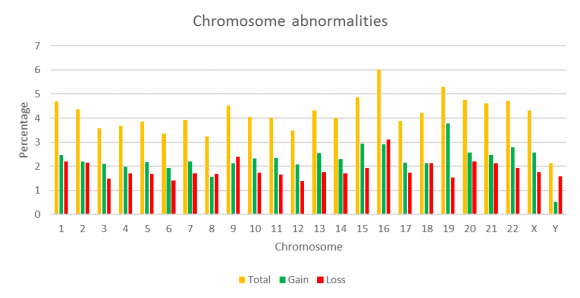
This retrospective study was collected data from April 2014 to April 2015. Infertile couples undergoing IVF/ICSI were included into this study however those with known genetic disease were excluded. All cases were approved by the Ethics Committee of Ramathibodi Hospital, Faculty of Medicine, Mahidol University, Thailand. A total of 2,066 embryos from 281 patients were collected and tested using aCGH. All embryos biopsied were either blastomere or trophectoderm. Biopsied cells were load into a 0.2ml sterile microtube. The DNA was generated by whole genome amplification to microgram quantity DNA using half volume SurePlex DNA amplification kits according to the manufacturer's instructions (Illumina, San Diego, CA, USA) and the Sukprasert et al. study (42). Amplified DNA was verified by gel electrophoresis. DNA was labeled and hybridized according to the BlueGnome 24 sure protocol (available at www. cytochip.com). Chromosome copy number variation was analyzed by BlueFuse Multi software (Illumina, San Diego, CA, USA). The efficiency of the whole genome amplification was evaluated by gel electrophoresis. A successful amplification of 96.85 % (2001/2066 embryos) at least 90% for each marker is recommended by ESHRE (43). In addition, PGS with aCGH for screening chromosome aneuploidy in embryos showed the euploidy rate for all embryos was 42.23%. TE had a higher euploidy rate than blastomere especially in the young patient group (70.53%). In the blastomere group, the percentage of abnormal embryos was higher than the percentage of normal embryos for both the good and poor prognosis as shown in Figure 1. Complex chromosome abnormalities (more than one chromosome abnormality) were demonstrated to be the most common abnormalities of this study (66.44%) while monosomy and trisomy were minor (18.16% and 15.40%) as shown in Figure 2, similar to that reported in the Qi et al. study (44). The chromosomes least involved in aneuploidy were chromosomes Y, 8, 6, 12, and 3. We found that the types of aneuploidy in chromosomes were more gains than losses. The chromosomes most involved in aneuploidy were chromosomes 16, 19, 15, 20, and 22 (gain: chromosome 19, 15, 16, 22, and X; loss: chromosome 16, 9, 1, 2, and 20, respectively) as shown in Figure 3.
3. III. Results
4. A
The data was calculated using SPSS software to compare the results among the four groups. A value of P < 0.05 was considered statistically significant. IV.
5. Discussion
A meta-analysis of PGS demonstrated improving clinical outcomes because comprehensive chromosome screening with advanced technologies was used. The high thoughput technology requires sufficient amount of DNA but the starting material from embryo biopsy has limited DNA quantity. Whole genome amplification technology solves this problem by amplifying DNA into microgram quantity yields, however the ability to amplify sufficient good quality DNA from a few cells depends highly on following the guideline protocol (43). Amplification failure causing the amplified DNA not sufficient for use in high throughput method may occur due to factors such as human error when loading cells into the microtubes or quality of cells being biopsied from the embryos.
The present study reports the primary outcome in chromosome abnormality of embryos and shows that the euploidy rate of blastocyst was high (62.99%), and correlates with other studies in which the euploidy rate ranged from 42% to 83% (22)(23)(24). We found that patients with AMA had high aneuploidy rates in both the blastomeres and trophectoderm because maternal age affects chromosome segregation during the development of oocyte, as shown in previous studies (45)(46)(47)(48).
Moreover, we found that the aneuploidy rate of blastomeres was 60.79%, in concordance with previous studies showing aneuploidy rates of 38% to 64% (39,40,49). In addition, the aneuploidy rate of blastocysts was 37.01% in concordance with ability of other techniques such as SNP microarray to detect aneuploidy rates of 15% to 52% (22)(23)(24). This study demonstrated a high incidence of chromosome aneuploidy in chromosomes 15, 16, 19, and 22, as did Dekel-Naftali et al. and Alfarawati et al. (50,51) but chromosome 20 was excluded.
The limitation of aCGH is that it detects copy number changes rather than polyploidy and haploid embryos. Gutierrez-Mateo reported 7.5% (6,898/92,018) of embryos were polyploid or haploid by FISH analysis. Most of these embryos had other abnormalities detectable by aCGH. Only 1.7% of embryos were polyploid or haploid undetectable by aCGH. Approximately 0.2% of embryos had homogeneous polyploidy or haploidy with good morphology demonstrated. Therefore, we estimated that the misdiagnosis rate due to non-detection of polyploidy is below 0.2 % (40).
This study is the first report of aneuploidy screening using aCGH in Thai patients. We investigated the primary outcome in a large sample size to study the incidence of chromosome abnormalities in embryos and found that the percentage of chromosomal abnormalities equal to the other studies. The limitation of this retrospective study is that we could not report the final outcome or livebirth rate.
6. V. Acknowledgements
There is no conflict of interest References Références Referencias The blastocysts had lower aneuploidy rates than blastomeres due to self-correction and mosaicism. The self-correction phenomenon is a process in the differentiating embryo for eliminating mosaicism by bringing about death and/or a decrease in abnormal cells (52). Barbash

| total of 2,066 embryos from 281 patients were |
| classified according to embryo stage and maternal age |
| into four groups: group 1 were blastomeres from |
| maternal age < 35yrs; group 2 were blastomeres from |
| maternal age > 35yrs; group 3 were blastocysts from |
| maternal age < 35yrs; and group 4 were blastocysts |
| from maternal age > 35yrs ( |
| Year 2015 | ||||
| 12 | ||||
| Volume XV Issue III Version I | 1. Kimberly L, Case A, Cheung AP, Sierra S, AlAsiri S, Carranza-Mamane B, et al. Advanced reproductive age and fertility: no. 269, November 2011. Int J Gynaecol Obstet. 2012 Apr;117(1):95-102. 2. Harton GL, Munné S, Surrey M, Grifo J, Kaplan B, McCulloh DH, et al. Diminished effect of maternal age on implantation after preimplantation genetic diagnosis with array comparative genomic hybridization. Fertil. Steril. 2013 Dec;100(6):1695-703. 3. Menken J, Trussell J, Larsen U. Age and infertility. Science. 1986 Sep 26;233(4771):1389-94. 4. Forman EJ, Hong KH, Ferry KM, Tao X, Taylor D, | |||
| Levy B, et al. In vitro fertilization with single euploid | ||||
| blastocyst transfer: a randomized controlled trial. | ||||
| Global Journal of Medical Research | Fertil. Steril. 2013 Jul;100(1):100-107.e1. 5. Scott RT, Upham KM, Forman EJ, Hong KH, Scott KL, Taylor D, et al. Blastocyst biopsy with comprehensive chromosome screening and fresh embryo transfer significantly increases in vitro fertilization implantation and delivery rates: a randomized controlled trial. Fertil. Steril. 2013 Sep; 100(3):697-703. 6. Yang Z, Liu J, Collins GS, Salem SA, Liu X, Lyle SS, et al. Selection of single blastocysts for fresh transfer via standard morphology assessment alone and with array CGH for good prognosis IVF patients: results from a randomized pilot study. Mol Cytogenet. 2012;5(1):24. | |||
| 7. Sher G, Keskintepe L, Keskintepe M, Maassarani G, | ||||
| Tortoriello D, Brody S. Genetic analysis of human | ||||
| embryos by metaphase comparative genomic | ||||
| hybridization (mCGH) improves efficiency of IVF by | ||||
| increasing embryo implantation rate and reducing | ||||
| multiple | pregnancies | and | spontaneous | |
| miscarriages. Fertil. Steril. 2009 Dec;92(6):1886-94. | ||||
| 8. Schoolcraft WB, Fragouli E, Stevens J, Munne S, | ||||
| Katz-Jaffe MG, Wells D. Clinical application of | ||||
| comprehensive chromosomal screening at the | ||||
| Scott | RT. | Single | embryo | transfer | with |
| comprehensive chromosome screening results in | |||||
| improved ongoing pregnancy rates and decreased | |||||
| miscarriage rates. Hum. Reprod. 2012 Apr; 27 (4): | |||||
| 1217-22. | |||||
| 10. Keltz MD, Vega M, Sirota I, Lederman M, Moshier | |||||
| EL, Gonzales E, et al. Preimplantation genetic | |||||
| screening (PGS) with Comparative genomic | |||||
| hybridization (CGH) following day 3 single cell | |||||
| blastomere biopsy markedly improves IVF | |||||
| outcomes while lowering multiple pregnancies and | |||||