
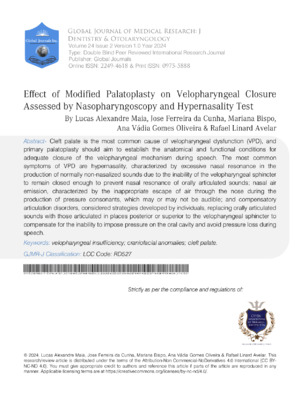
Effect of Modified Palatoplasty on Velopharyngeal Closure Assessed by Nasopharyngoscopy and Hypernasality Test
Keywords:
velopharyngeal insufficiency; craniofacial anomalies; cleft palate
Abstract
Cleft palate is the most common cause of velopharyngeal dysfunction (VPD), and primary palatoplasty should aim to establish the anatomical and functional conditions for adequate closure of the velopharyngeal mechanism during speech. The most common symptoms of VPD are hypernasality, characterized by excessive nasal resonance in the production of normally non-nasalized sounds due to the inability of the velopharyngeal sphincter to remain closed enough to prevent nasal resonance of orally articulated sounds; nasal air emission, characterized by the inappropriate escape of air through the nose during the production of pressure consonants, which may or may not be audible; and compensatory articulation disorders, considered strategies developed by individuals, replacing orally articulated sounds with those articulated in places posterior or superior to the velopharyngeal sphincter to compensate for the inability to impose pressure on the oral cavity and avoid pressure loss during speech.
Downloads
How to Cite
References
Joana Amorim, Gomes De (2014) Estudo Comparativo das técnicas de palatoplastia de Von Langenbeck, Veau-Wardill-kilner e Furlow. 28(2), 36-43.
Adriano Barbosa, De Amorim (2011) Análise videonasoendoscópica do esfíncter velofaríngeo após palatoplastia em portadores de fissuras labiopalatinas.
Janusz Bardach (1995) Two-Flap palatoplasty: Bardach's technique. 2(4), 211-214.
K Bzoch (2004) Introduction to the study of communicative disorders in cleft palate and related craniofacial anomalies. Communicative disorders related to cleft lip and palate. 3-66.
Laurence Chait, Gerald Gavron, Cathy Graham, Errol Noik, Gavin De Aguiar (2002) Modifying the Two-Stage Cleft Palate Surgical Correction. 39(2), 226-232.
Rodger Dalston, Donald Warren, Eileen Dalston (1991) Use of Nasometry as a Diagnostic Tool for Identifying Patients with Velopharyngeal Impairment. 28(2), 184-189.
Rodger Dalston, Donald Warren, Eileen Dalston (1997) Use of Nasometry as a Diagnostic Tool for Identifying Patients with Velopharyngeal Impairment. 28(2), 184-189.
Ashley Dao, Steven Goudy (2016) Cleft Palate Repair, Gingivoperiosteoplasty, and Alveolar Bone Grafting. 24(4), 467-476.
José Freitas, Daniela Garib, Marchini Oliveira, Rita Lauris, Ana Almeida, Lucimara Neves, Ivy Trindade-Suedam, Renato Yaedú, Simone Soares, João Pinto (2012) Rehabilitative treatment of cleft lip and palate: experience of the Hospital for Rehabilitation of Craniofacial Anomalies - USP (HRAC-USP) - Part 2: Pediatric Dentistry and Orthodontics. 20(2), 268-281.
V Spina (1972) Classificação das fissuras lábio-palatinas. 27(2), 5-6.
Emi Funayama, Yuhei Yamamoto, Noriko Nishizawa, Tadashi Mikoya, Toru Okamoto, Satoko Imai, Naoki Murao, Hiroshi Furukawa, Toshihiko Hayashi, Akihiko Oyama (2014) Important points for primary cleft palate repair for speech derived from speech outcome after three different types of palatoplasty. 78(12), 2127-2131.
J Furlow, T Leonard (1986) Cleft Palate Repair by Double Opposing Z-Plasty. 78(6), 724-736.
Katia Genaro, ; Flores, Renata Yamashita, ; Paciello, Inge Trindade, Kiemle (2004) Avaliação clínica e instrumental na fissura labiopalatina. 456-477.
David Kuehn, Lisa Henne (2003) Speech evaluation and treatment for patients with cleft palate. 175-183.
Fabiane Larangeira, Jeniffer Dutka, Melina Whitaker, Olívia De Souza, José Lauris, Mariana Da Silva, Maria Pegoraro-Krook (2016) Speech nasality and nasometry in cleft lip and palate. 82(3), 326-333.
A Leow, L Lo (2008) Institute of Heartmath Newsletter for Jul-Aug, 2008. 31(4), 335-345.
Katia Menegueti, Ignacio (2011) Comparação dos resultados da fala após as cirurgias de retalho faríngeo e veloplastia intravelar para correção da disfunção velofaríngea. 16, 92-98.
Peter Mossey, Julian Little, Ron Munger, Mike Dixon, William Shaw (2009) Cleft lip and palate. 374(9703), 1773-1785.
José Mélega, Marcos (2002) Cirurgia plástica fundamentos e arte: cirurgia reparadora de cabeça e pescoço. 1063-1063.
Joyce Mcintyre (2016) Number of surgical procedures for patients with cleft lip and palate from birth to 21 years old at a single children's hospital. 76, 205-S208.
Isabella Monlleo, Peter Mossey, Vera Gil-Da-Silva-Lopes (2009) Evaluation of Craniofacial Care outside the Brazilian Reference Network for Craniofacial Treatment. 46(2), 204-211.
Elisa Altmann, Bento De Carvalho (1997) Carapicuíba-SP: Pró-Fono R. Atual. Cient. 4.
Peter Neligan, Geoffrey Gurtner (2015) Cirurgia plástica: Princípios.
A Sadove, ; Michael, John Van Aalst, John Culp, Andrew (2004) Cleft palate repair: art and issues. 31(2), 231-241.
Mahdi Shkoukani, Lauren Lawrence, Daniel Liebertz, Peter Svider (2014) Cleft palate: A clinical review. 102(4), 333-342.
Darren Smith, Joseph Losee (2014) Cleft Palate Repair. 41(2), 189-210.
Etienne Silva, Barbosa (2005) Aleitamento materno em recém nascidos portadores de fissura labiopalatina: dificuldades e métodos utilizados. 7(1), 21-28.
Inge Trindade, Kiemle (2005) Proposta de classificação da função velofaríngea na avaliação perceptivo-auditiva da fala. 17, 259-262.
Renata Yamashita, Tathiane Oliva, Ana Fukushiro, Carolina Brustello, Inge Trindade (2010) Efeito da veloplastia intravelar sobre o fechamento velofaríngeo avaliado por meio da técnica fluxo-pressão. 15(3), 362-368.
Published
2024-10-23
Issue
Section
License
Copyright (c) 2024 Authors and Global Journals Private Limited

This work is licensed under a Creative Commons Attribution 4.0 International License.