
A Basic Drug Formulation Appropriate for Many Psychiatric Diagnoses
Abstract
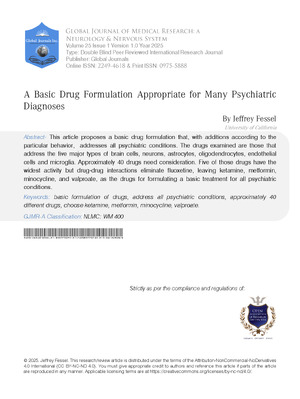
This article proposes a basic drug formulation that, with additions according to the particular behavior, addresses all psychiatric conditions. The drugs examined are those that address the five major types of brain cells, neurons, astrocytes, oligodendrocytes, endothelial cells and microglia. Approximately 40 drugs need consideration. Five of those drugs have the widest activity but drug-drug interactions eliminate fluoxetine, leaving ketamine, metformin, minocycline, and valproate, as the drugs for formulating a basic treatment for all psychiatric conditions.
Downloads
How to Cite
References
Andro Montoya, Daniela Elgueta, Javier Campos, Ornella Chovar, Paulina Falcón, Soledad Matus, Iván Alfaro, María Bono, Rodrigo Pacheco (2019) Dopamine receptor D3 signalling in astrocytes promotes neuroinflammation. 16(1), 258.
R Howland (2006) MAOI Antidepressant Drugs. 44(6), 9-12.
Y.-Q Liang, X.-C Tang (2006) Comparative studies of huperzine A, donepezil, and rivastigmine on brain acetylcholine, dopamine, norepinephrine, and 5hydroxytryptamine levels in freely-moving rats. 27, 1127-1136.
C Nyakas, I Granic, L Halmy, P Banerjee, P Luiten (2011) The basal forebrain cholinergic system in aging and dementia. Rescuing cholinergic neurons from neurotoxic amyloid-β42 with memantine. 221, 594-603.
Paul Whiting, Timothy Bonnert, Ruth Mckernan, Sophie Farrar, Beatrice Bourdelles, Robert Heavens, David Smith, Louise Hewson, Michael Rigby, Dalip Sirinathsinghji, Sally Thompson, Keith Wafford (1999) Molecular and Functional Diversity of the Expanding GABA‐A Receptor Gene Family. 868(1), 645-653.
O Larsson, L Gram, I Schusboe, A Schousboe (1986) Differential effect of gamma-vinyl GABA and valproate on GABA-transaminase from cultured neurones and astrocytes. 25, 617-625.
Yoel Yaari, Michael Selzer, Jonathan Pincus (1986) Phenytoin: Mechanisms of its anticonvulsant action. 20(2), 171-184.
K Sutton, D Martin, R Pinnock, K Lee, R Scott (2002) Gabapentin inhibits high-threshold calcium channel currents in cultured rat dorsal root ganglion neurones. 135, 257-265.
N Garrido-Mesa, A Zarzuelo, J Gálvez (2013) Minocycline: far beyond an antibiotic. 169, 337-352.
P Rolan, M Hutchinson, K Johnson (2009) Ibudilast: a review of its pharmacology, efficacy and safety in respiratory and neurological disease. 10, 2897-2904.
Anna Macpherson, Klaus Dinkel, Robert Sapolsky (2005) Glucocorticoids worsen excitotoxin-induced expression of pro-inflammatory cytokines in hippocampal cultures. 194(2), 376-383.
Jeffrey Rothstein, Sarjubhai Patel, Melissa Regan, Christine Haenggeli, Yanhua Huang, Dwight Bergles, Lin Jin, Margaret Dykes Hoberg, Svetlana Vidensky, Dorothy Chung, Shuy Toan, Lucie Bruijn, Zao-Zhong Su, Pankaj Gupta, Paul Fisher (2005) β-Lactam antibiotics offer neuroprotection by increasing glutamate transporter expression. 433(7021), 73-77.
P Chen, C-C Wang, C Bortner, G-S Peng, X Wu, H Pang, R-B Lu, P-W Gean, D-M Chuang, J-S Hong (2007) Valproic acid and other histone deacetylase inhibitors induce microglial apoptosis and attenuate lipopolysaccharide-induced dopaminergic neurotoxicity. 149(1), 203-212.
Sarah Demaré, Asha Kothari, Nigel Calcutt, Paul Fernyhough (2021) Metformin as a potential therapeutic for neurological disease: mobilizing AMPK to repair the nervous system. 21(1), 45-63.
Alan Hazell, Samantha Faim, Guilherme Wertheimer, Vinicius Silva, Cleiton Marques (2013) The impact of oxidative stress in thiamine deficiency: A multifactorial targeting issue. 62(5), 796-802.
L Hertz, D Rothman, B Li, L Peng (2015) Response: Commentary: Chronic SRI Stimulation of Astrocytic-HT 2B Receptors Change Multiple ene Expressions/Editings and etabolism of Glutamate, Glucose nd Glycogen: A Potential Paradigm Shift. 9.
M Stenovec (2021) Ketamine alters functional plasticity of astroglia: an implication for antidepressant effect. 11, 573.
A Green (2017) Clemastine fumarate as a remyelinating therapy for multiple sclerosis (ReBUILD): a randomised, controlled, double-blind, crossover trial. 390, 2481-2489.
V Deshmukh (2013) A regenerative approach to the treatment of multiple sclerosis. 502, 327-332.
Björn Neumann, Roey Baror, Chao Zhao, Michael Segel, Sabine Dietmann, Khalil Rawji, Sarah Foerster, Crystal Mcclain, Kevin Chalut, Peter Van Wijngaarden, Robin Franklin (2019) Metformin Restores CNS Remyelination Capacity by Rejuvenating Aged Stem Cells. 25(4), 473-485.e8.
Jeffrey Mason, Shouhong Xuan, Ioannis Dragatsis, Argiris Efstratiadis, James Goldman (2003) Insulin-Like Growth Factor (IGF) Signaling through Type 1 IGF Receptor Plays an Important Role in Remyelination. 23(20), 7710-7718.
Armita Gorabi, Nasim Kiaie, Saeideh Hajighasemi, Maciej Banach, Peter Penson, Tannaz Jamialahmadi, Amirhossein Sahebkar (2019) Statin-Induced Nitric Oxide Signaling: Mechanisms and Therapeutic Implications. 8(12), 2051.
Reza Ranjbar, Mojtaba Shafiee, Amirreza Hesari, Gordon Ferns, Faezeh Ghasemi, Amir Avan (2019) The potential therapeutic use of renin-angiotensin system inhibitors in the treatment of inflammatory diseases. 234(3), 2277-2295.
X Ma (2021) Glp-1 receptor agonists (Glp-1ras): Cardiovascular actions and therapeutic potential. 17, 2050-2068.
Xinguo Hou, Jun Song, Xiao-Nan Li, Lin Zhang, Xingli Wang, Li Chen, Ying Shen (2010) Metformin reduces intracellular reactive oxygen species levels by upregulating expression of the antioxidant thioredoxin via the AMPK-FOXO3 pathway. 396(2), 199-205.
Pasquale Mone, Fahimeh Varzideh, Stanislovas Jankauskas, Antonella Pansini, Angela Lombardi, Salvatore Frullone, Gaetano Santulli (2022) SGLT2 Inhibition via Empagliflozin Improves Endothelial Function and Reduces Mitochondrial Oxidative Stress: Insights From Frail Hypertensive and Diabetic Patients. 79(8), 1633-1643.
Yasuhiro Maejima (2020) SGLT2 Inhibitors Play a Salutary Role in Heart Failure via Modulation of the Mitochondrial Function. 6, 186.
H Al-Muzafar, F Alshehri, K Amin (2021) The role of pioglitazone in antioxidant, anti-inflammatory, and insulin sensitivity in a high fat-carbohydrate diet-induced rat model of insulin resistance. 54(8), 10782.
Jorge Farías, Víctor Molina, Rodrigo Carrasco, Andrea Zepeda, Elías Figueroa, Pablo Letelier, Rodrigo Castillo (2017) Antioxidant Therapeutic Strategies for Cardiovascular Conditions Associated with Oxidative Stress. 9(9), 966.
Christopher Henry, Yan Huang, Angela Wynne, Mark Hanke, Justin Himler, Michael Bailey, John Sheridan, Jonathan Godbout (2008) Minocycline attenuates lipopolysaccharide (LPS)-induced neuroinflammation, sickness behavior, and anhedonia. 5(1), 1-14.
Michael Heneka, Magdalena Sastre, Lucia Dumitrescu-Ozimek, Anne Hanke, Ilse Dewachter, Cuno Kuiperi, Kerry O'banion, Thomas Klockgether, Fred Van Leuven, Gary Landreth (2005) Acute treatment with the PPARγ agonist pioglitazone and ibuprofen reduces glial inflammation and Aβ1-42 levels in APPV717I transgenic mice. 128(6), 1442-1453.
Isaias Glezer, Ariel Chernomoretz, Samuel David, Marie-Michèle Plante, Serge Rivest (2007) Genes Involved in the Balance between Neuronal Survival and Death during Inflammation. 2(3), e310.
Shweta Mandrekar-Colucci, Andrew Sauerbeck, Phillip Popovich, Dana Mctigue (2013) PPAR Agonists as Therapeutics for CNS Trauma and Neurological Diseases. 5(5), 20130030.
Bin Xing, Tao Xin, Randy Hunter, Guoying Bing (2008) Pioglitazone inhibition of lipopolysaccharide-induced nitric oxide synthase is associated with altered activity of p38 MAP kinase and PI3K/Akt. 5(1), 4.
D Li (2016) Targeting Pro-Inflammatory Neuronal Death After Intracerebral Hemorrhage Improves Neurological Deficits in Mice. 62, 67-75.
Published
2026-01-03
Issue
Section
License
Copyright (c) 2025 Authors and Global Journals Private Limited

This work is licensed under a Creative Commons Attribution 4.0 International License.