
Immunization Status among Government Urdu Higher Primary Schools of Azad Nagar and its Surrounding Area, Bangalore
Keywords:
Health education, immunization status, school children
Abstract
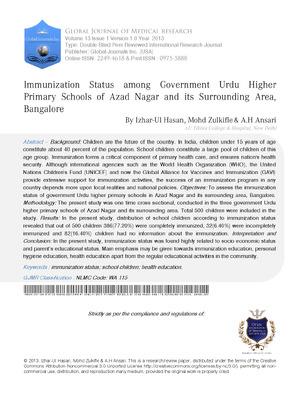
Children are the future of the country. In India, children under 15 years of age constitute about 40 percent of the population. School children constitute a large pool of children of this age group. Immunization forms a critical component of primary health care, and ensures nation's health security. Although international agencies such as the World Health Organization (WHO), the United Nations Children's Fund (UNICEF) and now the Global Alliance for Vaccines and Immunization (GAVI) provide extensive support for immunization activities, the success of an immunization program in any country depends more upon local realities and national policies. Objectives: To assess the immunization status of government Urdu higher primary schools in Azad Nagar and its surrounding area, Bangalore. Methodology: The present study was one time cross sectional, conducted in the three government Urdu higher primary schools of Azad Nagar and its surrounding area. Total 500 children were included in the study. Results: In the present study, distribution of school children according to immunization status revealed that out of 500 children 386(77.20%) were completely immunized, 32(6.40%) were incompletely immunized and 82(16.40%) children had no information about the immunization. Interpretation and Conclusion: In the present study, immunization status was found highly related to socio economic status and parent's educational status. Main emphasis may be given towards immunization education, personal hygiene education, health education apart from the regular educational activities in the community.
Downloads
How to Cite
References
(2013) 20. http://www.education.com/reference/article/importancechildhood-immunizations/
(2009) Children in India, A Statistical Appraisal: Coverage Evaluation Survey. 2, 44.
Bhatia V, Swami HM, Rai SR, Gulati S, Verma A, Parashar A (2004) Immunization status in children. 71(4), 313-315. https://doi.org/10.1007/bf02724097
Vinohar Balraj, Satish Mukundan, Reuben Samuel, T. John (1993) Factors Affecting Immunization Coverage Levels in a District of India. 22(6), 1146-1153. https://doi.org/10.1093/ije/22.6.1146
N. Kumar, C. Shekhar, P. Kumar, A. Kundu (2007) Kuppuswamy's Socioeconomic Status Scale- Updating for 2007. 74, 1131-1132.
J. Chowti, G. Prabhakar, P. Aswashid (1995) A study on nutritional status of school children in Hubli city. 4, 50-56.
Sankaranarayanan Sundaram MV, Varalakshmi Susila R (1978) Health profile of school children in Madras city. 15(9), 725-730.
Published
2013-11-04
Issue
Section
License
Copyright (c) 2013 Authors and Global Journals Private Limited

This work is licensed under a Creative Commons Attribution 4.0 International License.